It would have been a memorable score, highway robbery pulled off with
Published 5:53 pm Thursday, October 31, 2013


It would have been a memorable score, highway robbery pulled off with a pen and paperwork. The mastermind was soon-to-be-Governor Albert D. Rosellini, the FBI was told. He would secretly orchestrate the purchase of property where—as he’d heard on the sly—a new floating bridge was going to be built across Hood Canal. The title to the future bridge landings would be listed under his co-conspirators’ names. When the project was finalized years later, they’d sell the land to the state of Washington. And the governor, after snipping the opening-day ribbon, would receive an extraordinary chunk of cash.
Improbable? Not, it would seem, for a man who would lie to the Pope.
Not that any of this, papal lying included, actually happened. But it’s written down as truth in Al Rosellini’s thick and dusty Federal Bureau of Investigation file, a new chapter in the political history of Washington spelled out in black and white and 50 shades of FBI gray.
J. Edgar Hoover, among others, likely believed it. After all, the legendary FBI director was kept personally informed of the secret federal investigation into Washington’s governor almost a half-century ago, and, despite the lack of any solid evidence, was led by agents to believe Rosellini was, in their words, an “underworld fixer” who had “no code of ethics” and held “immoral associations with women.”
Released to Seattle Weekly last month through a federal records request, the late governor’s once-confidential file could have dramatically changed Washington political history had its contents—unsubstantiated though they are—been revealed during Rosellini’s active political career, which included five gubernatorial campaigns (two successful, in ’56 and ’60) and one failed try for King County Executive.
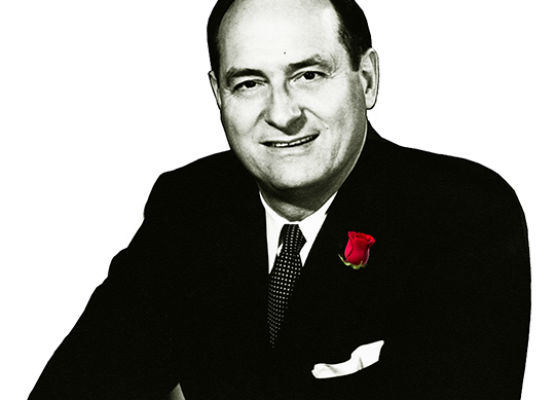
In the turbulent mid-1960s, as McCarthyism wound down and the Vietnam War revved up, Hoover and his top aides were recipients of the most incriminating memoranda in Rosellini’s thick dossier, a 779-page collection of allegations, gossip, and rumors about the colorful and controversial governor, the first Italian-American to be elected to such a post west of the Mississippi. An immigrant’s son who became a Seattle attorney and consummate politician, Rosellini spent almost seven decades in the public offices and smoky back rooms of Washington state before dying two years ago at age 101.
The file, which became available for public release upon Rosellini’s death, includes the names of most of the officials and sources interviewed by agents, but the agency’s secret informants have been kept anonymous. The papers show Rosellini was exposed in part by those he trusted most—including Seattle’s then-Catholic archbishop, who, sitting for a background interview on his parishoner, bragged to a federal agent about how he broke up the governor’s affair with his “blonde bombshell” secretary.
Rosellini was also visited annually in Olympia by the head of the Seattle FBI bureau and the two swapped friendly stories, with Rosellini expressing his support for the FBI, unaware the agency was keeping a file on him. (In one of his letters to Hoover, the Seattle bureau head labeled Rosellini “a scoundrel.”) The governor was also targeted by two Seattle Times “officials” who doubled as unnamed FBI informants. One of them tipped off the agency to the newspaper’s ongoing investigation of Rosellini, saying the Times was weighing whether to publish a story or just to withhold it if Rosellini would agree to quit the governor’s race. The paper had assigned a Pulitzer Prize–winning reporter to the story, which was so hot, the source said, that documents were being kept locked “in a vault” in the Times building.
In a letter to an aide to President Lyndon Johnson—who in 1965, according to the file, was considering Rosellini for an appointment to an unspecified post in his administration—a top Seattle FBI official called Rosellini “one of the most controversial figures we have ever investigated as a special inquiry for the White House . . . Some individuals who recommend him say these rumors are vicious and [have] no basis in fact and [are] politically inspired. Others indicate that if he receives a federal appointment, it will be a tragedy.”
Rosellini later withdrew his bid for the federal job. One of the Times sources told the FBI that Sen. Warren Magnuson persuaded Rosellini to drop the effort in exchange for an agreement by the IRS to end a probe of his personal finances.
Or so the file says. The documents read at times like an indictment of Rosellini, but also tend to indict the investigative methods—much of it merely gathering rumors and hearsay—used to darken his name. Some of those interviewed admitted to failing memories, while many others conceded they lacked proof, including documentation, of their claims. At least one source’s accusations had to be retracted after it was learned he was delusional and mentally ill. Verifying many of the claims all these years later, with so many of the sources deceased, is virtually impossible. But the claims tend to collapse under their own unsupported weight.
Of course, Rosellini was no angel. As a young Seattle attorney who knew his way around the city’s underbelly, he at times defended pimps, prostitutes, and gangsters and made a small fortune representing bar owners seeking liquor licenses. He grew into an old-style pol who practiced cronyism and demanded party loyalty, sometimes strong-arming donors and rewarding supporters with state jobs. As a political consultant and money rainmaker in his later years, he was involved in payoffs made by convicted racketeer Frank Colacurcio Sr. to Seattle City Council members during the mid-2000s “Strippergate” scandal, a minor parking-lot-rezone issue that blew up into re-election losses for two councilmembers. His success and political connections, dating to the 1940s, first earned him the “fixer” sobriquet, and Strippergate resurrected that image.
But in almost 70 years of law and politics, he was never charged with a crime, and likely no other politician in state history has been subjected to more rumors and stereotyping. Though Rosellini, a onetime King County deputy prosecutor, won two gubernatorial races after a successful run as state senator and left a legacy of new highways, social programs, and educational advancements, his Italian heritage led to accusations of involvement in organized crime. The Times railed against him, and the Seattle Post-Intelligencer followed suit. Though not the cause, he was blamed for a scandal involving a liquor-board employee who took payoffs prior to the 1964 election, which he lost by a landslide 55-to-44 percent vote to Dan Evans. Rosellini felt he lost a subsequent election—a 1972 gubernatorial comeback bid against Evans—after being smeared in the P-I as a Mafia godfather. Rosellini called it the “wop” factor.
Similar accusations pile up in his FBI file. Had some of these unproved assertions been leaked to the papers when Rosellini was a candidate—given the added headline certification of an “FBI investigation”—he might never have held the state’s highest office. The 1972 smear—innuendo based on unnamed sources—is evidence of the bad blood that even a nugget of falsity could stir up about Rosellini.
Incidentally, Rosellini’s file was compiled in the days of typewriters, land-line telephones, and reel-to-reel tape recorders. Today, massive government information-trolling is undertaken with supercomputers, satellites, and electronic intercepts—collecting financial histories, personal habits, Internet rumors, telephone metadata, and audio and video records. This “system of suspicionless surveillance,” as journalist Glenn Greenwald calls it, allows authorities from the FBI to local police to assemble sweeping collections of unsubstantiated claims and semi-truths about anyone. According to the American Civil Liberties Union, federal agencies, right down to your local firefighters, gather information that is widely shared through new institutions like Joint Terrorism Task Forces, fusion centers, and public/private partnerships.
In other words, after you read about Al Rosellini’s wild and crazy file, you might want to check for your own federal or local dossiers. (To submit information requests, visit muckrock.com; to learn more about data collected on you, visit aclu.org/spy-files).
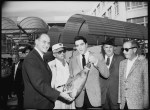
Al Rosellini rides with JFK at Seafair in 1960. (The Post-Intelligencer Collection,Museum of History & Industry. All rights reserved.)
In Rosellini’s hefty file, the focus is on the 1940s through the 1960s, the era when the handsome, Tacoma-born Rosellini rose to prominence as a well-connected Seattle attorney, a crime-fighting state senator for 18 years, and a progressive Democratic governor. A political brawler, he had been a boxer in college and worked as a Pike Place Market butcher, an Alaska steamer deckhand, and a law clerk to put himself through college. But his career-long battle was with name-calling detractors who saw “Italian” as synonymous with “mob.” “That Mafia crap really hurt,” he once said.
The FBI believed most of its sources were solid, even if none provided any apparent documentary proof. For example, Don Abel, a man Rosellini removed from his State Liquor Board seat, called the governor a “crook,” but said he couldn’t prove it—adding that Rosellini undertook liquor-license shakedowns, adding that he couldn’t prove that either. (Another liquor-board member said that Rosellini suspected Abel of taking payoffs.) Investigators tapped dozens of subjects for the White House background check, including Magnuson and fellow U.S. Senator Henry Jackson along with congressional members, former governors, mayors, and police officials. Rosellini’s enemies, allies, and critics offered support and complaints, revealing both friendships and die-hard grudges. Agents relied on named and unnamed insiders, including a newspaper editor in Spokane (“a very good friend of ours”) and the unnamed Times officials in Seattle, one of whom “has provided a great deal of very good information.”
Ex-Seattle Police Chief George Eastman told an agent he was still suspicious of Rosellini and once wanted to indict him (but had no proof), while then-current Chief Frank Ramon supported him. He’d checked into some of the many rumors about Rosellini, Ramon said, and found them to be false. But it’s the nature of such profiling to gather everything thrown on the walls whether it sticks or not. Thus Rosellini’s file includes allegations he was the silent owner of Seattle bars, was in business with a prostitute, and that the Catholic governor lied to the Pope. None were proven. Still, the papal fib is on the record.
“[An informant] recalls having heard that Rosellini, during a visit to Italy, had an audience with the Pope,” a report in the file states. “Rosellini’s wife, together with a political associate of Rosellini, were also at the Papal audience. This political associate, according to information [the informant] had received, thereafter had made the statement on one or more occasions, that Rosellini ‘lied even to the Pope’ in that, in presenting his wife to the Pope, he said, ‘And here is another good Catholic’ or words to that effect, whereas Mrs. Rosellini is not even Catholic.” (Emphasis added.)
Mr. Rosellini’s Catholicism was a more serious issue when, during a mid-’60s interview, an FBI agent asked the governor’s archbishop about a confession the governor had made, which the archbishop readily revealed.
“Thomas A. Connolly, Archbishop of Seattle, Washington, advised on May 21, 1965,” states an agent’s report of the interview as part of the White House background check, “that shortly after Albert D. Rosellini was elected Governor of the state of Washington in 1956, immediate relatives and close advisors to the Governor approached him and requested he counsel the governor concerning certain indiscretions with one of his secretaries.” Some state legislators, the archbishop said, were intending to use the indiscretions “in an attempt to force the Governor to pass certain legislation favorable to that group.” Connolly told the agent he beckoned Rosellini to his office and counseled him—that is, “You might more appropriately say that I called the Governor on the carpet, hit him over the head with a baseball bat, and told him to straighten out or he would suffer the obvious consequences.” By that, Connolly said, he meant he would “denounce the Governor from every Catholic church in the Archdiocese of Seattle and further, he would not sit at the table with the Governor at any social affair, nor, in fact, would he ever attend any function in the State of Washington in which he knew the Governor would be in attendance.” Connolly said the governor got the message and later called and thanked him for his intervention. Nevertheless, the talkative archbishop, who died in 1991, told the FBI that while he could support Rosellini for “certain executive-type positions” in the Johnson administration, he didn’t think he’d make much of a state judge, for example, because he was too politically indebted here.
Rosellini’s romantic dalliances are likely the one demonstrably true claim in the FBI file. Numerous sources, many of them friendly, confirmed to the FBI that the father of five (his wife of 64 years, Ethel, died in 2002) had an affair with his “blonde bombshell” secretary, as she’s described in the file. She reportedly wanted Rosellini to leave his wife; instead, all agree, he left the secretary. The records also contain claims of Rosellini squiring other women in his younger married days. Those assignations make up some of the first entries in his file.
Rosellini had come to the FBI’s attention long before the White House asked for a background check, chosen in much the way that others fell into J. Edgar Hoover’s crosshairs in those days: as a suspected commie sympathizer. The FBI had begun an inquiry into his activities in the early 1950s, amid the rise of McCarthyism and the bureau’s quest for disloyal Americans. As Seattle’s historylink.org notes of the time: “Anticommunist agitation began early in Washington state under the leadership of State Representative Albert Canwell (1907–2002), and conservatives in both parties frustrated many left-of-center reforms and initiatives by associating them with Moscow. Among the casualties was Rosellini’s personal crusade to create a separate juvenile justice system and get minors out of adult prisons. Rosellini was personally ‘red-baited’ by critics such as Ross Cunningham, powerful editorialist for The Seattle Times.”
In November 1952—the year then-state senator Rosellini first ran for governor (and lost in the primary, a race ultimately won by incumbent Arthur B. Langlie)—the Seattle bureau was asked by Hoover’s office to gather a summary of “pertinent information” about Rosellini, including “all derogatory information of a nonsubversive nature, as well as of a subversive nature.” No reason is given in the file as to why Rosellini was singled out or how he came to the agency’s attention. But that was the case with many who fell under the secret oversight of Hoover’s FBI, where dissent was seen as a sign of disloyalty.
A month later, the Seattle bureau filed a nine-page response that shadowed Rosellini’s career back into the 1940s, suggesting the FBI had kept earlier records on him that are not included in this file. The then-state senator—who had held the 33rd District seat in southeast Seattle for most of two decades—“has, in the past, supported the activities of some CP [Communist Party] fronts and has associated with known CP members in connection with his political activities as a state senator,” the bureau claimed. He also allegedly had “underworld connections with bootlegging and gambling interests” dating back through the ’40s.
The file includes a 1952 letter on his senate stationary (provided by an FBI source) in which he stated he was sending $5 to a suspected American Communist Party member whose name has been deleted from the file. That person, the FBI said, had recently been arrested under the Smith Act, the 1940 federal law that banned advocating, or being a member of a group that advocated, the violent overthrow of the government. The file states Rosellini had also given $10 to another suspected subversive, and had once donated to the National Negro Congress.
Nothing came of the loyalty inquiry (in fact the file depicts Rosellini as nothing more suspicious than a liberal Democrat). But the data-gathering continued as the FBI grew more interested in the company Rosellini kept, and legally represented.
Then-King County Sheriff Harlan Callahan and former Seattle Police Chief of Detectives James Lawrence told the agency that Rosellini allegedly was a “fixer for individuals engaged in racket activities in Seattle” and “was using his political prestige” on the racketeers’ behalf. Several informants claimed they were directed to see the attorney and senator in order to open licensed bottle clubs and gambling joints, which were then operating privately under an often-abused “tolerance policy” which flourished until a 1970s crackdown and two grand jury investigations led to corruption indictments of top police and city officials. (As an attorney in those days, Rosellini was making around $50,000 a year, much of it from representing applicants seeking liquor licenses, according to press reports.) The FBI also noted that Rosellini was holding crime hearings around the state even though he was “closely associated” with such crime figures as then-pinball and jukebox distributor Colacurcio, the future racketeer and strip-club owner.
None of the informants reported obtaining any illegal “fixer” services from Rosellini, according to the file, and there is no indication of why the sheriff or other law-enforcement officials didn’t arrest Rosellini if he was breaking the law. Rosellini’s association with Colacurcio was no secret, having begun in 1942 when the 32-year-old private attorney defended 25-year-old Colacurcio on a statutory-rape charge, on which he was convicted. Colacurcio would go on to become one of the region’s more legendary organized-crime figures, repeatedly busted for tax skimming and other violations at his strip-club empire.
Rosellini and Colacurcio were associated for more than a half-century, with Rosellini keeping a mostly safe, professional distance except for a bit of line-straddling during Strippergate in 2003. The ex-governor, then 93, quietly distributed campaign checks to City Council members as he lobbied for a parking-lot rezone sought by Frank Colacurcio Jr. at the family’s strip club, Rick’s, in Lake City. Frank Sr. and son Frankie ended up pleading guilty to illegally bundling those contributions—the Colacurcios and 36 of their family members, friends, and business associates gave council members almost $39,000 in donations—while the elderly Rosellini was allowed to skate. “There is no evidence of criminal wrongdoing” by Rosellini, is all King County Prosecutor Norm Maleng would say about it.
In newspaper interviews, Rosellini would describe Colacurcio as a family acquaintance and client, saying the relationship had cost him at times. In particular, he cited the 1972 P-I article that ended his gubernatorial comeback bid. Written by executive editor Lou Guzzo and published without giving Rosellini a chance to respond, it claimed the candidate had made a phone call on behalf of one of Colacurcio’s brothers to transfer a liquor license from one club to another in Hawaii four years earlier.
KING-TV called it a “baseless smear,” and discovered the story was planted by a Republican operative to aid Rosellini’s opponent, Dan Evans. But the tale sparked a bumper sticker, “We Don’t Need a Godfather” (The Godfather had just been released), and Rosellini claimed the story led to his defeat. Guzzo, who went on to work for conservative Democratic Gov. Dixy Lee Ray and later supported Republican gubernatorial candidate Dino Rossi, and who died earlier this year at 94, boasted that the story “finally got Rosellini out of politics once and for all.”
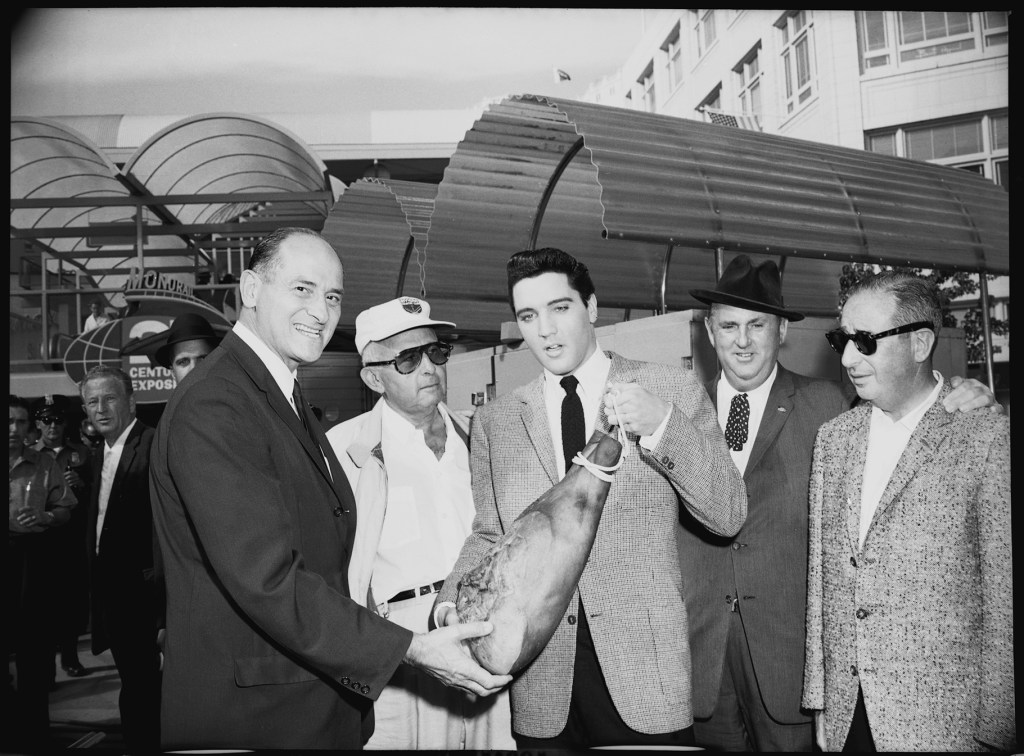
Elvis Presley presents Rosellini a ham from his Tennessee farm at the World’s Fair in 1962. (The Post-Intelligencer Collection,Museum of History & Industry. All rights reserved.)
Clearly, had Rosellini’s FBI file fallen into his hands back then, Guzzo would have been orgasmic. “We Don’t Need a Fixer” would have made a memorable bumper sticker.
Guzzo might have been even more delighted to see some of the next entries in the Rosellini file, starting with an April 1960 letter from the Seattle FBI bureau agent in charge, S.E. Milnes, directed to Hoover’s “personal attention.” It details what Guzzo’s competitor, the Times, had once been planning to write about the governor.
A Times investigative team had “developed information concerning illegal activities of Rosellini, much of which is documented,” the letter states. Milnes informed Hoover that the team was being led by Ed Guthman, who won the Times’ first Pulitzer in 1950, though the agent didn’t mention to his commie-hunting director that Guthman’s prized story exonerated University of Washington professor Melvin Rader, who had been wrongly accused of being a communist.
The paper had “absolute proof” Rosellini had accepted money from highway contractors in return for state contracts, and “proof positive” that the governor took payoffs from a bank president in return for the bank’s business with the state. Documents and other findings about Liquor Board misdoings were being kept locked in a Times vault, the letter said. The paper had also learned Rosellini was using aliases to register at hotels and motels with “a number of different women.”
The name of Milnes’ source is deleted from the file, which identify both The Spokane Chronicle, which folded in 1992, and the Times as newspapers “friendly” to the FBI at the time. One entry, a memorandum from a D.C. FBI official to Hoover, says “The Seattle Times has been a friendly newspaper and SAC [Special Agent in Charge] Milnes and the Bureau enjoy cordial relations with several of this newspaper’s officials.” The information on the paper’s investigation appears to come from someone within the Times—the longtime “reliable” source (whose name has been deleted by FBI censors) “confirmed” the details, Milnes’ letter says, and provided specific and unpublished data gathered by reporters.
In a separate memo from Milnes to Hoover, the source’s name and Times position is also deleted. But the blank space is followed by “page of The Seattle Times called me today . . . ”, suggesting the source was most likely someone from the paper’s editorial page—which had long been an enemy of Rosellini’s. In his 1997 book Rosellini, author Payton Smith says the paper’s animosity was rooted in the belief that Rosellini was, if not a communist, an aspiring socialist. A few days before the 1952 gubernatorial primary, a Times editorial called gubernatorial newbie Rosellini “the least desirable” of the Democratic candidates, and seemed to go out of its way to sink him: “He has waged an utterly irresponsible campaign. We wonder if many voters will be gullible enough to be taken in by Rosellini’s tactics.” That editorial, wrote author Smith, “started a feud with the Times and [editorial page editor Ross] Cunningham that lasted throughout Rosellini’s political career.”
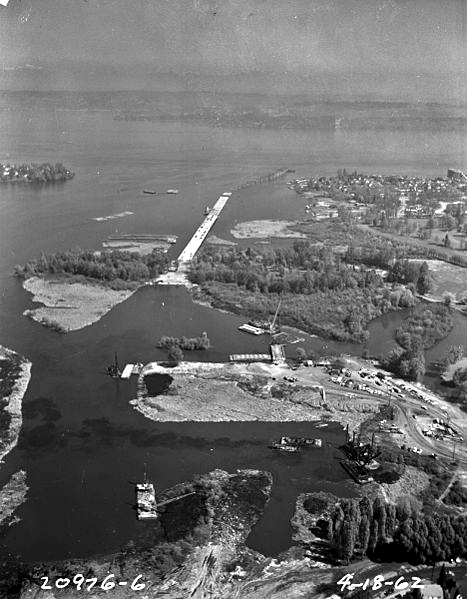
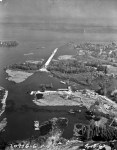
“This same informant,” Milnes wrote to Hoover in the April 1960 memo, “says that Rosellini has purchased considerable real estate, either in his own name or under a straw name, at the terminal ends of the contemplated floating bridge now under construction over Hood’s [sic] Canal in Washington. According to this informant, ‘The Seattle Times’ has not yet decided upon a course to take with respect to this information, whether to publish it and make it known to the public or, as an alternative, produce the facts before Rosellini and thus force him to remove himself from the Governor’s race.”
One fact missing from the file: No such story ever ran. (And if the Times attempted to extort a campaign resignation from Rosellini, it didn’t work.) Seattle Times files show Guthman did write a 1960 “Times investigation” about how Rosellini spent political funds for apparent non-political expenses, including hotel rooms in Seattle (back in the days when such expenses were not required to be publicly reported to the state, as they are now). Guthman, who went on to become an aide to Bobby Kennedy and an editor at the Los Angeles Times and died in 2008, turned up a number of “irregularities” in Rosellini’s private political funds, including donations from top administration officials and hotel rooms for his use—all legal today when properly reported. In rebuttal, Rosellini accused the Times of using its news columns to promote his Republican opponent, and issued a denial published by the Times, filling most of a page of newsprint.
The public apparently sided with the governor. Though Washington state voters favored Republican Richard Nixon over Democratic winner John F. Kennedy in 1960, Rosellini went on to win re-election against Republican challenger Lloyd Andrews by a narrow margin: 18,000 of 1.2 million votes cast.
Nonetheless, when Rosellini came up for a possible White House appointment five years later, the unproved Times claims and a raft of other accusations were repeated in an FBI memo to the White House. Scoop Jackson wouldn’t make an unequivocal endorsement of Rosellini, the FBI said, although Sen. Magnuson—who as King County prosecutor had hired Rosellini right out of law school—did. Yet the FBI concluded that both senators were “reluctant to completely endorse Rosellini for a presidential appointment and have elected to dump the job of cleaning him up in the laps of the FBI.”
The file includes a collage of rumored payoffs, such as $50,000 supposedly given to Rosellini by Dave Beck to pardon the convicted former Teamster president from a state prison conviction for grand larceny, and a claim that the governor offered a judgeship to powerful King County Prosecutor Charles O. Carroll if he would ease up on enforcement actions against liquor sales (Carroll told the FBI he’d hardly even talked to Rosellini since he became governor). Others told of allegedly illegal donations to Rosellini’s war chest in return for liquor licenses and state permits.
Political opponents labeled him a crook, and one FBI source claimed Rosellini’s father John was once head of the state La Cosa Nostra, even though the Mafia in Washington state is thought never to have consisted of more than a few retired mobsters. John Rosellini did, in fact, serve a year at McNeil Island for smuggling drugs out of Mexico in 1927, but the file states he led a crime-free life thereafter as a liquor distributor. (Al Rosellini had said his father inspired him to go to law school, and that John’s background was why he began to represent bar owners and distributors, including bringing about reforms to the state’s old Blue Laws, which restricted the sale of liquor.)
Frank Colacurcio got a drop-in visit from the FBI, too, seeking his views on Rosellini. Colacurcio’s notoriety was already on the rise, his name having come up in connection with racketeering hearings being conducted in part by Bobby Kennedy. But Colacurcio was willing to chat, and said Rosellini had long been his family’s attorney. He hadn’t seen much of the governor in years, he said, and while he campaigned for him, “he denied any influence-peddling, graft, or campaign contributions in connection with the granting of liquor licenses,” the FBI reported. “Colacurcio was formerly engaged in the jukebox and vending-machine business in Seattle, Washington,” an agent noted. “He has FBI Number 3467500.” (While facing his eighth felony—for racketeering and prostitution—and likely his seventh prison term, Colacurcio died in 2010 at age 93).
FBI interviewees said they’d all heard the rumors of Rosellini payoffs and other reputed sins, but most didn’t think they were true—yet, almost to a person, they repeated them to agents. Sen. Magnuson said maybe it was time to get to the bottom of all that. He told an FBI interviewer that “he has never been able to verify any of these stories and on that basis does not believe them to be true. He stated frankly that he felt that the FBI investigation was definitely in order.” The claims should be either verified or refuted “so that Rosellini’s career would not be in jeopardy based strictly on gossip and rumor.”
Though the agency churned out several long reports, they contained no proven allegations of corruption. Nonetheless, in July 1965, Milnes, the head of the Seattle bureau, addressed a memo to “Mr. Hoover” stating the bureau’s investigation “revealed quite clearly that Rosellini was a thorough scoundrel.” His basis for this? Triple hearsay, starting with the “page” informant at the Times. Milnes said the 1) Times source said that 2) Magnuson said that 3) Rosellini said he wanted the appointment and “was bringing a lot of pressure to bear on Senator Magnuson to get him a federal appointment. Simultaneously,” Milnes said the Times source said that Magnunson said, “the Internal Revenue Service was conducting an investigation into Rosellini’s financial activities.”
The Times source “told me confidentially that Senator Magnuson had called him and told him that ‘We have got that thing killed here.’ He implied that Rosellini had withdrawn his interest in a federal appointment. Simultaneously the Internal Revenue Service had discontinued their investigation of Rosellini.”
And so had the FBI. The file was closed not long after. The politically bruised and bloodied Al Rosellini was free to go.
After making his final bid for public office in 1972, Rosellini ran a beer-distribution company and returned to his law practice as a political consultant, going to work every day until age 99. He drove a white Cadillac with a personalized license plate, “GOV ADR,” which was also his e-mail handle. He is remembered for his progressive politics, but also as someone who got away with something. What that was, exactly, wasn’t clear. In his book on Rosellini, author Smith opines, “I believe that if evidence of corruption had been available, local officials or the United States attorney would have brought charges. Certainly The Seattle Times and Ross Cunningham would have rushed into print any such information.”
After Rosellini died on October 10, 2011, more than 600 mourners attended a funeral Mass. Said former Gov. Mike Lowry, “Al was just one of the nicest people you ever met. He was a very good governor and he was also a very good guy. And you don’t always get those two together.” He died a millionaire, and his will, on file at the King County Courthouse, shows he left most of his estate to his five grown children and 15 grandchildren. He had also designated that a quarter-million dollars go to Vivian Kalfaolu, his companion for the last six years of his life, but she had died six months earlier.
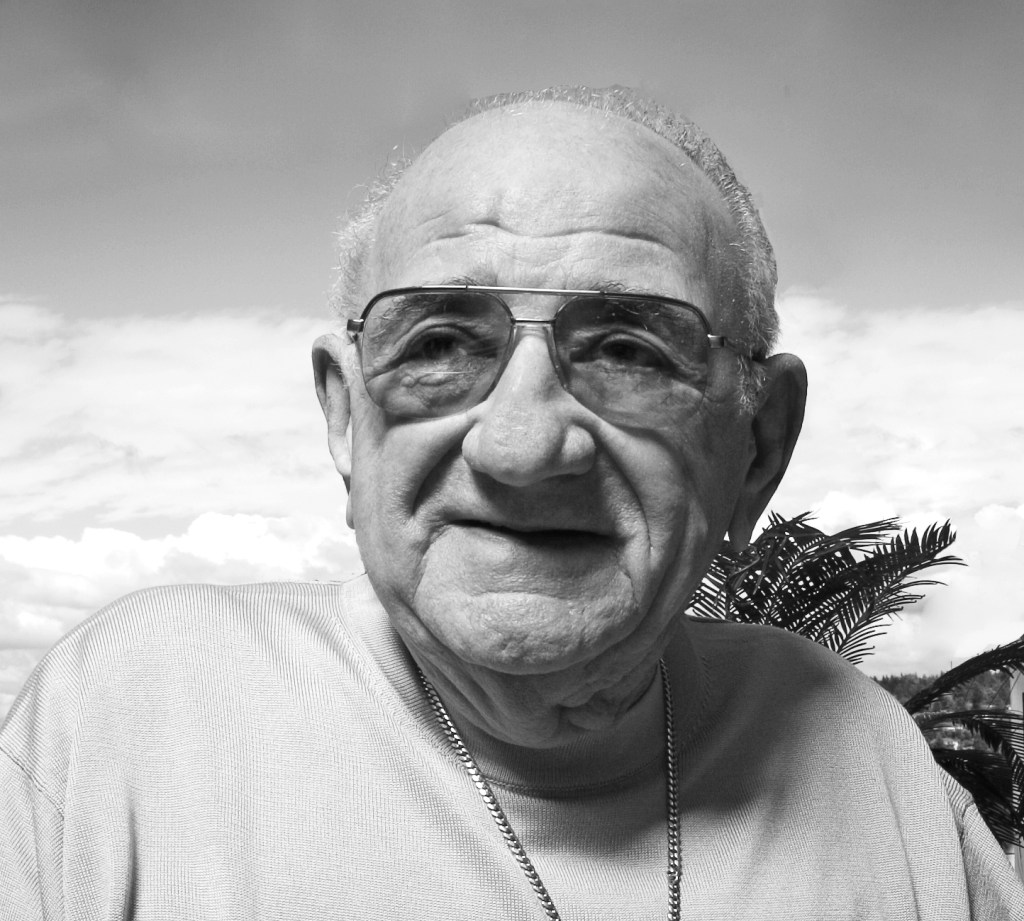
In his senior years, Rosellini was his party’s respected elder statesman, and he mentored some of his gubernatorial successors, including Christine Gregoire and Gary Locke, now ambassador to China. In January 2010, Locke, then-Gov. Gregoire, and four other former governors, including Dan Evans, all showed up for Rosellini’s 100th birthday celebration at his retirement home on Seattle’s First Hill. By then, any political backstabbing was long forgiven and forgotten as Rosellini, suffering from a broken hip, rolled into the room in a wheelchair, sincerely telling the assembled, “Sorry for being so crippled.”
Locke brought a happy-birthday letter from Barack and Michelle Obama; Republican Congressman Dave Reichert handed over a flag that had just flown over the nation’s Capitol; Gregoire declared an upcoming Al Rosellini Day. Others noted his legacies—the University of Washington School of Medicine and the 520 floating bridge (officially the Albert D. Rosellini Bridge), among them.
I was there and chatted with him a bit, and dropped the word “Strippergate.” His eyes brightened. He hadn’t said much about the scandal, during or afterwards.
“That was just politics,” he said, smiling. A friend stepped in to give Rosellini the chance to change the subject, but he waved him off.
“Everybody—not everybody but many, on the opposition—looks for these things to criticize,” said the governor. “I’ve never been concerned about it, because things happen in the world—sometimes all hell breaks loose. That’s politics, and if you can’t take it, you should get out of it.”
As the record shows, he stayed to the glorious end. There’s no indication he ever saw his file.
randerson@seattleweekly.com