Opening Nights Rope The Ballard Underground, 2220 N.W. Market St., 395-5458,
Published 4:09 pm Wednesday, October 30, 2013
Opening Nights
Rope
The Ballard Underground, 2220 N.W. Market St., 395-5458, ghostlighttheatricals.org. $12–$15. 7:30 p.m. Thurs.–Sat., plus 2 p.m. Sun., Nov. 10. Ends Nov. 23.
Nothing’s more savage than murder, and nothing’s more bloodless than a British drawing-room chat-fest. Pair the two, and you’d bet money that a grisly killing would keep tensions high in Ghost Light Theatricals’ Rope, inspired by the 1924 Leopold and Loeb murder. (Alfred Hitchcock’s 1948 movie was adapted from this play.) Yet though the show clocks in at only two hours (with 15-minute intermission), Justin Ison’s stultifying direction and Patrick Hamilton’s endlessly meandering text make this Rope very slack. Forget the murder: This play is death by filibuster.
Why? English playwright Hamilton wrote Rope in 1929, and it’s a product of its time. During several long speeches—punctuated by one character’s repeated demands for yet another drink—I was reminded of the English insistence that meat should be boiled until all traces of flavor had safely vanished. And that is what happens here, after two upper-crust collegians strangle an Oxford classmate for sport. Wyndham (Jaryl Draper) evinces a cool braggadocio that barely conceals his homicidal bloodlust, while Charles (Geoff Finney) veers madly between conniving stealth and the shivering, wild-eyed terror of a mistreated chihuahua. To their house come various gasbags who cannot wait their turn to deliver speeches that could be timed with a calendar. Principal among them is Rupert (Chris Martinez), the worthy if wordy adversary who eventually uncovers both the crime and the body—perhaps to his own ruin.
On the plus side, Kristina Stimson drapes her cast in some splendid Gatsbyesque finery, and Ison’s set design (in collaboration with Terra Morgan) shrouds the proceedings in an eerie elegance. But the British accents, while clipped and delivered with aristocratic pomp, correspond little to a map of the UK. That the actors are working so hard on their Oxbridge-ese only slows further what little action there is. As true-crime tales go, Rope is dated enough in its dramatic construction. What really signals its age, however, is the (then-) shocking suggestion that the perpetrators are—gasp!—homosexual lovers. Today, if you wanted to update the text, you’d have Wyndham and Charles exchange their vows on death row, and have their execution chamber decked out as a wedding suite. Kevin Phinney
P25 Saints
ACT Theatre, 700 Union St., 292-7676, azotheatre.org. $25–$30. runs Thurs.–Sun. Ends Nov. 24.
“You’re disposable people,” a corrupt sheriff tells a pair of West Virginia meth dealers in the tensest of many tense scenes in this suspenseful stage thriller. But these disposable people will steal your heart even while scrambling from one tragicomic mess to the next, under the skillful direction of Desdemona Chiang. Azeotrope is known for its intense performances of hard-edged texts where the subject and writing don’t aspire to the avant garde. (Red Light Winter, which shares the same cast, is running on alternate nights.) They’re hot-wired traditionalists, an approach well suited to Josh Rollins’ credulity-testing tale, which premiered in Chicago last year.
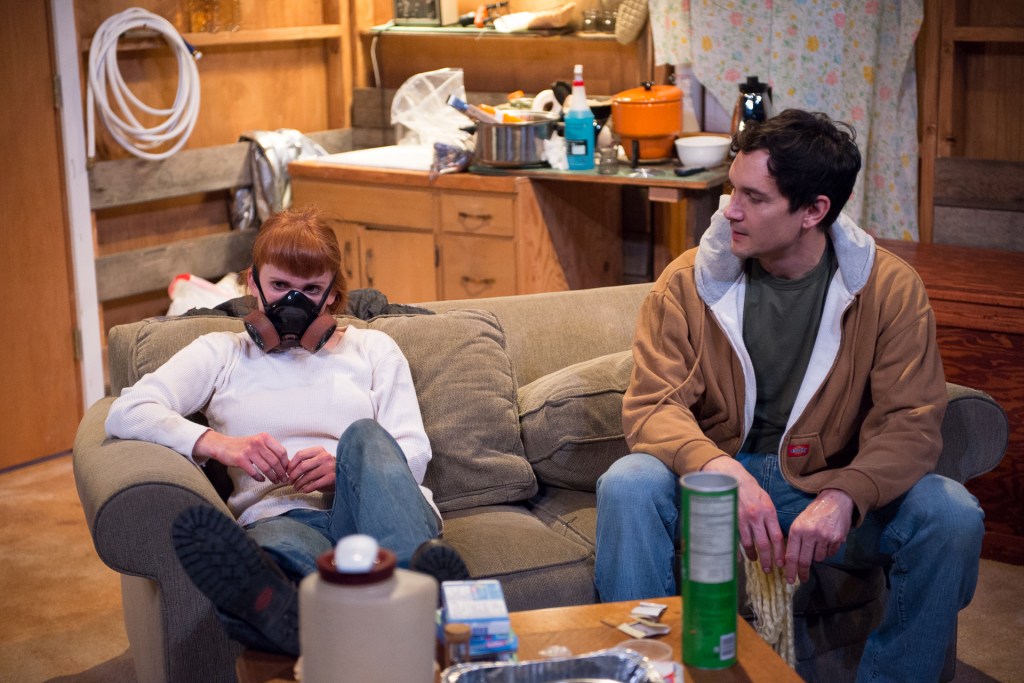
Charlie (a very fine Tim Gouran) lives for Sammy (Libby Barnard), his missing brother’s girlfriend, whose (offstage) bloody tangle with the sheriff launches the story’s sprint like a starter pistol. Shell-shocked in the cabin doorway, smeared with blood, Sammy strips as Charlie and his best friend/meth colleague Tuck (Richard Nguyen Sloniker) wrestle a wounded deputy into a big wooden trunk. Don’t get distracted by Evan Mosher’s “screaming” crickets or Andrew D. Smith’s ethereal, leaf-filtering lighting ; 25 Saints requires close listening, as crucial plot elements are embedded in rapid torrents of dialogue, making it easy to miss some of Rollins’ story twists.
Even for viewers who loved Breaking Bad, the material can make you uncomfortable; it’s like watching beetles trying to save themselves from drowning in vinegar. Can any of these characters leverage their meth money to escape the Appalachian dirt? (Catherine Cornell’s cramped, shabby set contributes to a sense of claustrophobia and chemical menace.) Each bears the scars of multigenerational poverty and abusive authority. Meanwhile, motives are crossed as to who will flee and who will be ensnared by One Last Score.
Rollins does unfortunately write his villains as cartoons, which undermines the intended realism here. Many of this production’s gems occur in the subtler moments, as when Sammy dons a respirator mask to avoid a conversation, but then removes it to accept a Pringle. For such a purchase price, how can these kids ever hope to escape? Margaret Friedman
E
stage@seattleweekly.com