Too much time at my desk (and in museums and galleries), not enough time in screening rooms. The usual excuses, I know, for a lazy local film critic who doesn’t fly to Cannes or Sundance on the company expense account. (Hell, they don’t even pay for parking.) So my 10-best list hardly overlaps with that of my esteemed colleague J. Hoberman, and it also considers only those releases that played Seattle during the past calendar year—no stragglers from New York or L.A. (SIFF titles are also excluded.)
1) The Artist (see review) is the third film by Michel Hazanavicius that, I predict, will be a favorite with Seattle filmgoers. His two OSS: 117 spy spoofs, also rooted in past movie conventions, were both popular at SIFF, though the subtitled French dialogue precluded a wider audience. This time around, there are only a few English-language title cards to read and (almost) no spoken dialogue. Unlike most films about Hollywood, it’s not a sour indictment of the industry but a charming, loving tribute to bygone melodramas.
2) Given our lingering recession and high unemployment, Take Shelter is all the more timely and disturbing. Released in October, the film’s about a blue-collar Ohio guy (Michael Shannon, sure to be nominated) suffering apocalyptic visions of doom. With a wife and daughter to support, he half believes in these omens, half hopes he’s merely crazy. Either way, they threaten his job and medical benefits (his daughter needs an operation). Written and directed by Jeff Nichols, Take Shelter makes you think about every frightening thing a family wants to be insured against.
3) Another holiday release, Tinker, Tailor, Soldier, Spy seems to be dividing critics between the TV camp, who revere the ’79 BBC miniseries, and those who don’t mind seeing John le Carré abridged and stylized. And Swedish director Tomas Alfredson (Let the Right One In) is surely the right man for that job. To summon the Cold War paranoia of the early ’70s, he doesn’t need every word or scene from le Carré’s novel. This Tinker (review) skips back and forth in time, more intent on mood than chronology (or even strict narrative clarity). Toxic vapors of distrust are practically visible in the air, and good men are ruined merely by breathing them. A sequel, Smiley’s People, is being discussed. Let’s hope it happens.
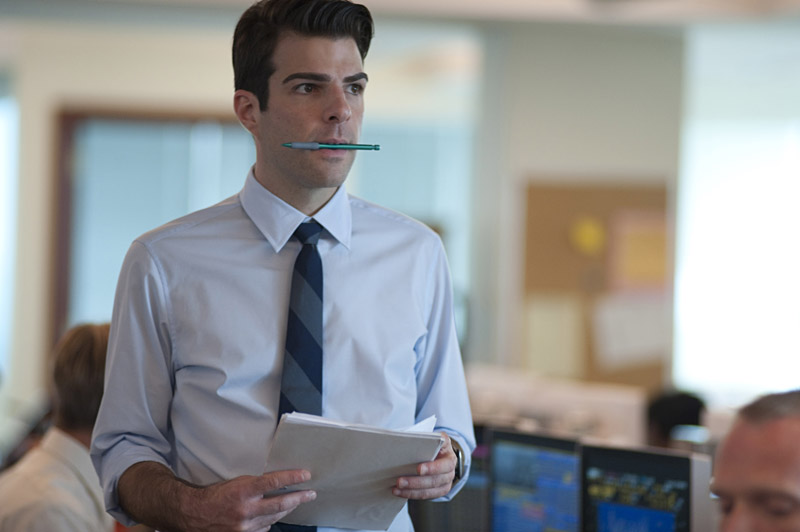
4) Why did some critics hate Margin Call? Because, they wrote, it let financiers off the hook for the subprime mortgage meltdown of 2008? That’s not exactly how it works in writer/director J.C. Chandor’s October release. Men (and one woman) in suits gradually realize they’re overexposed in junk securities and—to save their own skins—decide to unload those toxic assets before other firms make the same realization and sell first. What emerges in a two-day panic session of meetings, firings, and recrimination isn’t so much venality as stupidity. Smart people are suddenly ashamed of what they didn’t know—or didn’t want to know. On DVD this week, Margin Call is a deserving shelf companion to Charles Ferguson’s documentary Inside Job and Michael Lewis’ book The Big Short. (See Mike Seely’s take.)
5) Surely the most award/audience-friendly release of the season, Alexander Payne’s The Descendants is precisely the sort of smart, affecting seriocomedy that Hollywood seemingly had forgotten how to make these days. It’s a generous study in everyday catastrophes—death, infidelity, fractured families—that artfully acknowledges the obvious without wallowing in it. George Clooney plays the about-to-be widower forced to consider his bonds to family and Hawaiian heritage. And he, like the protagonists of Payne’s About Schmidt and Sideways, must take stock at midlife. The view isn’t pretty, nor does Payne render Hawaii like a postcard. This paradise is nearly lost. Don’t hold the movie’s many expected award nominations against it. (Review.)
6) There’s not enough sci-fi on most top-10 lists, and Duncan Jones’ Source Code deserves its place for so sincerely and effectively selling what’s essentially a gimmick—Jake Gyllenhaal waking up over and over again in a stranger’s body, for the last eight minutes of his life, trying to avert a train crash and save Chicago from a nuclear bomb. It’s a nightmare of eternal recurrence, but also a moving parable of personal engagement. Gyllenhaal’s pilot—previously wounded in Afghanistan, we learn—forms a social bond with his fellow passengers (Michelle Monaghan in particular) and a strange connection with the military handlers who dispatched him on his mission. Source Code (review) artfully scrambles our notions of free will and personal sacrifice. (April release, now on DVD.)
7) A pure expression of early ’80s nostalgia, Drive bears no relation to the real world of L.A. getaway drivers or crime bosses. Instead, Danish director Nicolas Winding Refn simply casts Ryan Gosling as a white knight—without history or name—who cruises nighttime streets to moody synth-pop. There’s a girl, a heist gone bad, and some entertaining goons (Albert Brooks chief among them), but no more plot than Refn requires. And the film’s hyperstylized look corresponds exactly to the period of his youth spent in the U.S. (1978–87). Yet there’s no kitsch or winking at that era or its conventions. Released in September, Drive (review) makes all this year’s so-called “action movies” look bloated and stale.
8) James Marsh’s documentary Project Nim (review) relates the profoundly weird, sad story of a chimp raised by humans during the freewheeling ’70s, when academic hustling wasn’t so different from the variety practiced in singles bars. Nim’s sponsor is a randy Columbia professor who places the young chimp with a New York family (first in a line of surrogate parents). The project is, putatively, an experiment to see if chimps can learn sign language (Nim does), but further funding, publicity, and beddable grad students are equally important goals. Though never used for medical research, Nim (1973–2000) is an essentially tragic figure—alone and unknowable in the end, but retaining more dignity than his human handlers. (Released in August, not yet on DVD.)
9) The Tree of Life is equal parts wonderful and ridiculous, and both parts run too long. But this is Terrence Malick, so allowances must be made. I could do without all the dinosaur-era musings and cosmic lights, but the director’s evocation of a Texas boyhood in the 1950s, of the strains and bonds within a normal, loving family, is fairly magical (and, one suspects of the reclusive filmmaker, biographical). In this clan, Brad Pitt does some of his best work as an emotionally thwarted patriarch; Jessica Chastain, everywhere this year (including Take Shelter, above), is equally fine as his wife. Released in June, Tree is—in its best moments—moving, profound, and rapturous.
10) Mike Mills based Beginners on the late-life coming out of his closeted gay father, who died a few years later. He adds to this June seriocomedy a son (Ewan McGregor) who’s wary of commitment, since his father (Christopher Plummer) was less than honest with their family. All of which sounds like a navel-gazing puddle of indie mope-itude, but Mills fractures his story into so many elements—grief, graffiti, comedy, new romance, and a dog whose thoughts are communicated via subtitles—that Beginners (review) escapes solipsism into something tender and moving. (Now on DVD.)