Christmas is coming, and with it a wave of out-of-towners who want to be wowed by something they can’t eat back home. Hosts charged with making plans for those potentially memorable meals know how difficult it can be to dazzle visiting palates, even in a city as culinarily blessed as Seattle. Oysters are an excellent start, but Uncle Jack is steadfastly partial to Gulf-borne bivalves, and can’t understand why The Walrus and the Carpenter won’t put his name on the wall if he polishes off dozens of puny Olympias. Sushi is lovely, although it hardly compares to what Aunt Jane sampled on her alumni club trip to Tokyo last year. Cocktails are too frilly for the Schlitz- drinking contingent from Topeka, and too staid for the cousins who just drank their way through London.
These are perfectly legitimate concerns—and entirely irrelevant in the face of Katsu Burger, the brilliant new Japanese burger lodge from Hajime Sato, the sushi chef who masterminded Mashiko’s transition to an all-sustainable format. Not only is the food at this 24-seat Georgetown joint exceptionally good (and priced to please the most tightfisted kin), but the namesake sandwich has a stronger claim to quintessential Seattle status than just about any dish that isn’t teriyaki or a hot dog smeared with cream cheese.
“It’s been a while since Seattle came up with something completely new,” says Sato, who envisions the city becoming synonymous with tempura-battered, panko-breaded beef patties framed by cushy hamburger buns. “People in Seattle are going to say, ‘That started here.’ “
An entrepreneur can’t just wave his wand and transform a sandwich into a municipal icon. But Sato has smartly assembled most of the components Seattle eaters would wish in an entrée with national-sensation aspirations. Topped with pineapple and wasabi mayonnaise or jalapenos and Sriracha sauce, Katsu’s working-class burgers are made with hormone-free beef, fresh vegetables, and a cross-Pacific wink.
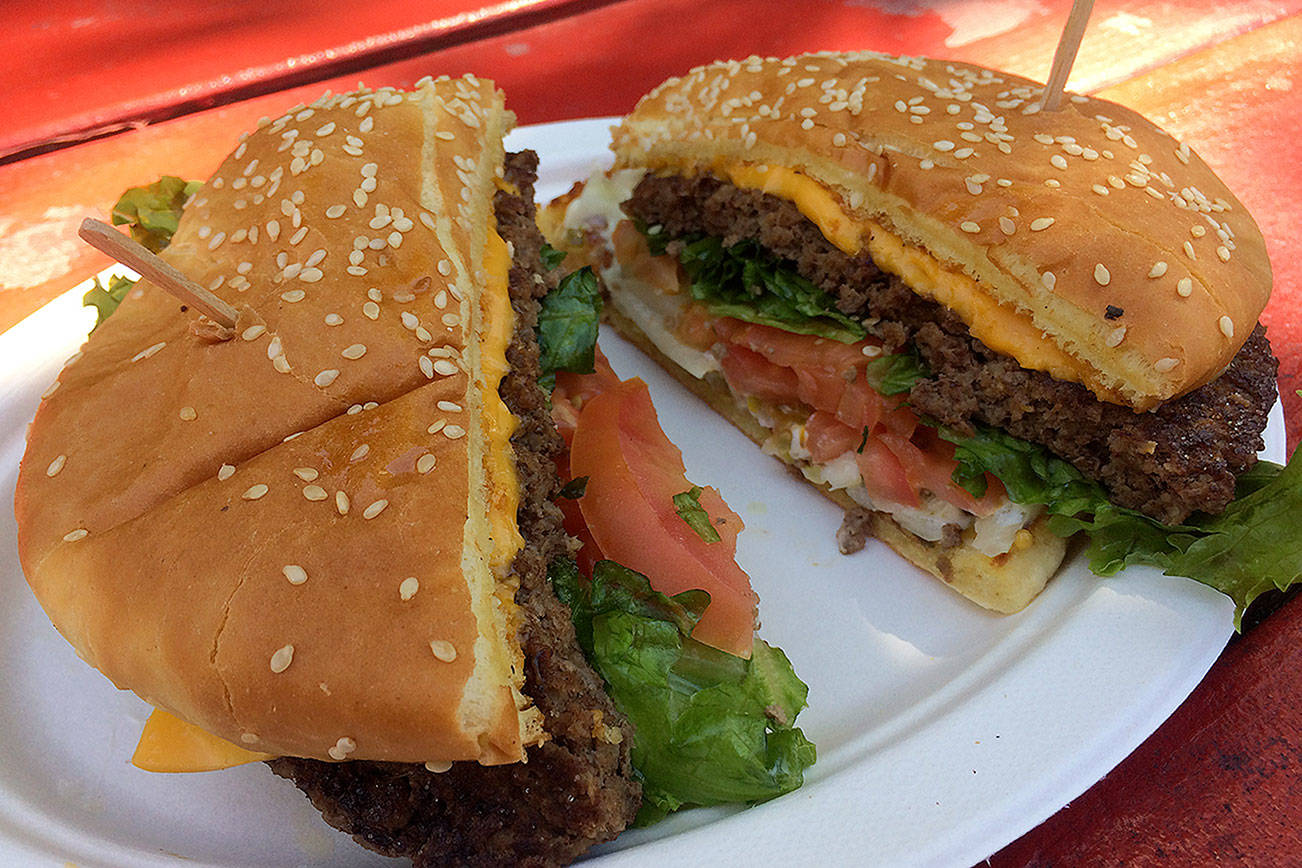
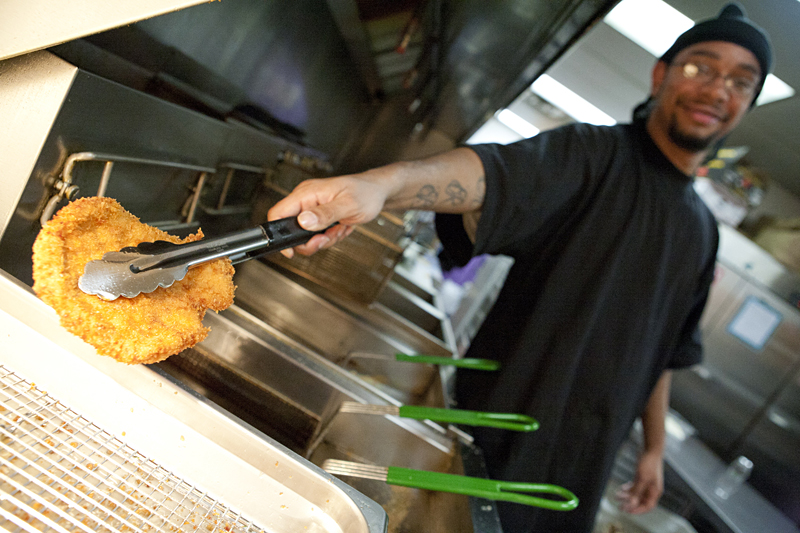
The flagship burger at Katsu is the Tokyo Classic, which becomes a Tokyo Tower with the addition of an extra beef patty and two slices of American cheese, a flavor splurge that’s regrettably ordered so infrequently that line cooks follow the sandwich from the kitchen to the dining room so they can watch it get eaten. Aficionados of Japanese cuisine will recognize the burger’s fine, irregular breading, as crazily textured as a child’s crystal garden, from tonkatsu, the deep-fried pork cutlet that’s a mainstay of izakayas and ramen shops.
Nineteenth-century Japanese cooks based the katsu techinique on then-stylish European dishes such as Wiener schnitzel and cotoletta alla Milanese, for which meat was pounded, dipped in eggs, dredged in flour, and fried. The first katsus were made with veal, and beef remains a popular katsu option in contemporary Japan. Sato’s innovation is to put the concoction on a bun.
Katsu fries its patties in very hot oil, producing consequential-looking burgers clad in chestnut-colored coats. For the Tokyo Classic, the rough-surfaced burger is slathered with a tangy tonkatsu sauce, from which a wine drinker might pick up notes of dried fruit and earth, and a vinegary Japanese mayonnaise. It’s perched on a soft sesame-seed bun, which it shares with a blizzard of crisp shredded cabbage, tomatoes, pickles, and red onions. The burger’s Japanese pedigree doesn’t signal refinement, however, as the sauces and cabbage have a tendency to sloppily overshoot the bun, creating a triumphant mess.
Since chefs started taking cues from state-fair concessionaires, few foods have been spared a trip through the deep fryer. But burgers respond inordinately well to the treatment, since the shell of salt-prickled batter seals in the meat’s juices, creating a concentrated nexus of drippy beefiness. Katsu’s crusted burgers are counterintuitive wonders, enlisting vinegar and bread crumbs to produce more straightforward red-meat flavors than most restaurants can summon from their unadorned steaks.
“If you fry it, people think it’s going to be really greasy,” Sato says. “I feel like I’m promoting McDonald’s, but deep frying has a huge impact.”
For eaters who want a stronger hit of spice or sweet, Katsu offers four preparations that riff on the Tokyo Classic. A Godzilla Attack is flourished with jalapeños and a spicy mayonnaise that bristles with chili oil, while a Samurai Select is layered with bacon and pineapple chunks. Customers with their own burger visions can select add-ons from an extras menu featuring eight sauces, four cheeses, ham, and a fried egg.
What’s not on the menu is a burger without the signature katsu finish. That’s because Sato fears people might order it. “I’m really trying to push my idea,” he explains. “If there’s an alternative, my idea is going to fail.”
Sato has been prodded by Asian and Anglo eaters to adjust his fusion equation to better align with their preferences. Workers from nearby Boeing Field sometimes flinch when asked whether they want their fries garnished with curry powder or seaweed flakes, and lifelong tonkatsu fans are stumped by Sato’s insistence on burying a perfectly good pork cutlet under Cheddar cheese, bacon, and a bun.
“The Japanese people ask me, ‘Where’s the rice?’,” says Sato, recalling one customer who was particuarly perplexed. “She was like, ‘Huh. Just a bun. Huh. But are you going to have rice in the future?’ I said ‘No, you can bring rice in the future.’ “
Sato’s “Soup Nazi” bravado notwithstanding, Katsu is a charmingly chipper restaurant, manned by smiling counter clerks willing to explain anything on the menu. The walls are painted in a bisected color scheme of bright violet and orange, and hung with a laminated world map on which customers can indicate their hometowns (the restaurant’s apparently popular with Californians). A rack of Japanese snacks and a cooler stocked with fizzy Japanese sodas suffice for decoration. And the dining room has such a thoroughly wholesome feel that it’s easy to imagine it filling in for Arnold’s in a Japanese remake of Happy Days.
Just like at Arnold’s, the cool kids here drink milkshakes. The velvety green-tea version—made with matcha, the green tea central to Japanese culture—is especially magnificent. “I’m not a milkshake drinker,” Sato says. “As a Japanese, I should not be drinking milk. My only concern was I didn’t want to do fake flavors.”
Few pleasures are more instinctual than drinking a milkshake and eating french fries, a pastime made even more fun by lots and lots of dipping sauces. At Katsu, the terrific unbent shoestring fries are crisped according to tempura principles Sato honed over 17 years at Mashiko. Purists can order the fries plain, but nori seasoning adds a tickle of salt that plays off the sweet teriyaki and miso honey-mustard sauces, and a sprinkle of curry brings depth to the silky-smooth mayos.
Fries and milkshakes are my favorite non-burger items at Katsu, but the tight menu is refreshingly free of weak spots. Even a square of tofu soaked in a miso-honey glaze impressed. “I don’t want to have a mediocre veggie burger that’s really gross,” Sato says.
Every menu item emerged from rounds of experimentation, says Sato, who determined it was not a wise idea to put cheese on his burgers before deep frying them. “It was good, but it became huge,” he says. Sato’s trials also proved that coleslaw with a whoosh of wasabi was viable. “People said that’s not going to work, but people are loving it,” Sato says. The soggy slaw delivers a horseradish wallop so unexpectedly crushing that it’s likely to send eaters’ minds reeling back to the first time they sampled wasabi by the spoonful.
“I’m trying to add more things,” Sato says. “I get excited. But my goal right now is to get my life a little easier. That’s my first goal. If I can be a king of the katsu empire, that’s great, but if I can get two or three in Seattle, that’s good too.”
Katsu Burger is currently open only on weekdays. “I need a life too,” Sato explains. If he says so. But what the city’s residents and visitors—and just maybe the whole wide world—really, really need are his deep-fried Japanese beef patties with tonkatsu sauce.
Price Guide
Tokyo Classic $6.95
Godzilla Attack $7.55
Tokyo Tower $11.25
Nori or Curry Fries $2.15
Milkshake $3.95