The Evolution of John McKay
Published 7:00 am Tuesday, September 27, 2011
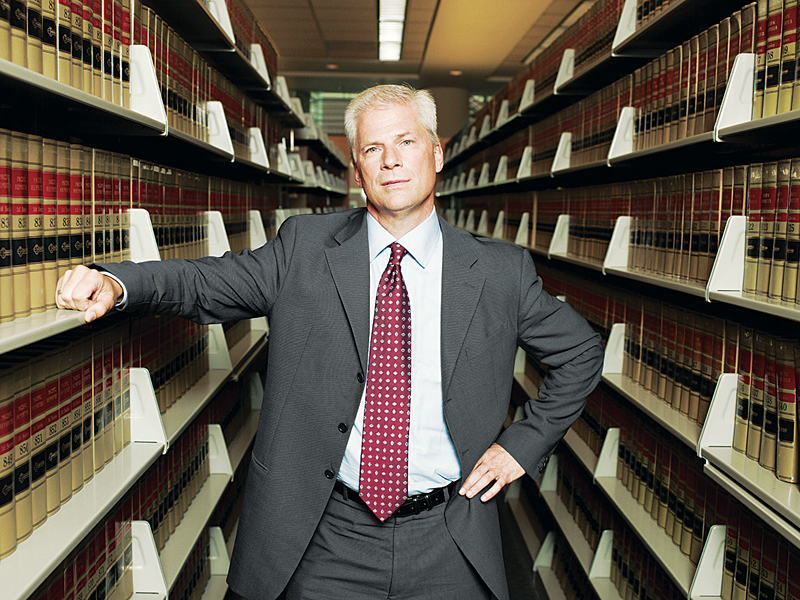
One day in March, John McKay ran into Jodie Emery. It was an encounter that should have been awkward—to say the least.
McKay, the former U.S. Attorney for Western Washington, had put Emery’s husband Marc in prison. The so-called “Prince of Pot” is now serving a five-year-sentence in connection with the seed empire he ran from Vancouver, B.C., a business hailed as heroic by the legalization movement and demonic by federal law-enforcement authorities like McKay.
“He may become the Prince of Federal Prison,” McKay quipped on a 60 Minutes episode as his office sought extradition of the pot entrepreneur to the U.S.
“Mr. McKay? I’m Jodie Emery,” said the glamorous, dark-haired 26-year-old, who still runs a pot-paraphernalia store in Vancouver called Cannabis Culture.
McKay, 55, is known for his gregarious charm. Despite his high-profile career and roots in Northwest Republican aristocracy, he likes to call himself “an Irish country lawyer.” At this moment, however, the onetime George W. Bush appointee “was extremely flustered,” Emery recalls.
“I’ve never met your husband,” he said, quickly.
“I know you haven’t,” she replied, “and I know there’s no personal thing here, so that’s why I don’t hold anything against you.”
And then Emery did something unexpected. She thanked him—not for prosecuting her husband, but for coming around afterward to a position that contradicts McKay’s former actions in office, flouts the pronouncements of federal authorities, and veers left from standard conservative politics. Like Emery, McKay on this day had come to the legislature to speak in favor of a bill that proposed to legalize marijuana.
“Marijuana prohibition has failed at the federal level. It’s failed at the state level. It’s failed at the local level,” he told legislators.
In the following months, McKay would come to act more decisively on his newfound beliefs. He would join a coalition—one that includes Seattle City Attorney Pete Holmes, travel guru Rick Steves, state Rep. Mary Lou Dickerson (who sponsored the legislative bill McKay testified for), and ACLU drug-policy director Alison Holcomb—that has since put forward a legalization initiative.
Despite the cluster of well-known names, it was McKay’s participation that made headlines. According to Tom Angell, a spokesperson for the national group Law Enforcement Against Prohibition, McKay is likely the highest-ranking law-enforcement official, present or past, ever to come out in favor of marijuana legalization.
Emery likens McKay’s epiphany to that of “soldiers coming back from the war in Vietnam”—McKay’s war, of course, being the war on drugs. But that’s not the only battle McKay has fought in recent years. In 2006, he was one of nine U.S. attorneys fired by the Bush administration in a crass display of partisanship that blew up into a national scandal.
“I was deeply affected by it,” McKay says now. And he has changed in ways that go beyond his thinking on marijuana.
A couple of years ago, in a little-noticed speech given at Whitman College in Walla Walla, McKay announced that he was leaving the Republican Party. “It is painful in one sense to walk away,” he said.
In another sense, he seems liberated. Now a Seattle University professor with a part-time gig at the law firm run by his brother, Mike McKay, also a former U.S. attorney, he still has time to travel the world—recent destinations, for both fun and legal projects, have included Ireland, the Eastern European republic of Georgia, and Rwanda. “Ever since John left the U.S. attorney’s office, he’s gotten tanner and he never wears a tie anymore,” joked Leigh Winchell, a top agent for U.S. Immigration and Customs Enforcement, during a visit to McKay’s classroom earlier this month.
McKay also says he made a decision upon leaving office: “I would speak out on issues as long as anyone wanted to listen.” That includes offering startlingly frank criticism of the Bush administration he once served.
“I can’t quite figure it out,” says Pramila Jayapal, executive director of the immigrant-advocacy group OneAmerica. Having clashed with him when McKay was U.S. attorney, she says she’s had much more simpatico conversations with him of late: “I could see that either he was shifting his views, or they were coming into focus more. I’m not sure which.”
The McKay clan is sometimes likened to a Republican version of the Kennedy family, an apt comparison in many ways.
“The McKays are one of these old Seattle families,” says Chris Vance, a Republican political consultant and former state party chair. While Vance describes his own background in south King County as public-school plebeian, he sees the McKays as belonging to a more rarefied social circle. “They’re very comfortable in the Rainier Club, the Washington Athletic Club, the Tyee section of Husky football games.”
Like the Kennedys, the McKays are also Catholic, and numerous—though McKay never had children himself and lives in a condo on Lake Union, he is one of 12 siblings.
The McKay kids grew up on Capitol Hill in the shadow of St. Joseph Parish, to which they belonged, surrounded almost exclusively by other large Catholic families. McKay’s younger sister Tricia reckons there must have been 100 kids on their street, 22nd Avenue East, many of them with last names beginning with “Mc.” She says the homes that now appear so stately looked more lived-in back then. But the neighborhood was prosperous enough, with parents who worked at Catholic institutions like Seattle University or Providence Hospital, which employed the McKays’ dad, a doctor, also named John.
He may not have attained the success or wealth of patriarch Joseph Kennedy, a millionaire businessman, but Dr. McKay was intimidating, with a stern way of peering down his glasses at his brood and nightly demands for a rigorous exchange of ideas at the dining table for 14 that he and his wife had custom-built.
The elder McKay also had firm ideas about politics. He was, McKay says, “the rare Irish Catholic Republican, raised by a mother who despised Franklin Roosevelt because he sought to bring Americans into World War II on the side of the British.” A precinct committeeman, he resisted the influence of some of the moderate Republicans coming to the forefront in the state—chief among them Dan Evans, a former governor and U.S. senator who once offered a legislative-assistant job to a young Tricia McKay.
She says she’ll never forget her dad’s reaction to the news. “He was a little sad that I was going to work for ‘the big pinko.’ “
“Johnny,” as he is still known to his siblings, liked sparring with his father. “He took up a lot of the oxygen in the room,” Tricia says of her brother. But he wasn’t too rebellious. After parochial school and college at the University of Washington, McKay enrolled in the School of Law at Creighton University, a Jesuit institution in Nebraska that his father, mother (who trained as a nurse but never practiced), and brother Mike had all attended.
Mike, the eldest sibling, became even more of a Republican stalwart than his father. “If anything big was happening among Republicans, he was part of it,” Vance says. The first President Bush, on whose election committee Mike served, appointed him U.S. attorney. He was later a key player in numerous other presidential and congressional campaigns.
During that time, Vance says he never heard of Mike’s younger brother John.
Yet McKay’s career was starting to take off, and it took some notable turns from the path his older brother had cleared. By the mid-’90s, McKay had shored up his legal and political bona fides by working as an aide to Republican congressman Joel Pritchard and putting in time at a couple of big law firms. One firm in particular, Lane Powell, had a tradition of pro bono work, and with the firm’s encouragement McKay took on cases handled by the legal-aid nonprofit then known as Evergreen Legal Services (subsequently subsumed into Columbia Legal Services).
When the 1994 Republican Revolution put federal legal-aid funding in jeopardy, McKay ended up testifying before Congress on behalf of a local coalition of law groups that were trying to keep alive legal services for the poor. His testimony caught the attention of the national Legal Services Corporation, whose longtime president was stepping down. In 1997, the group asked McKay if he would take over.
“I spoke fluent Republican,” is how McKay explains his appeal.
He says his technique was first to tell the new Republican members of Congress about himself, being sure to mention his conservative credentials as a former Pritchard aide. Then he would offer reassurances that legal-aid lawyers were not, as Republicans suspected, “a bunch of liberals trying to change the law by suing the government.” Instead they were people trying to help little old ladies avoid eviction and battered wives collect child support. “Walk into our waiting room,” he says he urged the lawmakers.
After building a coalition of 80 or so Republicans, he says he told those representatives who still wanted to decimate legal aid to “do the math.” Eventually they gave up.
McKay was surely helped by his people skills. He has a politician’s penchant for referring to seemingly everybody as his “friend,” and attempting to make them feel like one, too. “Always be kind to the people you’re dealing with,” he tells his law students one day. “Those people are your greatest allies.”
McKay also knows how to glare as well as any prosecutor, and is not immune from exerting his authority. Jayapal recalls one meeting during his tenure as U.S. attorney to which she’d brought an uninvited member of her staff.
“John just looked at me,” she says. “I didn’t say you could bring anybody,” he told her. “I felt it was a bit of a power play.”
Yet family lore suggests that McKay’s natural instincts lean more toward the lighthearted. As the eldest, Mike was the brother who “always came across as a little more grown-up than the rest,” sister Tricia says. Johnny was the one “sneaking away from the dinner table to avoid doing the dishes.”
In 2001, the ascension of George W. Bush opened a set of plum jobs across the country, as every new president picks a new slate of top federal prosecutors. McKay, then living in D.C. as the head of Legal Services Corp., put his name in for Seattle U.S. Attorney.
“I was the last person to apply,” he says. But he won the job anyway, which Vance says surprised him once he finally learned a little about McKay. “Anybody who knows anything about John McKay knows that he’s a liberal Republican, and the Bush administration was not populated by liberal Republicans.”
If McKay’s affiliation with Legal Services Corp. raised any doubts in the Bush administration, they may have been assuaged by his other connections. Brother Mike had not only worked for Bush Sr., but had been vice-chair of George W.’s campaign in Washington (a role he repeated in 2004).
In late 2001, McKay stepped into the position once held by his brother—”the only time in the history of the Justice Department,” he says, that such a thing has happened.
The defining event of 2001, of course, was 9/11, and McKay says “it became the story of my service as U.S. attorney.”
One of the first things required of all the new U.S. attorneys was a trip to Ground Zero with Attorney General John Ashcroft. McKay doesn’t remember Ashcroft saying much, but the 92 assembled prosecutors got the point. “Terrorism was the #1 criminal priority,” McKay says.
He dutifully carried out the charge. The biggest case on his plate was that of Ahmed Ressam, the so-called Millennium bomber, who had been caught coming into Washington state from Canada with explosives in his car and plans to bomb Los Angeles International Airport. Although Ressam’s lawyer argued his client deserved leniency for cooperating (at least initially) with authorities, McKay took a hard line, asking for a sentence of 35 years that would serve as a “deterrent to the horror that Mr. Ressam sought to launch.” (The case is still under review by the 9th Circuit Court of Appeals.)
Jayapal also remembers McKay as a faithful soldier in the war on terror. Shortly after he took the U.S. attorney job, the FBI raided several Muslim grocery stores and a wire-transfer operation that the feds alleged were linked to Al Qaeda. Islamic community groups were outraged by what they believed were unjust accusations.
McKay, says Jayapal, “said something along the lines that he was not pleased” with the FBI action, which he intimated was not properly coordinated with his office. “At the same time,” she says, “he also totally gave me the government line: ‘These are different times, we have to protect the security of the country . . . ‘ “
He would repeat those themes in numerous debates over the Patriot Act that took place as the Bush administration sought to expand its powers in the name of national security, while civil-rights groups protested that individual liberties were being eroded. McKay’s was a tough position to be in, says brother Mike. “Sometimes he was going on panels where there would be three or four people attacking the Patriot Act and the only one speaking for it was John.”
It was not something “most U.S. attorneys were willing to do,” Mike adds. “You don’t have to say yes to those kinds of things.” To his older brother, McKay’s doggedness in doing so showed that he was a “remarkably loyal member of the administration.”
Yet for much of that time, McKay says he was experiencing doubts. Over coffee one morning at a Capitol Hill Tully’s, which lies across the street from St. Joe’s and which he hails as his unofficial “office,” McKay describes what he says was a turning point. In The New York Times he came across the story of José Padilla, a Brooklyn-born American citizen and former gang member who, according to the feds, had gotten involved with Al Qaeda overseas.
After Padilla was arrested in 2002, President Bush declared him an “enemy combatant” who was therefore not entitled to either a trial or a lawyer. “I dropped the newspaper with my jaw open,” McKay recalls. He says he “didn’t understand how it was possible” that the government could take that position about an American citizen. In fact, he says, “I didn’t feel I could continue to serve as U.S. attorney unless I could answer the question.”
He says he began researching the relevant law. “I learned that we were wrong, we were terribly wrong.”
Eventually, Padilla would get a trial, and be found guilty of conspiring with terrorists. But McKay was grappling with other warning signs by then. Shortly after Alberto Gonzales succeeded Ashcroft in 2005, the new Attorney General held a meeting in Scottsdale, Ariz., with all the U.S. attorneys.
McKay was excited about Gonzales’ appointment. He called a number of his colleagues to tell them how much they were going to like the former Texas Supreme Court justice, whom he had met when he was head of Legal Aid. “I thought he was humble and intelligent, and really a good guy,” McKay says.
Then Gonzales stepped off the plane in Scottsdale, walked into a conference room, and issued a directive: “All staff leave the room,” McKay remembers the Attorney General saying, indicating that he wanted to talk only to the presidential appointees.
“He walked back and forth in front of us with his head down, pacing like this.” says McKay, drooping his head to demonstrate. “He said in this really threatening voice: ‘I work for the president of the United States. You work for the president of the United States.’ “
McKay remembers thinking: “Oh my God, what did he just say?” There were furtive glances around the room, and in subsequent days, calls among the U.S. attorneys to discuss the implications.
“I think it was pretty clear what he was talking about,” McKay says. “If the president called me and said, ‘I want you to indict so and so,’ ” he would have been expected to follow orders—never mind the evidence that might be at hand and the impartial judgment that U.S. attorneys are supposed to make.
For all his public loyalty to the administration, McKay insists that privately he let it be known that he would not simply do as he was told. He cites, as an example, an order that went out as the Patriot Act came up for reauthorization. The U.S. attorneys were told to contact the congressional delegation in their area and lobby for the act.
McKay’s problem with that order: “It’s a crime.” A federal statute prohibits federal employees from lobbying. (Justice Department spokespeople later argued that the U.S. attorneys were exempt because they were presidential appointees.) McKay says he began calling his colleagues, sharing his concerns, and passing along a message for his bosses at the Justice Department: “I’m not doing it.”
Paul Charlton, the U.S. attorney in Phoenix at the time, doesn’t remember McKay pushing back on Patriot Act lobbying. But he does recall McKay “going his own way” on other matters, most notably a new information-sharing system called LInX (the Law Enforcement Information Exchange) that McKay was trying to develop. The idea was to allow federal and local authorities to move beyond their silos. But, as Charlton recalls, “the FBI didn’t want to share information. It got very heated. John held his ground.”
By his own account, McKay also irritated his bosses by insisting that they weren’t pushing hard enough on the investigation of the murder of Tom Wales, the assistant U.S. Attorney assassinated right before McKay took office, and by balking when Justice officials told federal agencies one year to knock on doors and “rattle cages” in the Muslim community right before Ramadan.
“I joke now that I can’t believe I wasn’t fired sooner,” he says.
Yet the catalyst for McKay’s dismissal, by most people’s reckoning, wasn’t a power battle with the president’s men; it was a frenzied fight happening right here in Washington state. In November 2004, Chris Gregoire won her first gubernatorial election by 133 votes. Republican activists went wild, insisting there had been fraud. Calls for an investigation came to McKay’s office—in droves, especially after right-wing radio host Mike Siegel urged listeners to turn the screws on the U.S. attorney.
“I think it was the most phone calls ever received at the U.S. attorney’s office,” says McKay, whose assistants set up a separate line to handle them.
Nevertheless, he says he never seriously considered bringing charges against anyone because the evidence wasn’t there. He recalls an envelope of supposed “proof” sent to the FBI by Tom McCabe, then head of the Building Industry Association of Washington. FBI agents, McKay says, “literally laughed” when they opened it. According to McKay, it contained handwriting analyses of absentee ballots, but not anything linking Democratic operatives to fraud.
McKay’s pass on the affair, along with that of other law-enforcement and election officials, infuriated party faithful. Says Vance, “The activists believed we were being sold out by three moderate Republicans: [late King County Prosecutor Norm] Maleng, [Secretary of State Sam] Reed, and McKay.” Vance, however, says he “can’t fault” the former U.S. attorney, because he believes McKay made a fair assessment of the evidence.
Siegel, on the other hand, still fumes. Other U.S. attorneys didn’t sit back and wait for evidence of voter fraud to be spoon-fed them, says the nationally syndicated radio host who broadcasts from his Seattle home studio; they launched their own investigations.
To him, McKay’s inaction is symptomatic of a larger character flaw. While others laud McKay for what they consider his courage in standing up to Republican leaders in D.C. and at home, Siegel argues that the congenial attorney has always wanted to “placate people rather than take strong positions.” McKay’s bosses may have been conservative Republicans, but the reigning political culture in this state—and certainly in Seattle—is liberal. The calculus of a moderate Republican like McKay, Siegel says, is that “it’s OK to be slightly off the reservation—but not too far. I don’t believe he really stood up for Republican values at expense of being accepted by the political elite.” As Siegel sees it, McKay kowtowed to that elite by not challenging Gregoire’s election results.
Yet the cost of not placating the Republican lions was high. In later congressional testimony, Alberto Gonzales conceded that he had “received letters from groups and outside parties” of those angry at McKay, which generated “a great deal of concern.”
On a “dark and rainy” December day in 2006, McKay says, he received a call from a higher-up in the Justice Department. “The administration wanted a change,” McKay says he was told. It was time to “move on.”
“It was my duty to leave office quietly,” McKay says he initially thought, writing about the imbroglio in 2008 for Seattle University Law Review. He kept to this idea even as he learned, through news of similar firings across the country, that something bigger seemed to be going on. He put out a brief statement saying he had decided to “return to the private sector.”
The moment that galvanized McKay, and turned him into the public pot-stirrer he is today, came when Gonzales went before the Senate Judiciary Committee in January 2007. In response to sharp questioning by Senator Dianne Feinstein about the mass firings, Gonzales insisted that they were “performance” related: “I think I would never, ever make a change in a U.S. attorney position for political reasons.”
As the fired U.S. attorneys communicated furiously with each other in the days afterward, McKay writes in his paper, many came to the same conclusion: “The attorney general was lying.” By then, it seemed clear that those fired had all gotten on the wrong side of the administration, politically, in one way or another. Eventually Gonzales gave in to a chorus of calls for his resignation, in no small part because of his role in the affair.
Subsequent to writing his Law Review paper, McKay says he got another indication that the Bush administration had tried to cover up its true motivation. In 2005, the administration compiled what McKay describes as a hit list of “U.S. attorneys who were not loyal Bushies.” Congress later got hold of the list, but McKay says “One name was redacted.” He says he now knows “that name was mine.”
McKay says “the significance is enormous” because the administration initially attributed his firing to his supposed mishandling of the LInX system, “but that only applied in 2006.” What was happening in 2005, as the list was being developed, was the battle over the Gregoire/Rossi election results.
In the months after Gonzales’ Senate testimony, McKay took to the airwaves. “This is a black cloud over the Department of Justice,” he told CBS News. On Meet the Press, he declared that it was the government’s job “not to allow politics in the work we do in criminal prosecutions.” Interviewed by KCTS, he discussed a phone call he had received from a Justice Department official before Gonzales’ congressional testimony. He said the official, whom McKay compared to a “thug” threatening a witness, implicitly warned him to keep quiet.
His reckoning with what had happened to him grew expansive. “I had time for one thing,” McKay explains. He began to see the mass firings as emblematic of the attitude of Bush and his underlings: “They saw the law as an impediment” to their agenda, he says, and “anyone giving legal opinions as people they had to control.”
This insight, in turn, made him question not just Republican orthodoxy, but partisan politics of any description. “I just came to doubt that political parties are all that interested in pursuing the common good,” he says. “Their primary purpose is to obtain and keep power.”
He has consequently not leapt in with Democrats. And his rejection of both parties has put a freeze on any political ambitions.
This year, as state Attorney General Rob McKenna announced he would run for governor, McKay considered putting himself forward as a candidate to be McKenna’s successor. “I was advised to run as a Republican,” he says. “I reread my paper,” he continues, referring to his speech at Whitman where he laid out his reasons for becoming an independent. “Everything in there I still believed.”
He then toyed with the idea of running as an independent. “I think I’d have a very good chance.” He believed he had a good case to make about politics having no place in the work of an AG. But where would he go next? The logical next step would be a campaign for governor or U.S. senator, but that was a much harder sell without a political party behind him.
So he decided to stay put in the job he loves.
McKay has a lot going on in his “national security law” class one afternoon this month. It’s the day Winchell is scheduled to give a presentation about his work for ICE.
McKay regularly invites speakers to his classes. Last year, for Constitutional Law of Terrorism, McKay’s guests included David Iglesias, the former U.S. attorney in New Mexico who was fired along with McKay, and former U.S. Senator and Republican icon Slade Gorton. Jayapal has also become a regular visitor to his classroom.
Student Brandon Rain says the access to such high-profile and wide-ranging figures help make McKay’s classes “something special.” Law-school dean Mark Niles, who has benefited from McKay’s help in fund-raising and promoting, agrees that McKay brings “an unusual range of people” to the school.
On this day, Winchell is merely one attraction in a three-ring circus. On a screen linked to McKay’s computer, students are watching a live Seattle Times forum related to the 10th anniversary of 9/11. McKay has accepted an invitation to participate, which he announces that he intends to do while going on with his regular class.
As the other participants’ long-winded paragraphs fill the screen, McKay questions students about the meaning of a Supreme Court case dealing with the delegation of foreign-policy powers to the president. “Secrecy is the reason why Congress should delegate substantial powers to the president,” McKay says, summarizing a student’s explanation. “Anybody skeptical of that?”
“You’re being asked a question,” interjects a student who has been watching the screen.
McKay looks up, scans the question about the “stumbling points” for agencies involved in national security, and tosses off an answer. “Turf” battles are the big problem, he writes. “I also want to offer that the debate between liberty and security is often misstated. The Constitution provides for both.”
“OK, we’ll see if that gets anything going,” he says, returning his attention to the class.
Getting something going seems to be an aim of his these days—his biggest stab in that direction being, of course, his surprising support for marijuana legalization.
Like his views on the Bush administration, McKay says he harbored private doubts on the feds’ official line while he was U.S. attorney, when he dealt with pot investigations constantly. The “B.C. bud” industry is huge, with much of the product coming into the States through “trains, planes, automobiles, canoes, backpacks” and more, McKay says. “Our joke was that a Canadian hockey bag was probable cause for arrest.”
Still, despite the efforts of the Border Patrol, ICE, and the Drug Enforcement Administration, the marijuana industry continues to thrive. And that, he realized, was because of “this gigantic American demand.” So instead of anguishing about what could be done about it, he says he concluded, “maybe we ought to be asking another question: Is marijuana properly illegal?”
He says it was not a question he could ask publicly while in office. “It was my job to enforce the law,” he says. Once fired, however, he says he began to research the medical evidence. He concluded that the case against weed—much of it, he notes, put forward not by the National Institutes of Health, but by the DEA—was weak.
The biggest issue for him, though, was that the black market has turned stunningly violent, particularly in Mexico, where the drug war has resulted in more than 30,000 deaths in the past five years. “When they uncover a pit in Mexico and find 40 people beheaded, it’s due to us,” McKay says, meaning pot-loving Americans. Legalizing pot would, he feels, reduce the violence.
Last September, he laid out these arguments in an op-ed for The Seattle Times. Rep. Dickerson subsequently asked him to testify for her legalization bill.
That might have been the end of McKay’s advocacy had the legislation not failed. Dickerson has since joined forces with an array of legalization proponents to draw up an initiative, which given enough signatures will go first before the legislature in the next session, then before voters if legislators fail to act. One of the initiative’s sponsors, Steves, is a family friend. (Steves’ former mother-in-law and McKay’s mother went to Creighton together.) Another, Holmes, has long attended St. Joe’s Parish along with McKay. And it was the city attorney who called McKay to ask him to sign on.
“John asked a lot of probing questions,” Holmes recalls. But McKay didn’t have much time to weigh the matter. He was in Idaho, about to go on a river-rafting trip. He says he liked what he heard from Holmes about the details of the so-called “New Approach” initiative. Unlike previous efforts put forward by the group Sensible Washington, which simply would have removed the criminal and civil penalties related to marijuana, this one would tax and regulate the pot industry.
“I decided ‘in for a penny, in for a pound,’ ” McKay says.
McKay has won new plaudits for his stand—by Dickerson, for one. She adds that he “was man enough to say ‘I was wrong,’ ” referring to his pot prosecutions as U.S. Attorney.
But McKay has never said he was wrong. “He got what he deserves,” he says even now of Emery, the “Prince” he put away for five years. “He wanted to change policy, and the way he chose to do that was not to get himself elected to the B.C. parliament, but to break the law.”
McKay’s refusal to apologize drives Douglas Hiatt nuts. Hiatt is a founder of Sensible Washington and a defense attorney specializing in marijuana cases. “He’s never talked about his own moral culpability,” Hiatt says of McKay.
Hiatt continues: “His whole patrician view ruffles my feathers: ‘I’m the high and mighty John McKay who’s come to talk to all of you because I have decided to change my mind.’ Well, fuck you. A lot of us changed our minds a long time ago.”
Adding insult to injury is that Hiatt considers the specifics of the “New Approach” initiative “depressing.” Similarly, Hiatt’s associate Jeffrey Steinborn, a Sensible Washington co-founder, calls the initiative “the worst plan I have seen offered in 40 years of reform.” They have a litany of complaints: Only a small amount of pot in a person’s bloodstream would make it illegal for him or her to drive; there’s no provision allowing people to grow their own; and a person could only buy an ounce of marijuana at a time.
“New Approach” backers defend it against such criticism. Holcomb, for instance, asks why anyone with ready and legal access to pot would need to buy more than an ounce at a time. But it is true that the “New Approach” initiative treads a more conservative line than the one articulated by many activists—as does McKay.
He makes fun of stoner culture (imitating the spaced-out drawl of a couple of pothead kids he met at one talk: “Well, you know, man . . . “), considers the medical-marijuana industry, by and large, a “sham” (he says a “patient” will request a prescription with the lament “I’m feeling blue today”), and says he wouldn’t dream of smoking a joint himself. “They’re certainly not my people,” he says in reference to pot smokers and activists.
Similarly, it’s hard to see McKay—whose favorite hangout is across the street from the church he went to as a child; who still goes to that church, only blocks from his childhood home; and who sits on the board of his old parochial high school (Seattle Prep) while teaching at another Catholic institution—as straying far enough from his heritage to become a classic Seattle liberal.
He hinted at this in a recent exchange with Jayapal. The two were discussing immigration, likely the next issue McKay takes on. As Jayapal remembers it, he told her that he thought U.S. policy on the matter was “hypocritical.”
To elaborate, he sent her a copy of his Whitman College speech, in which he addressed the subject: “Deporting the tens of millions of those here illegally, but who are serving our food, cleaning our hotel rooms, plucking our chickens, and sweating in our fields is an impossibility short of an effort that would make only the Nazis and Khmer Rouge proud,” he had said.
Surprised but gratified, Jayapal asked if he would write a joint op-ed with her. “I’d really like to do that,” McKay replied. “But you know,” he added, “you might not like everything that’s in it.”