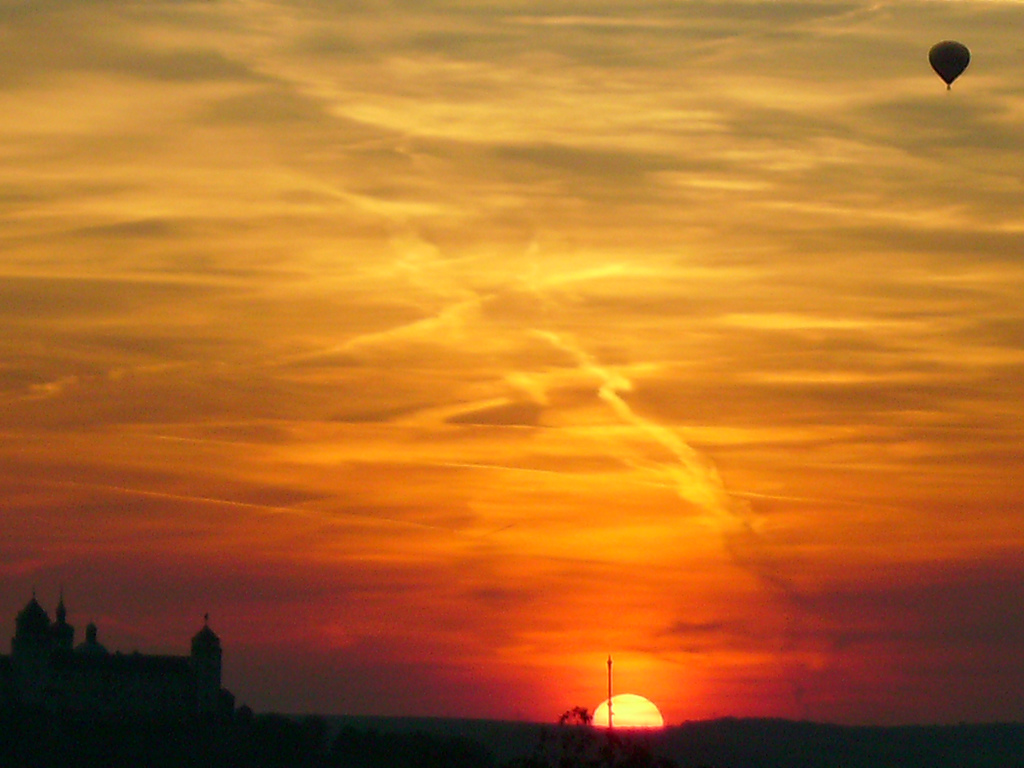
Seated at SkyCity, which twirls with the relentless grace of a music-box ballerina, it’s impossible to reckon why the rotating-restaurant rage ever subsided. The changing scenery is the ideal antidote for conversation that drags as slowly as the room. (“It won’t even ripple a martini,” early promotional literature promised.) Look, isn’t that Mt. Baker? Gosh, did you spy those sailboats off Bainbridge Island?
The tragedy of revolving restaurants being dismissed as outdated kitsch is compounded by the centuries of rotating-architecture visions that preceded their creation. Legend holds Nero took his meals in his palace’s rotating dining hall, and architects in every era since have sought the perfect application for a motorized room. Nineteenth-century entrepreneurs experimented with rotating jails surrounded by stationary outer cages, which prevented inmates from easily sawing escape routes, and sanitaria touted rotating convalescence sheds, designed so tuberculosis patients would always face the sun. Decades before it became trendy to set diners on a spin cycle, a New Jersey dairy reasoned it could milk its cows more efficiently by installing them in mechanized milking pens built atop a turntable.
But functionality eventually gave way to fun, as postwar architects rightly realized a 360-degree trip was too thrilling to waste on cows and crooks. In a culture obsessed with movement, merry-go-round restaurants and bars allowed diners to be everywhere and see everything while they sipped their highballs. Builders ultimately thrust the concept heavenward, hitting upon the perfect Space Age form.
When Seattle architect John Graham Jr. proposed putting an orbiting restaurant atop a Honolulu office building in 1959, a few especially ugly concrete TV towers and a barley silo in West Germany already sported revolving restaurants. According to Chad Randl, author of Revolving Architecture: A History of Buildings That Rotate, Swivel, and Pivot, it’s unclear whether Graham was aware of them before he unveiled the New World’s first rotating restaurant.
But Seattle’s civic leaders had visited Stuttgart’s lofty TV tower, and, sufficiently impressed, insisted upon a very tall building for the 1962 World’s Fair. They commissioned Graham to design the Space Needle, complete with a rotating restaurant at 630 feet that single-handedly launched the global craze for spinning eateries.
Tens of thousands of visitors reportedly supped at the Eye of the Needle during the Fair. They withstood two-hour lines to order “‘Round the World” cocktails of brandy and fruit juice, portioned for two or four imbibers, and rum drinks served in Space Needle–shaped receptacles. Judging from a popular 1962 postcard, depicting a squadron of guests with gentle bouffants seated in orange vinyl chairs at tables clothed in paisleys of “re-entry red” and “galaxy gold,” the Eye of the Needle was the Fair’s epicenter of sophistication.
What’s much harder to determine from the historical record is what those guests ate while they circled and sipped—and whether or not they enjoyed it. In the Elvis Presley musical It Happened at the World’s Fair, Elvis’ character, a struggling crop duster, takes his love interest to the restaurant for what appears to be the longest date in all of Elvis moviedom: The sun is shining with midday intensity when the couple boards the Space Needle’s elevator, but stars are twinkling by the time Elvis starts singing.
Presumably the pair wouldn’t have gone hours in a fancy restaurant without eating. But their small talk is unrevealing. Elvis doesn’t say how much he liked his steak, and his lady friend doesn’t enthuse about a salad. They talk about what Elvis ought to do with his life, which is fine for Elvis but hardly worth posting on Urbanspoon.
I consulted the keenest research minds at the Seattle Public Library and the Museum of History and Industry, and couldn’t pry a single 1960s restaurant review from the archives. Food, it seems, has never been the focal point of the restaurant now known as SkyCity.
SkyCity still isn’t a good choice for a great meal. While the menu has been freshened up in recent years, the food still has the soul-wilting flavor that distinguishes meals served in places where the cooks know the diners don’t show up to sample their culinary artistry. If you’ve ever eaten a stuffed chicken breast at a wedding or grilled salmon aboard a cruise ship, you probably have a fairly good handle on SkyCity’s cuisine.
Much of what I ate was disconcertingly squishy and sweet. Yet none of the dishes I tried—excepting perhaps a ramekin of Silly Putty–like crab-and-artichoke dip plated on a square of scrap paper—were so horrific that they interfered with the rush of watching a panoramic sunset. There are kitchen sins aplenty at SkyCity, but keeping score feels tantamount to ruing a fourth-grade orchestra’s intonation or besmirching an old woman’s name because she can’t keep time with the other dancers in her clogging club. Nobody expects an edible epiphany at a revolving restaurant; diners who go to SkyCity for the food probably read Playboy for the articles.
So why go to a restaurant if the food isn’t good? To savor the other elements of eating out, many of which SkyCity gets exactly right. The room’s mood is festive, largely because nearly every diner is celebrating a birthday or has an engagement ring in his pocket. The restaurant’s glamour isn’t diluted by colleagues wandering in for after-work beers or the sounds of city traffic. Service is brisk but polite, and the wine list is intensely local.
The view provides SkyCity’s decor, although it can be difficult to politely glance outside when seated at an inner table. Back when the restaurant was Eye of the Needle, a name that lasted only for the duration of the Fair, the second row of tables was oriented so guests faced the windows, dinner theater–style. I assume the restaurant has maximized seating by sticking with a more conventional arrangement, but it creates angles which are blinding at dusk.
The view—whether or not you’re positioned to appreciate it—doesn’t come cheap. Critics have been joking about the relationship between altitude and high prices since builders broke ground for the Space Needle, and Sky-City upholds the punch line. When I visibly blanched at a $63 tomahawk steak, my server assured me that “It includes the bone.”
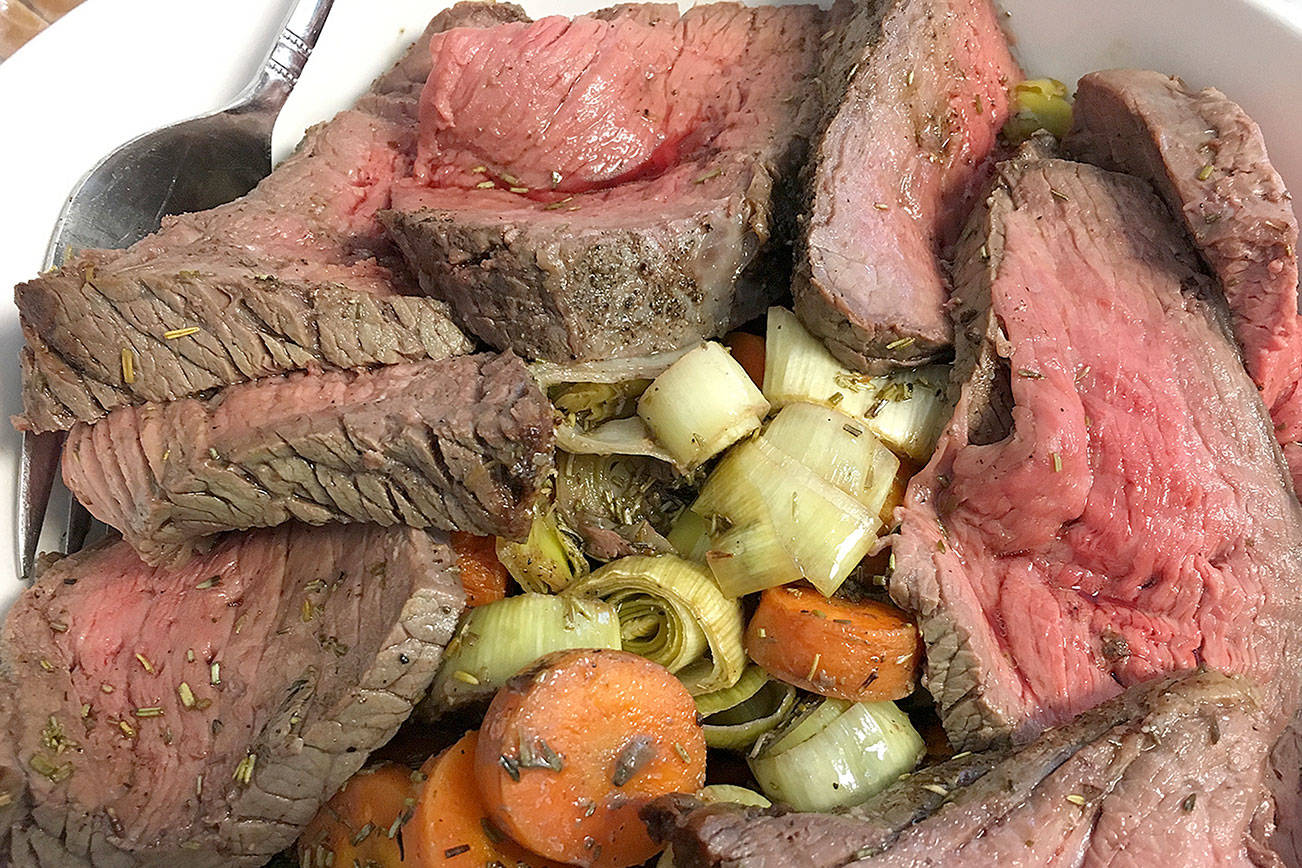
Unfortunately, it didn’t include much marbling, but the steak was decently cooked. Better still was an order of tender, coffee-brined short ribs, scented with cocoa and served with a heap of root vegetables. The dish was as subtle as a neon sign, but red meat is an appropriately kingly accompaniment to surveying the land below.
Other selections which sounded like can’t-miss candidates disappointed. A green salad was spoiled by achingly sweet huckleberry vinaigrette and chalky blue-cheese crumbles. A Caesar salad, freighted with a hostile amount of garlic, was built on a foundation of limp lettuce. A prawn cocktail featured water-saturated shrimp perched in a juice glass filled with cocktail sauce so sheer it could flow through a faucet.
SkyCity is the sort of restaurant that flies through Copper River king salmon when it’s in season: Our server told us the 90 available orders were sold in the restaurant’s first hour the night we dined there. I made do with a droopy slab of underseasoned halibut served with rigid fingerling potatoes.
If you can’t countenance paying $47 for mediocre fish, consider visiting SkyCity at lunch: The minimum required guest charge is $25 (it climbs to $35 at dinner), or a mere $7 more than it would cost to buy an observation-deck ticket. For that additional fare, it’s well worth enjoying a spinach salad, clam chowder, and a glass of sparkling wine rather than just racing to the Needle’s top.
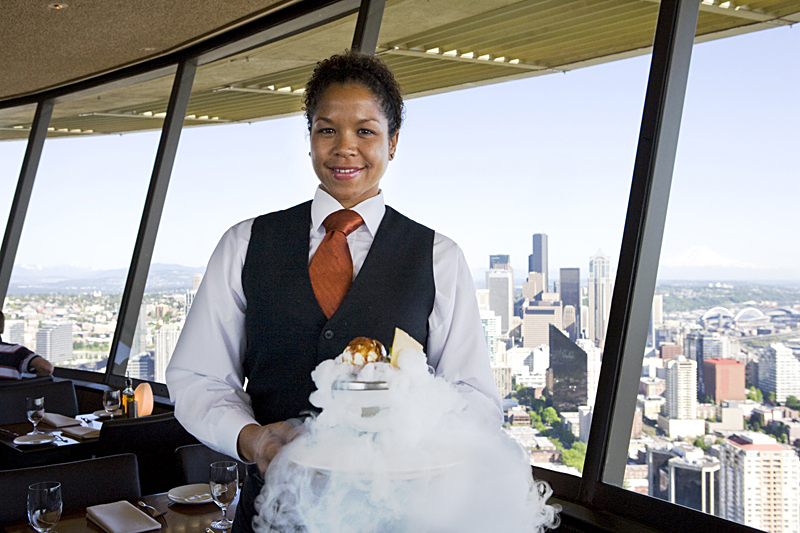
Or skip the wine and have dessert. SkyCity has been serving the Lunar Orbiter since 1962, making the ice-cream sundae its all-time bestselling menu item. The ice cream is famously enveloped in a cloud of dry-ice smoke that an official Space Needle blog likens to “if you will . . . an atomic explosion in reverse.”
Cataclysmic analogies aside, the silly dessert is fabulous. Breathe in deeply: Generations of futuristic, revolving building dreams are suspended in its vapor.
Price Guide
Prawn cocktail $12
Crab and artichoke dip $12
Caesar salad $9
Short ribs $38
Lunar orbiter $9