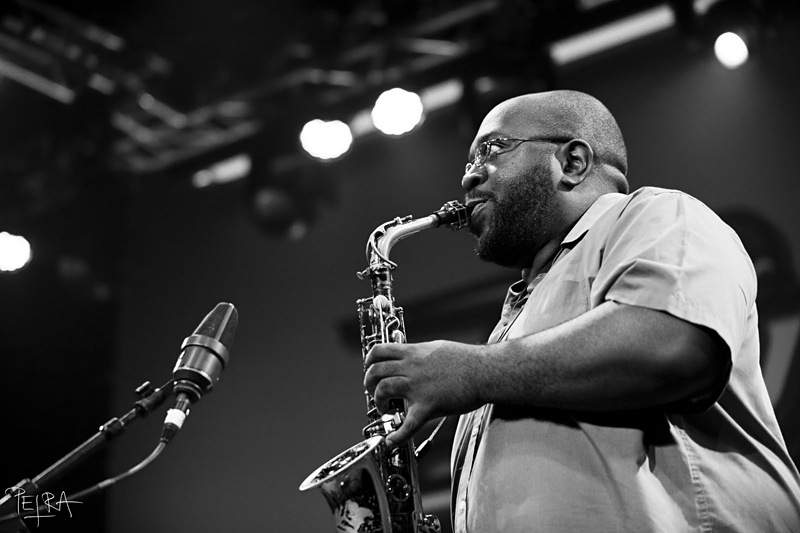
Though the Earshot Jazz Festivalis entering its third decade, longtime organizer John Gilbreath admits it’s “still a bit of a head-scratcher for a lot of people.” Which is somehow both his challenge and his triumph.
Gilbreath has always aimed for the festival to represent the breadth of music to which the term “jazz” might be applied. And that’s a pretty wide swath—so wide that it can be hard for people to get a handle on what exactly his festival encompasses, and what they might expect on any given night.
“The whole jazz world is so diffuse right now,” Gilbreath observes. “Say the word ‘jazz’ and 20 different lightbulbs go off in people’s heads.” As a result, “it becomes hard to market it.” Even people who call themselves jazz fans “may not know half the performers on this lineup,” he notes. “The main jazz station in this market [KPLU] plays maybe five out of the 50 artists at my festival.”
Of course, that’s in part because half the artists comprising the daily KPLU playlist are dead. Gilbreath does not have the luxury of booking these popular, but unavailable, acts. Nor does he want to stick with the kind of music they embody (though plenty of artists booked for the festival are fairly tradition-bound, or tradition-tied). Twenty years after Gilbreath attended his first Earshot event as a volunteer usher, and 19 years after he took over the organization, his festival has become an established, and unmatched, Seattle showcase for creative, improvised music—not to mention deep-in-the-tradition swing, and global sounds of all varieties.
At the same time, as he says, “this is not a commercial endeavor.” There are no big beer-brand sponsors. Ticket sales only cover about half the cost, and Gilbreath assembles the rest from charitable funders like the NEA and Paul Allen. “Jazz has always challenged its audience base by the mandate to constantly reinvent itself,” he notes. “The art form is being enriched tremendously from the inside, but the supply is going up as demand is going down.”
Gilbreath says there have been no big changes to the funding picture, but this year’s festival seems subtly, if unmistakably, scaled back, with fewer “headliner” names (such as there are in the jazz world) and more local bands—albeit deserving of the spotlight—occupying the schedule slots.
To help you navigate the three-weeks-plus of nightly shows, including many nights with multiple shows, here’s a thoroughly biased guide based on one writer’s taste. The music of the festival may be, as Duke said, beyond category, but we’re going to gin up a few categories anyway to help map it out.
New York Status Update
The festival has always specialized in fresh news from the city that remains the unquestioned jazz capitol of the world.
Darius Jones Trio: Jones, a Southern transplant, brings the big, hard-blowing sound associated with horn players from the lower half of the country. His ferocious trio plays wide-open, powerful free improv, rooted in blues and swing. Sheets of sound and piercing wails are likely in order, as well as more subdued reflections. 8 p.m. Sat., Oct. 23, Rainier Valley Cultural Center
Matana Roberts: This lyrically astute saxophonist has been working on compositions that explore her own family background. She’ll be spending a couple days in residency here in Seattle, then emerge for a performance with some of the city’s most artful creative players, such as drummer Greg Campbell, as well as a solo set. 8 p.m. Thurs., Oct. 28, Chapel Performance Space
Steve Lehman Octet: Jazz that’s both heady and passionate, fully engaged with tradition, and on a fervid mission to blow past it. Like the somewhat better-known Ken Vandermark, saxophonist Lehman leads a large band that combines virtuosic precision with brilliant abandon. 8 p.m. Fri., Oct. 29, Seattle Art Museum
Michael Blake’s Lucky Thompson Project: This quartet plays tribute to the unsung hard-bopper Thompson, who made an early splash in the ’50s, then had a mysteriously spotty career after. (He surfaced at the end of his life in Seattle.) There will be nothing retro about the music, though; the players here swing in a mode that is modern and forward-minded. Blake’s pianist, Søren Kjærgaard, will also perform a duo with Wayne Horvitz—a collaboration that may draw misguided bachelorette parties and will actually give them a much better time than a night at Chopstix. 8 p.m. Thurs., Nov. 4, Poncho Concert Hall, Cornish
Open-Wide Spaces
Bands whose connection to the traditional forms of jazz, even avant jazz, is more in conception than sound, more in the impulse to freedom than in the forms.
Chicago Underground Duo: Cornetist/electronicist Rob Mazurek and drummer Chad Taylor create alternately twitchy and wind-blown evocations. 8 p.m Sat., Oct. 16, EMP/SFM
Mural: This Oslo three-piece has moved beyond any expected musical tropes to pure textures, sounds, and atmospherics, carefully and playfully wrought. You are guaranteed not to be able to tap your foot, but you may slap your head. The fact that the show competes with the one above sadly splits an already limited audience. 8 p.m. Sat., Oct. 16, Chapel Performance Space
Scott Amendola Trio: Led by the SF-based drummer, this trio matches on-edge electric guitar with the warm, rooted power of acoustic bass and Amendola’s loose grooves to fall somewhere in a sweet spot between jazz, rock, and a crime soundtrack. 8 p.m. Tues., Oct. 26, Poncho Concert Hall, Cornish
Northwest Trek
Musicians based in and around Seattle loom larger than ever in this year’s festival. Here are just a few highlights.
The Kora Band: If you haven’t caught any of their recent Seattle shows, it’s time to meet this super-likable Portland/Seattle quintet, who take a bad-sounding gimmick—a jazzy band integrating the West African kora—and make it work beautifully. 7:30 p.m. Fri., Oct. 15, Tula’s
Bill Frisell Beautiful Dreamers Trio & Guests: OK, he’s an international guitar giant, but we can claim him as our own, can’t we? His newest trio of Americana, with Seattle/New York violist Eyvind Kang and N.Y. drummer Rudy Royston, is just as wry, absorbing, and all-around smart as you would expect. The guy just never disappoints. Tonight’s show will draw out more of the old-timey side of the band, with guests the Canoe Brothers and Danny Barnes. 7 & 9:30 p.m., Wed., Nov. 3, The Triple Door
Ziggurat Quartet: Most often heard in a straight-ahead context, Seattle pianist Bill Anschell shines even more in this more angular group, which avoids all swing clichés and has a little more dark fun. 8 p.m. Sat., Nov. 6, Poncho Concert Hall, Cornish
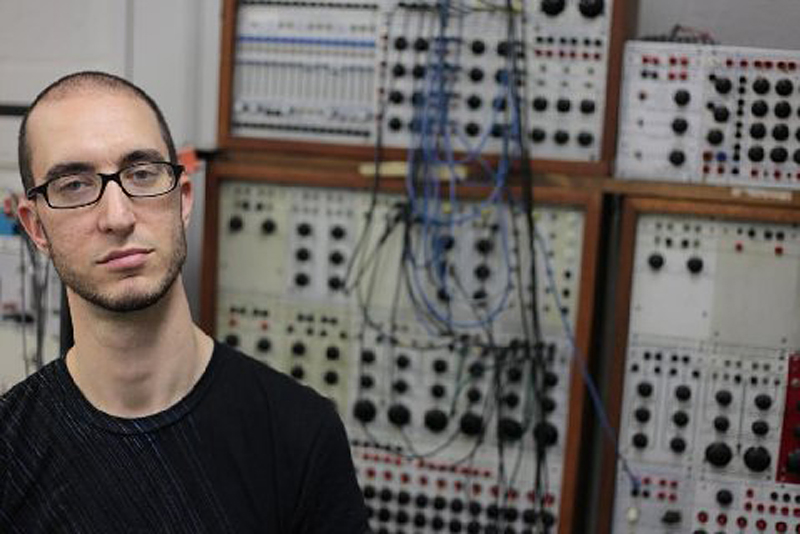
Steve Lehman plays SAM on Fri., Oct. 29.
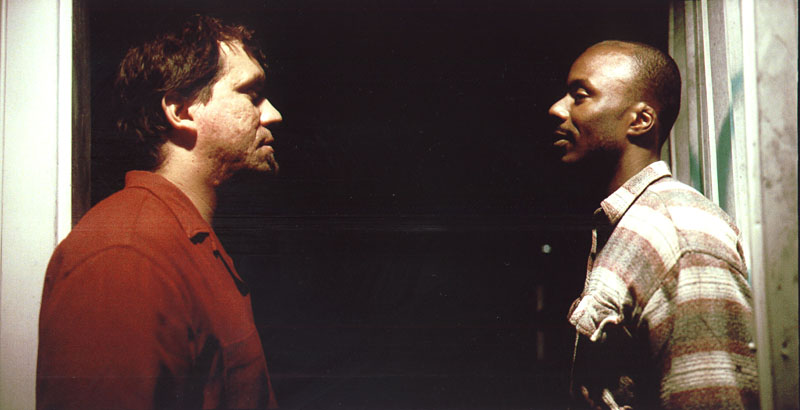
Chicago Underground Duo plays EMP/SFM on Sat., Oct. 16.