Charity Mace
Published 7:00 am Tuesday, August 24, 2010
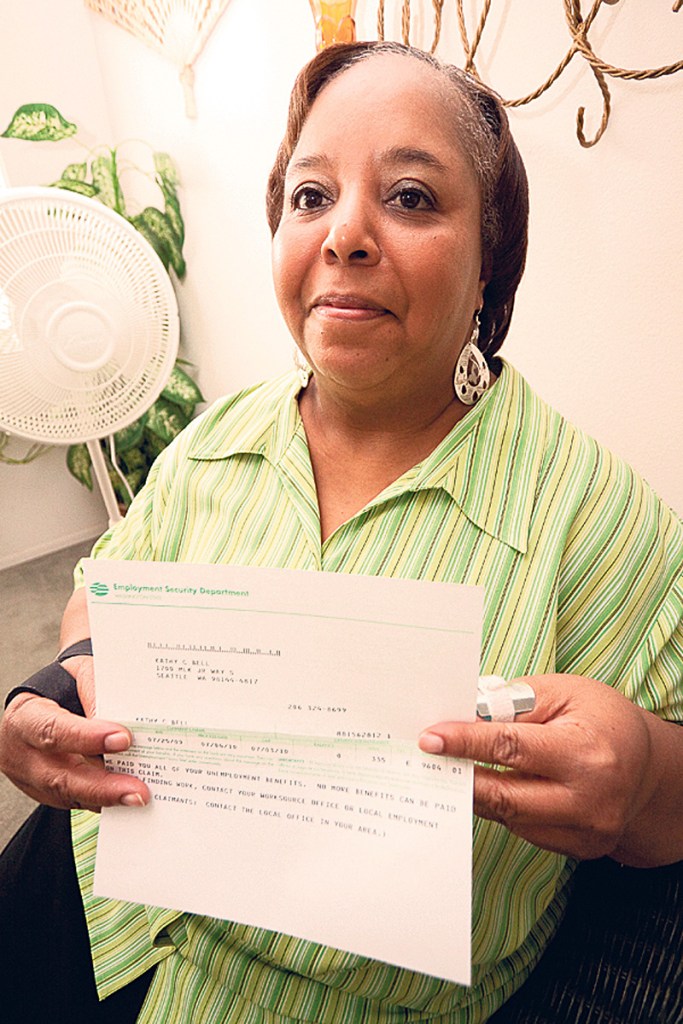









Kathy Bell opens the door of her Central District duplex in a simple gray pantsuit. She walks with a cane and a pronounced limp. At 52, her left knee barely works and her right wrist is strained from using the cane. Both have gone untreated for more than a year because she stopped paying for health care.
On her television, John Cusack is trying to save his family from a Mayan-predicted apocalypse in the movie 2012. Bell watches from a chair next to the couch (the chair is easier to get up from), and hits the mute button as earthquakes tear the world apart.
“Today I’m like, ‘What am I going to do?'” she says.
Bell recently went on Medicaid and food stamps, formally known as the state Supplemental Nutrition Assistance Program. Any other expenses are paid for with credit cards. She now has a balance of $8,000, and every month the amount she owes climbs higher. This month she applied for disability status with the Social Security Administration on the basis of her knee problems; she expects to hear in four to six months whether her application was approved. Currently, the maximum Social Security disability payment is $1,000 per month.
A little more than two years ago, Bell never imagined she would be in this position. She worked in the accounting department at Starbucks, auditing 1,300 stores to make sure they were depositing money each night. She had worked for the coffee giant for nine years and enjoyed a high-enough salary to purchase the duplex with her sister.
Then, on July 29, 2008, she received an e-mail summoning her to a room at Starbucks’ SoDo headquarters. “Within two seconds I was unemployed,” she says. At that time the company laid off about 180 people in Seattle, according to The Seattle Times.
At first, Bell wasn’t worried. Since moving to Seattle from Louisiana and taking a class in accounting at age 18, she had been steadily working. “I really thought, ‘Within the month I’ll find a job, and it’ll be fine,'” she says.
But a month passed and she still didn’t have a job. Then a year went by. Bell says she typically spends eight hours a day searching online for jobs, filling out applications, and sending resumes to banks, grocery stores, and day-care centers. She attends classes at job-search centers run by the state, where she can get tips on her resume and keep her computer skills current. Most of the time, she hears nothing back from potential employers, and interviews are sparse. “It’s very depressing and very stressful,” she says.
At the end of June, Bell received a letter from the state Employment Security Department, informing her that the period allowed for collecting unemployment had ended, and she was no longer eligible for benefits.
After a full 99 weeks, she had lost her only source of income.
Shortly after she became jobless, Bell started doing little things to cut costs. She clips coupons and can’t remember the last time she bought new clothes, but there are still utility bills and medications and her half of the mortgage, which she increasingly relies on her sister to pay.
That’s how Bell started living off credit cards. She estimates that she has maybe two months left before she hits their cumulative limit. If her disability application doesn’t pan out, she says, “I don’t know what I’ll do.”
Bell is not alone. The problem of expiring unemployment benefits—for many people, their last source of income—has been a quietly brewing storm. The state unemployment rate is double what it was three years ago: 8.9 percent, down from a high of 9.5 percent in March. ESD spokesperson Sheryl Hutchison says that’s the highest it’s been “in a generation”—and that doesn’t account for people who have gotten so discouraged they’ve given up and stopped looking for a job. If you factor them in, the unemployment rate is 5 to 6 percent higher, Hutchison estimates.
The state’s slow recovery from the recession is one major problem. Between 2008 and 2009, Washington lost 192,000 jobs; this year so far, only 23,000 have returned. To put a finer point on it, there are at least five unemployed people for every job opening in the state. And this spring, some of them, like Bell, started exhausting their unemployment benefits.
It started as a slow trickle, with about 2,000 people per month getting kicked off the dole, as was the case in 2007. Nearly 15,000 have lost their benefits so far this year. But Hutchison says that number is expected to quadruple by the end of the year, with more than 10,000 people getting kicked out of the system each month.
The jobless are running out of places to turn. This month, the state Department of Social and Health Services announced that due to a 30-percent rise over the past year in the number of people collecting welfare checks (a program separate from unemployment benefits), the department is making it harder to qualify for the payouts. Bell can’t get welfare because she doesn’t have kids. She and others in her position are moving in with friends, depending on their families for money, and flooding the doors of social-service agencies—which are running out of money themselves.
The “99ers problem,” as it’s colloquially known, is about to get much worse. “Even before we hit this stage, there were more people seeking assistance than there was assistance available,” says Dana Easterling. She manages the 2-1-1 call center at the Crisis Clinic, a Seattle-based nonprofit founded to help people who are evicted find shelter space, among other services.
Now, she says, her organization is dealing with a rising number of phone calls from people who’ve lost their jobs, are running out of unemployment benefits, and are looking for help. “We’re adding a whole new group of people, who haven’t [sought help from charities] in the past,” she says. “It’s a huge tax on the system. There are definitely not enough resources.”
A dozen people gather in folding chairs and on couches at a West Seattle coffee shop every Tuesday at 11:30 a.m. to talk about their job searches and give each other advice. Sometimes it’s so crowded you can’t find a place to sit.
Organized by career coach Steve Paul, the group, called “Notes From the Job Search,” has the feel of an Alcoholics Anonymous meeting. Sitting in a circle, everyone says their name, and tells the group a “high” from the last week. Among their numbers are a paralegal, a computer programmer, a salesman, and a former human-resources recruiter. Some of their highs are related to the job search—promising leads or even interviews. The computer programmer blushes a little and tells everyone that friends in Switzerland are flying her out for a short vacation. Gasps and congratulations are offered.
Paul goes over elevator pitches with everyone. One man takes too long to get to the point, Paul gently suggests. Another woman is too specific—he tells her to focus on what her transferable skills are, not on exactly what she did in her last job.
Rose Rodriguez has been attending Paul’s group for nearly two years. She has a B.A. in interior design from Washington State University and worked at two area firms before landing a job at a large Seattle architecture firm. (She asks to keep its identity a secret, since she’s worried that anything perceived as negative publicity will lead to poor references.) The firm cut nearly half its staff in October 2008, and Rodriguez was one of the victims.
Rodriguez says she spent her first several months on unemployment looking for work only in her field. After all, she notes, she studied design as an undergraduate and then worked in the business for six years. “I haven’t given up on my dream as a designer,” she says, though she may soon.
The state currently allows the jobless a maximum of $640 per week—the seventh-highest maximum benefit in the country, according to the U.S. Department of Labor. (Massachusetts has the highest, $943.) Hutchison says part of the reason for having high benefits is to keep skilled workers in the state and to get people into long-term employment. “It’s not money that’s being frittered away,” she says. However, under the state’s rules, once you reach your final 20 weeks of benefits, you have to expand your job search outside your field and be willing to take anything that pays more than your weekly benefit.
That’s the position Rodriguez is now in. Her eligibility will run out in November (she went off benefits for a few months in the summer of 2009 thanks to a short-term design contract). “One day, if I have to, I’ll take a job at Burger King,” she says.
Rodriguez says she recently tried to get into what had been a free retraining program at Seattle Central Community College, but was told that the funding for accepting students without tuition had run out. John Bowers, the director for workforce education at North Seattle Community College, says his school went through an entire year’s worth of retraining funding in one quarter. “The economy had tanked that much,” he says.
Thanks to the dearth of available jobs, employers are able to be extremely picky about whom they hire, Paul says, adding that “the amount of competition is brutal.”
Recruiters and employers tell Paul stories of receiving up to 900 resumes for a single opening. If they are submitted online, the resumes are run through a database and culled on the basis of keywords, so someone extremely qualified who merely happens not to use the right terms in their application is cut before any human has seen it.
Sonja Jo Krenz-Bush says applying in person doesn’t help either. Unlike Rodriguez, the 41-year-old wasn’t a victim of the recession. She worked in billing for the fiber-optic network company Telwest, which moved its operations to Austin, Texas, in the summer of 2007. Krenz-Bush says she was given the option to transfer, but decided not to. Her friends and family were in Seattle, and “previously I’d gotten any job I’d interviewed for,” she says. “That’s why, with hubris, I thought I wouldn’t have any trouble finding a job.” [Note: This story originally stated that Krenz-Bush worked in accounting at Telwest and has been corrected.]
At a Shoreline Starbucks, she admits that she feels some regret about the decision, but notes that it wasn’t “my dream job, with an amazing salary.”
After getting a letter in June saying her benefits had run out, she’s been frantically working to find new employment, if only temporary, especially after her car recently stopped running. In addition to sending out hundreds of resumes, Krenz-Bush says she regularly looks to temp agencies and career fairs. The fairs, especially, are frustrating, due to the huge number of other unemployed people who show up. “How do you stand out in a crowd of that many people—wear a feather hat or something?”
Paul says that getting a job is even more difficult for people like Bell, who for years haven’t gone through the process of applying and interviewing for jobs, and who are victimized by a widespread bias against hiring older employees. It’s something Paul can relate to. The 63-year-old started “Notes From the Job Search” three years ago when he left a job managing a team of programmers at Microsoft and found he had trouble finding a new position. He offers his services for free to this group, but some attendees ultimately become paying clients.
Paul tries to focus on smaller victories—like getting an interview—to keep his group’s spirits up. But after two years, the number of people coming to the coffee shop isn’t getting any smaller.
The benefit expiration crunch isn’t hard only on individuals. As people’s checks cease getting signed, the demand on charities, nonprofits, and government agencies is rising to untenable levels.
Ellen Hendrick lost her job as the executive director of the West Seattle homeless shelter Family Promise on the same day that Barack Obama was inaugurated in 2009. Hendrick, 53, says she has a master’s in social work from the University of Washington, “so I’m not a total loser.”
She repeats that phrase several more times over the course of our conversation. After 99 weeks of looking, she hasn’t been able to find another job. She lives in a condo owned by friends from her church, but owes back rent. Frantic about her financial situation when ESD cut off her benefits, Hendrick called the department to ask what she was supposed to do.
“They told me to call 2-1-1,” she says.
Unfortunately, as the Crisis Clinic’s Easterling says, the charities that 2-1-1 caseworkers refer people to are suffering their own lack of funds. Most rental- and mortgage-assistance nonprofits were set up to deal with one-time crises like a health-care emergency or an expensive car repair, not a long-term epidemic of joblessness, says Amy Besunder, executive director of North Helpline, a Lake City nonprofit that runs a food bank and will cover someone’s rent or mortgage for a month.
In the lobby of North Helpline, five people wait to ask one of the two caseworkers for help. Besunder’s charity didn’t see a sharp increase in demand until January of this year. The first wave of people came to the end of their unemployment benefits, and the phone calls started to steadily increase. So far, the number of people coming in for help is up 37 percent over last year—and climbing. (Charities that serve the most destitute people have remained relatively untouched, says Bill Hobson, executive director of the Downtown Emergency Services Center, who points out that people who are middle-class have more places to go before they find themselves homeless with no choice left but his organization. The people DESC serves are generally mentally ill or drug addicts. “The vicissitudes of the economy doesn’t stimulate spurts in those people,” Hobson says.)
Like many agencies, North Helpline doesn’t ask people why they need help. But some people volunteer the information, and anecdotally, Besunder says, the shift can largely be attributed to people running out of or nearing the end of their unemployment benefits. Notably, she adds, most of the increase is made up of people who have never had to get help before. You can always tell when someone is looking to a charity for the first time, she says. “Their arms are folded and they bite their lip a little.”
With little, if any, experience navigating social services, the newly needy can become easily aggravated. Recently one woman became angry with a caseworker who asked for her children’s birth certificates, a necessary piece of ID before North Helpline gives someone money. “She became so frustrated with the process” and walked out, Besunder says. “I have no idea what happened to her; she didn’t come back.”
The increase in requests for help couldn’t be coming at a worse time. North Helpline has been dependent on city and county governments for a substantial portion of its $310,000 budget. It lost its $5,100 contribution from King County last year in the midst of budget cuts. As the city of Seattle considers additional cuts as well, another $30,000 could be at risk.
Besunder says that private donations are, surprisingly, up by about 15 percent over last year. But thanks to the loss of county funding and the much larger rise in requests for help, it’s not enough. She says she’s looking for any money she can get to help people keep their homes at least another month. North Helpline used to give out bus tickets to help clients get to appointments or job interviews. But in February she ended the program. “It’s actually quite costly, and I had to make a hard decision,” she explains.
Even with the cut, “we’ve gone over [budget] every month so far this year,” Besunder adds. Now North Helpline is applying for two grants to help it get through the end of the year, and turning to regular donors and asking them to increase their contribution.
But Besunder says people’s inability to find new jobs is making it harder for her to successfully apply for grants or seek out new donations. When you’re asking for emergency help, you want to be able to say that it will be a one-time request, and show how the donation will help the agency through a rough patch, she says. But so far there isn’t any sign that the rising tide of people coming to North Helpline will drop off, or even just flatten out. “It’s hard when I can’t say ‘Support us for X amount of time, and then it’s going to turn around,'” she says.
If the money doesn’t come through, Besunder says North Helpline may have to close its doors to people facing evictions.
That’s already happened at the Puget Sound Labor Agency, which runs a food bank and a rent- and utility-assistance program similar to North Helpline’s. Executive director Steve Fox says many of the donations PSLA receives are given on the condition that the money will go to union members. While those funds are still in the black, Fox says, he plowed through the $14,500 he had available to the general public by the end of June. During the whole of 2009, his agency gave out $14,200 in utility and rental assistance to non-union clients, and never had to close its doors to the general public.
There’s been a similar jump in people coming to PSLA’s food bank. One of the 50 people gathered outside the door before 8 a.m. on an uncharacteristically chilly day in August begs not to be named, as he’s still searching for a job. “Just call me ‘Robert,'” he asks. He says he doesn’t want potential employers to know he’s been out of work for so long.
This is Robert’s second trip to the food bank. “I used to be on the other side,” he laments. As a member of the Teamsters, he occasionally donated to PSLA.
Robert used to work as a commercial driver, but was laid off from his job with a charter-bus company more than a year and a half ago. Since then he hasn’t been able to find any driving work: buses or trucks, union or non-. “You’d think if you had a [Commercial Driver’s License], you’d be able to find a truck,” he says.
He made a calculation and realized that he had six months before he ran out of unemployment benefits. So he started going to the food bank. “I gotta start thinking about every penny,” he says. “At some point it’ll get down to zero.”
“Even a couple months ago we were at 150 to 160 [people per day]; now we’re averaging over 200,” Fox says. For now, he adds, the food bank is able to handle the increase. But in the coming winter months, that will get harder. “The donations go down and you’re running low on the produce side because the produce is no longer available,” he explains.
If the number of people coming to his door keeps going up, Fox will have to tell them that not only can he not help them with rent, he can’t feed them, either.
The 99ers—though no one interviewed for this article referred to themselves that way—are not just Washington state’s problem.
Last month, an unemployed blogger named Donalee King, who uses the online handle Paladinette, crafted a letter to President Obama asking him to issue an executive order extending unemployment benefits beyond the 99 weeks. King sent the letter to Seattle-area Congressman Jim McDermott, who chairs the House Subcommittee on Income Security and Family Support. She asked him to personally deliver it to the President.
Speaking by phone, McDermott says doing so would essentially be meaningless, since executive orders can’t be used for new federal expenditures such as the extension of unemployment benefits. Earlier this month, though, McDermott co-sponsored a bill that would add an additional 20 weeks of unemployment benefits. Representative Shelley Berkley (D-Nev.) sponsored the original legislation.
McDermott says he doesn’t have much hope that the bill will make it to the President’s desk. The problem isn’t the House, he says, it’s the Senate, where a 60-vote majority is needed to pass controversial legislation and prevent a filibuster, and where minority Republicans are now using arcane Senate rules to stall almost any Democratic proposal. (McDermott sponsored a resolution calling on the Senate to change the filibuster rules to make it harder for the minority party to block legislation. It’s a purely symbolic gesture, as only the Senate can change its own rules. His resolution is currently sitting in committee with 28 co-sponsors.)
While Congress extended benefits to 99 weeks at the height of the recession, maintaining that extension led to a drawn-out fight this spring. Instead of the expected short period of public posturing followed by a quick vote, it took seven weeks of intense political warfare and a speech in which the President blasted Senate Republicans blocking the bill: “The same people who didn’t have any problem spending hundreds of billions of dollars on tax breaks for the wealthiest Americans are now saying we shouldn’t offer relief to middle-class Americans,” said Obama. The bill, which was supposed to pass at the end of May, didn’t make it to the President’s desk until late July.
After that, McDermott says, “We can’t get an [additional] extension of unemployment benefits out of the Senate.”
Instead, McDermott is focusing on ways to help people when the money dries up. He’s considering bills that would make it easier to qualify for Medicaid or expand a federal program that gives tax breaks to employers who hire people off the unemployment line. But even those ideas will require broad support in the Senate.
“If we can’t get the Senate to [maintain the current level of benefits], how the hell do we expect to get something else?” he wonders.
Getting something else is increasingly necessary. Hutchison points out that the people exhausting their benefits this year started collecting them in 2008. That year, a total of 289,000 people received benefits. In 2009, the number of people on the dole rose to 470,000.
That means the 59,000 people expected to lose their benefits by the end of this year is only the beginning. “If jobs don’t pick up fast, [the number of people being kicked off unemployment] will continue to grow exponentially,” she says.
While those numbers are terrifying to ESD and the social-service agencies preparing for a flood of fresh faces, Kathy Bell admits that she takes comfort in those enormous figures; it means she’s not alone. “In your mind, you feel like you’re the only one,” she says.
Still, on many mornings Bell wakes up and listens to the cars streaming past her window. “Those are people going to work,” she says, her eyes welling with tears.