Free in the Key
Published 8:00 am Tuesday, February 9, 2010
The Harlem Globetrotters are known mainly as a traveling basketball circus, beating up on the patsy Washington Generals throughout two halves of choreographed, through-the-legs, behind-the-back clowning. But while their unrivaled showmanship was present in the ’50s, the Globetrotters of that era were also viewed as a collection of formidably talented basketball players. Led by their center, Goose Tatum, they regularly clobbered NBA teams in exhibition games, and a Globetrotter loss was all but unheard of.
In 1952, Globetrotter impresario Abe Saperstein and Seattle P-I sportswriter Royal Brougham sought to stage an exhibition game between the Globetrotters and the University of Washington at Hec Edmundson Pavilion. But UW declined to participate, leaving Brougham to scramble for another local collegiate opponent. Seattle University was the logical second choice, and they accepted immediately.
Eddie O’Brien comprised one-half of Seattle U’s starting backcourt in the early 1950s. The other guard was his twin brother, Johnny. Together they were known as the “Flyin’ O’Briens,” and are largely responsible for putting Seattle U basketball on the map.
According to the O’Briens, who still live in the area, the team was not informed they would be facing the Globetrotters until the Friday before their Monday game. Johnny O’Brien recalls that in their haste to prepare, the team, then known as the Chieftains, held a previously verboten Sunday shootaround—SU being a Catholic institution and all.
Nonetheless, the team had a solid, if simple, two-prong game plan. One, they would belly up on the Globetrotters’ outside shooters and take their chances defending Tatum one-on-one with center Wayne Sanford. Two, they figured that since the Globetrotters played exclusively man-to-man defense, they could feed leading scorer Johnny O’Brien until his stat line was fat and happy.
The game was a big deal. Louis Armstrong provided the halftime entertainment. There was a standing-room-only crowd inside the gymnasium, and thousands more listened to a broadcast of the proceedings outside Hec Ed. As the Chieftains prepared to file into the arena, “Saperstein walked by and said, ‘This is all you got?'” recalls Johnny O’Brien. “I kind of think that’s where we won the ballgame.”
Seattle U opened with an 8-0 run and held on for an 84-81 victory. Johnny O’Brien scored 43 of those points, and the crowd stormed the court after the final buzzer sounded. “It took us a half-hour” to get back to the locker room afterward, Johnny recalls. That win, followed by a 102-101 victory over New York University the subsequent year at Madison Square Garden, established Seattle University as the West Coast’s leading basketball program.
“West Coast teams never got covered by East Coast media before then,” says Johnny O’Brien, who, with his brother, was named to the nation’s All-America team in 1953. “Those games put SU on the radar.”
Chieftain basketball would only blossom from there. Seattle U reached down to the District of Columbia’s Spingarn High School and established a pipeline of African American talent that led Seattle U, with its team integrated well before others, to become known as “the United Nations of college basketball.”
The most prominent Spingarn grad to attend SU was Elgin Baylor. Possessing athletic grace and fluidity previously foreign to the hardwood, the 6’5″ forward revolutionized the sport. He was Dr. J before Dr. J was Dr. J, Jordan before Jordan. And he first captured the nation’s imagination during his two years at Seattle U, in which he averaged 31 points and nearly 20 rebounds per game and led the Chieftains to the 1958 NCAA tournament final, where they fell to Adolph Rupp’s mighty Kentucky Wildcats.
The inner-city Jesuit school went on to send 10 players to the NBA between 1959 and 1981, beginning with Baylor, who enjoyed a 14-year Hall of Fame career with the Minneapolis and Los Angeles Lakers. (The 5’9″ O’Brien twins, equally skilled on the baseball diamond, each went on to play for the Pittsburgh Pirates.)
But in 1980, Seattle U basketball fell back off the radar, locally and nationally, as school administrators abruptly dropped Division I sports, citing anemic fund-raising and an institutional philosophy that perceived elite academics and sports to be incompatible. The team spent most of the next two decades playing NAIA (National Association of Intercollegiate Athletics) ball, a classification that ranks three rungs below Division I. But with the arrival of Father Stephen Sundborg in 1997, momentum began to build for a return to college basketball’s uppermost ranks. Sundborg viewed Division I athletics as being part and parcel of building a top-flight university, and the team, having already stepped up to Division III (which, like the NAIA, prohibits athletic scholarships) in 1996, made the move to Division II, which offers scholarships, in 1998—a far less complicated endeavor than making the leap to Division I. In 2000 they shed their politically incorrect name and became known as the Redhawks.
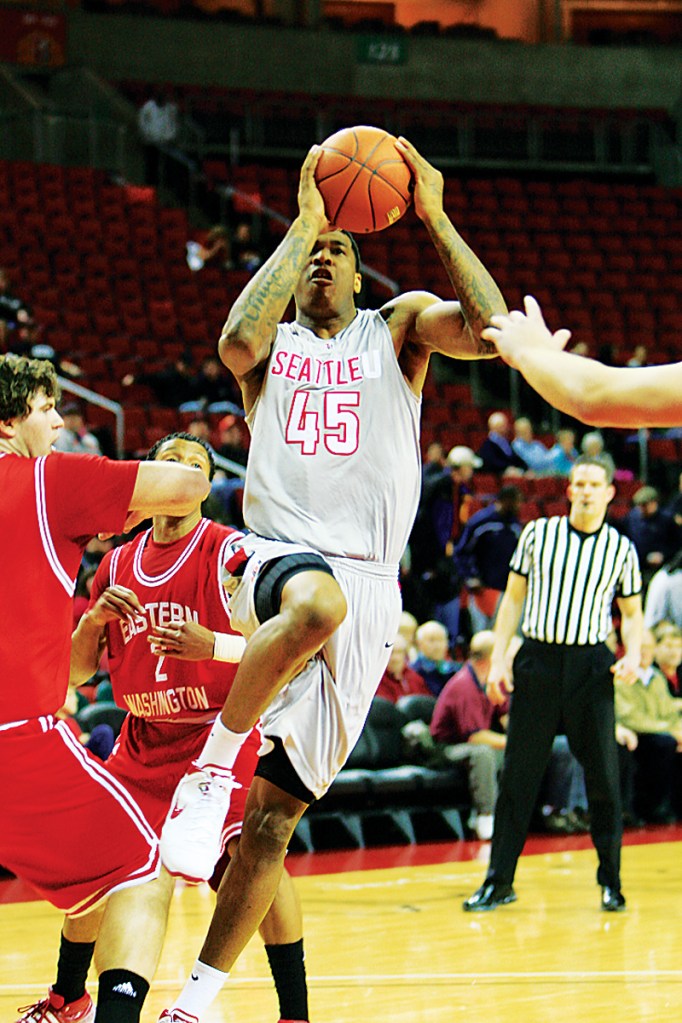
This season, Seattle U is playing its first all–Division I schedule in nearly 30 years. Thanks to the serendipitous presence of Chuck Garcia, a wiry, 6’10” forward with unusually good perimeter skills for a man his size; an NBA-caliber home court, KeyArena; and a high-profile first-year coach, former UW assistant Cameron Dollar (assisted by his father, Donald, an Atlanta coaching legend), the Redhawks’ return has been more splash than ripple. But as plush as KeyArena is, the fact that it’s not within walking distance of Seattle U’s campus, and its somewhat ambivalent student body, presents a serious hurdle. And at season’s end, Garcia will weigh the option of turning pro, where he is projected as a first-round draft choice. If he chooses to leave, it could take the air out of the early exuberance surrounding the program’s rebirth.
Like Baylor, Ernie Dunston starred at Spingarn before migrating west to Seattle U. He played forward for the Chieftains from 1960–63, starting alongside fellow Spingarn grad John Tresvant and Little Rock, Ark., native Eddie Miles, both of whom would enjoy eight-year careers in the NBA. Dunston remains in Seattle, and is as active an alumnus as they come, attending every Seattle U home game (as do the O’Briens) and most practices.
“It feels great,” Dunston says of the program’s return to Division I. “One side effect that’s quite nice is it’s brought so many people back, so many alums. We always said that would happen.”
“Tom Workman comes up from Portland for every game,” says Eddie O’Brien, referring to the former Blanchet High and Seattle U great from the ’60s who went on to a three-year NBA career. “The support from alums has been outstanding.”
O’Brien was summarily dismissed from his job as Seattle U’s athletic director when Fr. William Sullivan pulled the plug on the program in 1980. The university was in a financial bind at the time, and there wasn’t sufficient alumni representation on the Board of Regents to counteract Sullivan’s philosophy, which, as Dunston puts it, was that “big-time sports in college were not a good fit.”
“I knew it was coming,” recalls Eddie O’Brien. “We were dealing with an administration that wasn’t sports-oriented. Father Sundborg sees sports like I do: part of the overall picture. People connect back to their school through athletics. And it’s free publicity in a lot of ways.”
His twin brother, who after his major-league baseball career served as a King County Councilmember and helped run the Kingdome, concurs, offering an anecdote he heard at an event at which UW President Mark Emmert spoke. “[Emmert] said, ‘You know, the University of Washington has about 100 Rhodes Scholars, and I’ll bet none of you can name one of them,'” says Johnny O’Brien. “Whether you like it or not, the face of your university is athletics. The system may not be fair, but it does lead to a lot of things. From the time in 1980 to when we got back to Division I, we had no TV or radio or newspaper presence. Now every time we play, every media outlet in the country is reporting on Seattle U.”
Besides Sundborg, Dunston credits current Seattle U athletic director Bill Hogan with the program’s resurgence. Hogan spent several years in the same capacity at the University of San Francisco, a Jesuit institution that, like Seattle U, dropped out of Division I in the early ’80s despite a prestigious roster of alumni that included Celtic greats K.C. Jones and Bill Russell. (Fr. Sullivan’s influence was felt at USF as well: He was on that school’s board when it decided to drop down in class.) But USF swiftly re-entered Division I, and is now a member of the West Coast Conference (WCC), which many perceive as the most natural fit for Seattle University, currently an independent.
Hogan has been at Seattle U for three-and-a-half years, but says the momentum for the school’s return to Division I started approximately eight years ago, with firm backing from alumni and Sundborg. “If you want to be a premier institution, Division I is almost a requirement for Catholic schools,” says Hogan. “For Jesuit schools, all the ones who are thought to be the best in academics are Division I. So part of it is to take this wonderful school that no one knows about and give it exposure. We’re a vehicle for the nation to reflect on the university.”
The Redhawks have a losing record this season, a fact that would make it tough for fans of an established program to swallow the glass-half-full argument. But for Seattle U faithful, parched after 30 years without Division I basketball, the cup runneth over. Head coach Cameron Dollar is widely perceived to be the best recruiter in the city, and many were surprised when he took the Seattle U job instead of waiting for a more established school to come knocking.
“You have an NBA-caliber arena, a guy who could be one of the great college coaches, and a great tradition,” says Dave Grosby, the team’s radio play-by-play announcer. “In my opinion, you have the makings of wild, irrational success.”
Best known locally for co-hosting KJR-AM 950’s “Groz With Gas” sports talk show, Grosby began calling basketball games for Iona College when he was 15 years old. (Iona was then coached by future North Carolina State legend Jim Valvano, who looked after young Grosby when the team was on the road.) Grosby’s dad was also in the radio business, and his son eventually joined him in Sacramento, where the younger Grosby called Kings’ games and worked for the same station as Rush Limbaugh. Not yet a celebrity, the conservative talk-show host, as Grosby recalls, wasn’t a very good poker player, but always brought a bottle of bourbon to the weekly game, and was therefore considered indispensable.
After KJR cut his hours back in 2008, a friend suggested Grosby talk to Seattle U—not only about announcing the team’s games, but about purchasing their radio rights. He closed that deal and then struck another with 710 ESPN to air the games. Ironically, the Sonics’ departure has proved a boon to Grosby’s and Seattle U’s fortunes. Were the NBA still in town, the Redhawks likely wouldn’t have been able to sign a lease to play at KeyArena, and the demand to broadcast the games wouldn’t be nearly as great. And without the Redhawks playing at KeyArena, the Sonics’ former gym would be something of a white elephant for the city, which owns the facility.
“Without the Sonics leaving, it’s not the same opportunity,” says Grosby.
On December 17, Seattle U faced off against Oakland (Mich.) University at KeyArena. Oakland is a public institution near Detroit that entered Division I in 1999. When teams make such a move, the NCAA requires them to wait several years before they are eligible for postseason play, in order to ensure that the venture is legitimate. In Oakland’s case, this probationary period lasted three years; Seattle U will not be eligible for the NCAA tourney until 2013.
Oakland has made the NCAA tournament since entering the Summit League, and thus is a model SU hopes to emulate. But to do so, they’ll likely have to find a conference that will invite them to join, a cumbersome task given that conferences rarely solicit new members and that there’s no uniform process for doing so. In its heyday Seattle U never belonged to a conference, but successful independent programs these days are few and far between, with even Notre Dame joining the Big East—for basketball, anyway.
While it’s certainly not their only option (the Big Sky would seem a decent fit as well), Seattle U’s desire to enter the eight-team WCC is no secret. The conference almost exclusively comprises West Coast Jesuit schools, including Gonzaga. But WCC officials—in particular, Gonzaga head coach Mark Few—have expressed reluctance at the prospect of adding a team like Seattle U, for fear of watering down the conference’s power ranking, a key factor (based largely on the caliber of opponents a given team plays) for determining how many teams from a given conference make the 65-team NCAA tourney field.
“[The WCC] is concerned about bringing in a weak sister who would diminish the conference,” says Dunston. “[But the] selection of a coach is key to them, and I feel we really crossed that barrier with Cameron.”
Also at issue for Seattle U is the tepid support of its students. Often, even at home games, Seattle U students in the crowd are outnumbered by Seattle U students wearing numbered tank tops on the court.
“Half our students didn’t come here for Division I athletics,” explains Hogan. “They have a different attitude toward sports.” But alumni support has been strong. The Redhawks sold 2,700 season tickets this year—”more than anyone in the WCC except Gonzaga,” says Hogan.
Save for a handful of dates in the ’50s at the since-demolished Memorial Gymnasium, the Division I version of Seattle U has never played on campus. Instead, it’s occupied the old Civic Auditorium downtown, as well as the Seattle Center trio of Mercer Arena, the Coliseum, and now the Key. As when the Seattle Storm play, home games find the arena’s upper bowl cordoned off with black drapes, leading one to wonder whether a smaller, dedicated arena—a la Gonzaga’s 6,000-capacity McCarthey Athletic Center—wouldn’t be such a bad idea.
Sundborg has hinted at an interest in such a facility down the road, but the lack of available real estate in the densely populated area surrounding Seattle U’s campus would make a gym of any size hard to site. And Hogan’s quick to remind that urban Jesuit universities like Xavier in Cincinnati rose to prominence in large downtown arenas before building on-campus facilities on the strength of that fan base.
“Name me a finer college-basketball facility west of the Mississippi [than KeyArena], just for the basketball purist,” says Hogan. “KeyArena is special.”
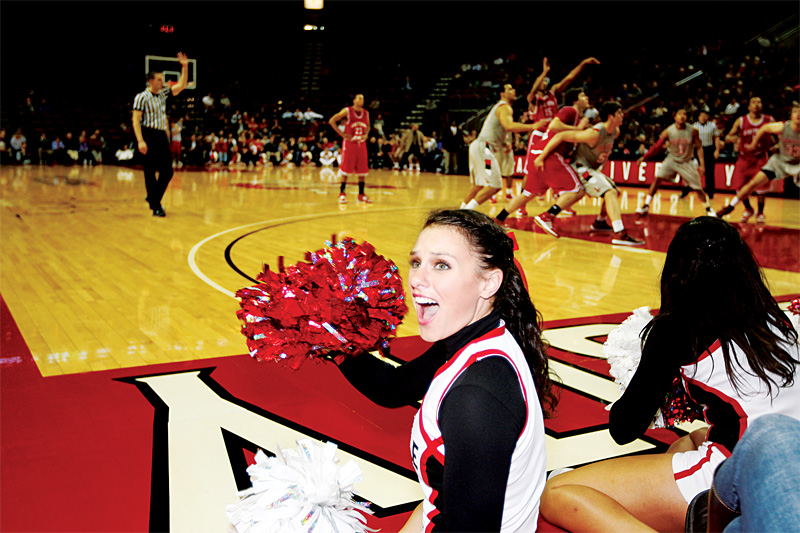
So too is the Redhawk experience, in every sense of the word. At times, it’s charmingly evocative of Will Ferrell’s ABA parody, Semi-Pro. Even with the black drapes, the Key is cavernous, making SU’s typical home crowd of 3,000 or so seem puny. The mascot’s outfit looks as if it had been stolen from the 1977 St. Louis Cardinals’ locker room after Keith Hernandez rolled around in the streets in it during a three-day Mardi Gras bender, and the individual inside the suit boasts all the energy of Jackie Gleason after his 12th Double Dickel on the rocks. One of the male cheerleaders claps out of rhythm, and bears a striking resemblance to Tattoo from Fantasy Island. And during the Oakland game, a participant in the half-court shoot-off had Down Syndrome, while the other shooter didn’t. That contest went precisely as you’d expect it to, with the Down guy’s shots rarely clearing the free-throw line, much less threatening the rim.
Similarly, at a break in action during a January game against Cal State Northridge, Seattle U’s director of ticketing, Matt Harper, came out on the floor with the Redhawk dance team, dressed in a blazer, tie, and sunglasses, reminiscent of a Blues Brother. On the arena’s stereo, the Buckwheat Boyz’s “Ice Cream & Cake” began playing, and Harper began dancing in the storied tradition of rotund men entertaining large crowds.
After the song ended, Harper exited to laughs and cheers, and the Redhawk P.A. announcer informed those assembled that “that’s what happens when you lose bets.”
Cameron Dollar was 4 years old when his mother, Faye, went out for groceries and never came back. Her dead body was later found in the trunk of a car in their hometown of Atlanta, and her murder has never been solved.
This left Donald Dollar alone to raise his two young sons, Cameron and his older brother, Chad. Absent Faye’s income as a teacher, Donald, a high-school physical education teacher and basketball coach who later became an assistant principal, took a second job working nights as a cook at Denny’s “to provide the style of living [my sons] were accustomed to before [their] mother died. It was rough, because we missed her, but we did a whole lot of things together.”
“He basically taught me that one person can do anything,” says Cameron. “My pops was mom and dad. I never felt like something was missing. He can sew, iron, fix the car. He’s the best cook I’ve ever met. I could say, ‘Pops, we’re gonna have 100 people over tomorrow,’ and he’d say, ‘No problem.'”
As a high-school coach in Georgia, Donald Dollar won more than 660 games and three state titles. He then moved to the college level, serving as an assistant coach at the University of West Georgia, as well as at his alma mater, Morehouse College. But despite his deep roots in the Peachtree State, Donald didn’t hesitate when Cameron asked him to take a job as his assistant coach at Seattle U, an extremely rare dynamic in sports at any level (vice versa, not so much).
Cameron enjoyed his most memorable game as an athlete at UCLA when he played a critical role in the Bruins’ victory over Nolan Richardson’s Arkansas Razorbacks in the 1995 NCAA championship game at the Kingdome. But once his collegiate career ended, Cameron, who looks and sounds like Chris Rock with a heavier midsection and drawl, had no interest in pursuing a professional playing career. Instead he became the youngest head coach in the country when he assumed the reins of Southern California College’s NAIA squad at age 22. He later joined the staff of Lorenzo Romar at Saint Louis University, and followed the current Husky coach to the University of Washington.
“[Coaching] is something he’s wanted to do since he was 4 years old,” says Romar, who was an assistant at UCLA when Dollar played there. “That’s not an exaggeration.”
Chad Dollar is also involved in the family trade, as an associate head coach at Arkansas State. “That’s all they were around was basketball,” says Donald Dollar of his sons’ upbringing. “I don’t know if they could be anything else [other than coaches].”
Dunston sees Dollar as “the number-one advantage” Seattle U will have over other schools going forward, and Eddie O’Brien feels that, under Dollar’s leadership, the Redhawks—whose middling record is nevertheless far better than most schools who’ve attempted similar jumps in class—are “ahead of the curve.” If Dollar makes good on his vow to stay at Seattle U “for the long haul” in the face of what are sure to be solicitations from more prominent programs, Hogan feels he could be to Seattle U what coaching legend John Thompson was to Georgetown University in the ’80s. (Thompson took a previously mediocre Jesuit program and turned it into a perennial national powerhouse now coached by his son, John III.)
“I was really happy at Washington,” says Dollar of his seven-year tenure as a Husky assistant. “I was not going to leave for a basic mid-major. This has the potential to match where I was, and I get to stay in an area that I love. The beauty of this job is [that] it’s uncharted waters; it’s limitless potential. And we’ve blown expectations out of the water.”
The Redhawks sprinted onto Elgin Baylor Court at KeyArena on January 19 intent on avenging a 98-90 loss at Cal State Northridge the week before. In the initial matchup, Chuck Garcia played one of his best games of the year, scoring 34 points, grabbing 14 rebounds, and making 12 of 18 free throws. He leads the nation in free-throw attempts, a testament both to his ability to beat defenders off the dribble and to the fact that opponents would rather try their luck with Garcia, a below-average free-throw shooter, at the charity stripe than give him a path to the basket.
In the rematch at the Key, Garcia missed his first four free-throw attempts before settling down and finishing the half with nine points, at which point SU trailed the visiting Matadors by four points. Saddled again with foul trouble, Garcia scored only four second-half points in what would eventually result in a 74-64 Redhawk win, but one basket exhibited perfectly why he is considered such a promising pro prospect after only one year of major college ball. Here, Garcia retrieved an errant Matador shot on the defensive end, then dribbled up the floor himself. Once across the center line, he drove hard with his left hand to the low block before coming to a dead stop, pirouetting, and laying the ball gingerly into the basket with his right hand.
Such agility is extremely rare for young, big players like Garcia, who considers small forward to be his most natural position. Despite the dexterity and footwork exhibited on this coast-to-coast conversion, those are precisely the areas where Garcia feels he needs the most work.
“My balance is number one, and even though they say I’m a good ballhandler, I need to improve,” says Garcia, whose favorite pro player is Denver’s Carmelo Anthony.
Happy as he is to have landed at SU, had Garcia had his way, he’d be a Dawg, not a Hawk. He accepted a scholarship to play for the University of Washington, only to learn in June that the school wouldn’t admit him, even though he’d met the NCAA’s minimum eligibility standards. He ended up falling into the arms of Dollar, the man who, as a Husky assistant, had been primarily responsible for recruiting him to UW—while the Huskies have gone on to fall short of preseason expectations, largely because they lack a player like Garcia.
The University of Washington cited privacy reasons in declining to specify why Garcia wasn’t admitted. Says Romar, “Chuck Garcia is one of the nicest young men I’ve ever met. He’s getting national acclaim and getting Seattle U’s program national acclaim. As devastated as I was not to get him, I couldn’t be happier for him. And I’ll leave it at that.”
When he found out in June that he wouldn’t be able to attend UW, “I thought my playing days were over,” says Garcia, who grew up in South Central Los Angeles. “I didn’t think another school would be interested in me, but then I got the phone call from Coach Dollar.” Garcia got a subsequent call from Syracuse, “but by then I’d already made my decision” to attend Seattle U, he says.
Lucky for the Redhawks: Aside from attracting attention from pro scouts, Sports Illustrated profiled Garcia for its January 11 issue, calling him “the best player in the country you won’t see—at least until June [the month in which the NBA draft is held].”
“When’s the last time SU was in SI?” wonders Hogan. “It’s probably been 30 or 40 years.”
Should Garcia choose to turn pro at the end of the school year, he is projected as a possible first-round draft choice. He admits he’s considering the option, promising only that he’ll be quick with his decision once the season ends.
Not surprisingly, Dunston and the O’Brien brothers think Garcia stands to gain a lot by returning for his senior year. “Charles eventually will be a very good player at a high level,” says Eddie O’Brien. “But I would hope he’d come back for a year instead of going pro. He tries to do too much, and his inexperience gets him in foul trouble.”
“I think he needs to stick around another year, and I think he will,” adds Dunston. “He really listens to the coaches, and has been learning about himself and his game. He can come back and really refine his game.”
Garcia’s game is indeed in need of polish. He’s prone to defensive lapses and asinine fouls; he’s sometimes slow to pass out of double teams and lacks a signature post move; and while the form on his outside shot is sound, he’ll need to connect with more consistency in order to garner regular minutes in the pros. But Garcia will likely be a high draft choice regardless of whether he sticks around—it’s the Seattle U program, still very much in its infancy, whose well-being hangs more precariously in the balance.
“A third of [Dollar’s] guys were recruited as Division II players,” says Grosby. Should Garcia stay, Seattle U will be a more attractive destination for Division I–caliber players by virtue of Garcia’s luminescence, and the program will continue to move forward as it rounds out its roster with similarly elite recruits.
“If he goes pro, hey, we’ve already produced a first-round draft pick,” adds Grosby. “And if he stays, they’ve got a stud to build around. In basketball, unlike football, you can win with one or two special players. The tail can wag the dog.”
But without that special player, Seattle U could be in for a dog day afternoon, at least in the near term.
On January 6, Seattle University traveled to Corvallis, Ore., to face Oregon State University of the mighty Pac-10 conference. The Redhawks entered the game as heavy underdogs against the Beavers, who are coached by Michelle Obama’s brother, Craig Robinson—one of the few people in the world who can show up unannounced at the White House in the middle of the night and gain entry simply by telling a Secret Service agent “Hey, it’s cool—I’ve got a spare key.”
In the crowd that night were nine professional scouts (including Celtic general manager Danny Ainge, a starting guard on Boston’s championship teams in the ’80s), there to assess Garcia’s NBA potential. They would not see much of him: Garcia got into early foul trouble, and was thus relegated to the bench for most of the game, leaving the challenge to his undersized teammates.
Eddie O’Brien was among a group of diehard Seattle U fans racing home to watch the second half of the game in Seattle on Fox Sports Northwest, a rare opportunity to catch the team on television. When somebody informed O’Brien, still en route to his TV set, that the halftime score was 41-27, his earnest response was, “Great, we’re only down by 14.” As it turns out, the Redhawks were up by 14. But when Garcia picked up his fourth foul a couple minutes into the second half, O’Brien and his Redhawk kin braced for the inevitable collapse.
They got their collapse, all right. At game’s end, the scoreboard read 99-48—in favor of Seattle U. The loss marked Oregon State’s worst margin of defeat in the program’s 109-year history, and the most startling Redhawk victory since the Flyin’ O’Briens outfoxed the visitors from Harlem.
After that win, the Redhawks would lose two games in a row, causing Dollar to remark that he was “disgusted” with the way his team responded to the lopsided victory. Still, he was somewhat understanding. “I guess nobody knows how to act after beating a team by 51,” he remarked after a recent practice.
Yet the Redhawks would bounce back, winning consecutive games against Utah Valley and Northridge heading into a January 26 date with the Huskies at Hec Ed. The year prior, Seattle U had played the Huskies on the same floor after UW’s previously scheduled opponent scratched. Without Garcia, who was in junior college at the time, the Redhawks were beaten by a score of 87-60.
A couple weeks before the game, Hogan remarked that he felt the Redhawks were a year away from being truly competitive with UW, whose players he deemed too athletic for SU to handle. Romar, however, wasn’t so sure. “We played Oregon State at home, and it was a four-point game or something [UW actually won by six],” said the Husky head coach. “They went into Oregon State, and it was a 51-point game. [A fierce rivalry] could be here quicker than people think.”
Romar would be squaring off against his former assistant, Dollar, for the first time. After seven years on the Husky sideline, if anyone knew UW’s system inside and out, it was Dollar. What’s more, before tip-off, it was announced that UW’s second-leading scorer, the pinball-like guard Isaiah Thomas, would miss the game due to illness, further buoying SU’s hopes for their third shocking road upset of the season (they knocked off the University of Utah in Salt Lake City in late November).
But it was not to be. The Huskies jumped out to leads of 18-0 and 30-3, and forced the Redhawks’ guards into so many turnovers that Garcia was pressed into bringing the ball up the floor himself. With an offense devoid of set plays and no matchups to exploit, the Redhawks’ best bet was to let Garcia try and bull his way to the basket. Each time he strode to the free-throw line, the Husky student section took the opportunity to loudly needle him for his perceived lack of smarts, either by chanting “SAT! SAT!” or by singing the alphabet, kindergarten-style.
The Redhawks finished the game with just four players on the floor, as six others had fouled out. At the final buzzer, the score read 123-76, with Garcia accounting for 20 of SU’s points. A mere 20 days after beating Oregon State by 51 points, the Redhawks had lost to the University of Washington by 47.
In spite of such setbacks, there’s something about cheering for the Redhawks that gives one the feeling of getting in on the ground floor of what could turn out to be a very hot stock. There’s Garcia, for one—hopefully, for one more year. Then there’s Dollar and his frenetic style of play, reminiscent of Nolan Richardson’s pressing, trapping, “40 Minutes of Hell” scheme that launched Arkansas’ program into prominence.
It might be a little rough around the edges now, but it’s undeniably compelling. Imagine inheriting a cherry ’65 Mustang that hasn’t been started in 30 years. That ride will be sweet once you get it running, and nobody doubts Dollar has got the tools.
Parisa Sadrzadeh contributed to this report.
Seattle University plays its next two games at KeyArena against Sacramento State on Feb. 13 at 1 p.m. and UC Davis on Feb. 16 at 7:10 p.m.
The Harlem Globetrotters play at KeyArena on Feb. 21 at 2 p.m. They will not be playing Seattle U.