Cover Story: Critical Mass
Published 8:00 am Tuesday, November 17, 2009
The National Center for Atmospheric Research’s Mesa Lab sits high in the foothills of Boulder, Colorado, but it feels as though it sits atop the world. The building itself, designed by the Chinese-born architectural titan I.M. Pei and used as a location in Woody Allen’s Sleepers, is considered a modernist masterpiece, its aesthetic a cross between Stonehenge and Kubrick.
Such majesty, however, seems unimportant to the six dozen scientists assembled in a windowless lecture hall a few steps up from the Lab’s main entrance. For two days in September, they’ve come from all over the world to Boulder for the “National Workshop on Mesoscale Probabilistic Prediction,” a title that boasts a sex appeal roughly equaled by the image of John Goodman in a leather unitard. But the serious name points to serious business: Those gathered are participating in the meteorological community’s equivalent of a G8 Summit, where what’s being wrestled with is nothing short of a potentially landmark change in the way weather will be predicted in the United States.
At the front of the room is Don Berchoff, Director of Science and Technology for the National Weather Service, a governmental subsidiary of the National Oceanic and Atmospheric Administration (NOAA). “Number one is, leave your baggage at the door. Because quite frankly, that’s not going to get us where we want to go,” Berchoff admonishes the attendees. “Number two is, figure out how to work together as a nation. We have an American way of doing business; we’re all individuals and we’re all competitive. The reason why Europeans beat our pants is they know how to work together better.”
Berchoff then asserts that the United States will ultimately overtake Europe as the leader in the meteorological field, drawing a chuckle from the crowd, which includes a significant number of foreigners.
“It’s more than just saving lives,” Berchoff continues. “It’s about how we can help our businesses and government save money by avoiding the weather. Can you imagine if we could forecast a thunderstorm within a 10-mile radius with 70 percent probability? Do you know how powerful that would be?”
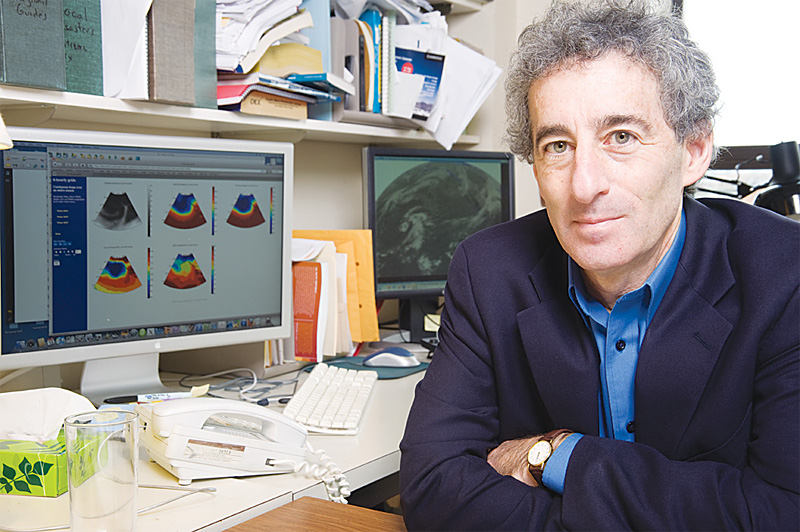
Berchoff cedes the podium to his co-chair, Cliff Mass, an atmospheric sciences professor at the University of Washington. Dressed in a blue blazer, a button-down shirt, khaki pants, and cushioned loafers, and boasting a shock of curly, salt-and-pepper hair with a mind of its own, Mass looks every bit the stereotypical college instructor. The theme of his chat is effectively the theme of the entire workshop: whether, how, and how soon the National Weather Service and the American meteorological community at large will move from a largely deterministic model of communicating weather forecasts to more complex, computer-driven “probabilistic” models.
“The time for concrete action has come,” announces Mass in his deep, swift, Gotham-tinged vocal delivery. “Let’s face it: This is our health care.”
He continues his presentation by cuing up a slide of a recent five-day deterministic forecast from KING-5, deriding its simplicity in a mock-weatherman voice. But before finishing, Mass aims his critical bazooka at his brainy colleagues. “Even when we try to provide probabilistic information, we’re not doing a good job,” he says, citing a shortage of technological firepower and institutional open-mindedness before classifying the U.S.’s lost leadership in its homegrown field of weather prediction as “an embarrassment.”
Such is the unflinchingly candid manner in which Mass gets his point across, a style gleaned from the famed astronomer Carl Sagan, whom Mass studied under at Cornell and whom he considers “the best communicator I ever met.”
“One thing [Sagan] felt strongly about was scientists shouldn’t just write papers; we have to interact with society and the media,” says Mass.
And interact Mass has. He delivers a weekly forecast every Friday on KUOW, and has helped develop a local, Web-based version—called Probcast—of what he feels should be the national standard for weather prediction. His frequently updated personal blog, cliffmass.blogspot.com, has developed a large, devoted following, and his 2008 book The Weather of the Pacific Northwest—which looks like a textbook, is titled like a textbook, and reads like a textbook—was a local best seller. Furthermore, he’s become a go-to meteorological authority for worldwide media such as The New York Times and The Economist.
That the Emerald City is home to one of the country’s foremost weather academics is very Seattle. Yet stylistically, the Long Island–reared Mass is anything but. A passionate “math activist” who would like to return to the days of calculator-free “explicit instruction” in elementary, middle, and secondary schools, Mass and a pair of co-plaintiffs currently have a lawsuit pending against Seattle Public Schools, in which they claim the District’s shift to a “Discovery Math” curriculum has widened the achievement gap between Caucasian and minority students. (A January court date has been set.)
“Instead of getting the answer right, it’s far more important to write an essay about your thought process,” says Mass of an instructional movement he claims has led to a severe deterioration of math skills among his collegiate students. “I’ve had students in my office crying because they’ve had to give up their dream of becoming meteorologists. They couldn’t pass the math. The most demanding aspects of my field are being dominated by people overseas.”
When it comes to weather, Mass seizes every opportunity to needle broadcast news and National Weather Service forecasters, whom he views as stubborn and prone to hyperbole. “A ‘not invented here’ attitude is something that’s pervaded the National Weather Service for too long,” says Mass, seated in his office on the UW campus. “For too long our profession has thought too small. It’s a sign of a deeper American malaise. We’ve gotten kind of soft. The way our nation has gotten away with it is we’ve imported people from overseas, but the day’s going to come when people don’t want to leave China anymore.”
But to view these entities as Mass’ enemies is far too simplistic—he’s more like a hard-ass football coach who curses his players on the practice field only to hug them in the locker room after the game. And thanks to a perfect storm on the national political front, it’s a game Mass finally feels he can win.
“You want to see some computers?!” Mass exclaims, having just finished his lunch in an on-site cafeteria at the Mesa Lab.
He walks to the building’s basement, to a window through which stack upon stack of processors is visible. He stares at them proudly, as though they were his offspring—if Mass were to design his ideal sentient being, it would undoubtedly be a robosapien. (UW has its own micro-version of the NCAR’s setup on the fourth floor of the Atmospheric Sciences Building, an apparatus Mass claims is “the greenest on earth” due to its air-cycling system.) Each machine is busy gauging a specific weather variable that might feed into an ensemble forecast, which is formed by pulling in a number of data points to nurture a meteorological prophecy of far more range and texture than we’re used to consuming on the evening news.
Such is the foundation upon which Mass’ favored probabilistic forecasts are built. A deterministic forecast, in its crudest form (and the boiled-down nightly network forecast is its crudest form), might tell us that tomorrow it’s going to be 49 degrees with a chance of rain. Meanwhile, a probabilistic forecast would tell us that: a) the daytime high is likely to be 49, but could be as high as 52 or as low as 46, and b) there’s an 85 percent chance of a rain accumulation between .49 and .78 inches. (This was the actual forecast posted on UW’s probcast.com for the 98105 zip code on November 6. In fact, the temperature and precipitation that day for that zip was 51 degrees and .34 inches.)
As the lunch hour draws to a close, Mass loiters in the stairwell leading back to the room in which the workshop will soon resume. Surrounding him is a mounted photo essay of how the Pei-designed jewel within which he stands came to be, yet all Mass is interested in doing is shooting the shit about the Colorado weather with a nearby cohort.
We all shoot the shit about the weather from time to time. It is, in a sense, the common thread in our lives, the one thing that two unfamiliar people who meet in an otherwise unoccupied elevator will be able to converse about on a level intellectual plane. While weather may affect us differently—residential elevation, form of employment, and mode of transport being three of many variables in play—it affects us all. Of just about nothing else on earth can that be said.
But for some folks, weather is an obsession. And for a guy like Cliff Mass, who as a small boy relished neither Tonka trucks nor baseball but “heavy rain,” it’s the core of human existence.
“A lot of meteorologists love intense weather. There are a lot of people who do too,” says Mass. “Weather is almost religious. It’s a good way to break the ice, certainly, but I think it’s more than that. People love watching weather on cable TV, and [network affiliate] news directors all tell me that their #1 draw is weather. Weather is bigger than we are; people are moved by it.”
Weather is wet, dry, cold, warm, and windy. But it’s also critical to the economy, national security, and human safety. Predicted in an accurate and timely manner, weather can save time, money, and lives.
Nobody articulates the practical consequences of weather prediction better than Don Berchoff. A career Air Force forecaster who only recently assumed his lofty post at NOAA/NWS, Berchoff met Mass on a recent visit to Seattle, where it was announced that Sen. Maria Cantwell had secured federal funding to begin work on the Washington Radar, a coastal weather gauge that Mass and his Northwest meteorological colleagues have long lobbied for, often browbeating the federal government in the process.
“Cliff has been very vocal about the radar in the past, and that our modeling efforts at NOAA have been lagging behind the rest of the world and that we haven’t been inclusive. There’s some truth to that, but it’s not totally true,” explains Berchoff, who’s based in the D.C. area. “I made a commitment when I went [to Seattle] that I was going to get to know Cliff better. We built a relationship, and I came to know Cliff as a passionate guy. He’s originally from New York; I’m from New York. So we understand each other. I decided I was going to work with him, because we have a lot to gain from his insights. Over time, we decided the best way to start the process was through the Boulder workshop.”
By workshop’s end, the group agreed to author a white paper that would establish a timeline for a wholesale national shift to probabilistic forecasting. Of this movement, says Berchoff, “I think the stars have all aligned, but we’ll see: A lot of this ensemble forecasting takes some high-capability computing. And generating the funds we need to develop those capabilities is tough in this budget environment.” (At the workshop, Mass remarked that “$5 to $10 million will do the job.”) “[But] if you can convince people that an investment of $500 million will generate $20 billion of savings to the U.S. economy, they might listen to that.”
Weather prediction’s impact reaches across the economic spectrum, and a cottage industry—one rooted in ensemble methodology—has sprung up to provide ever-more-sophisticated data to inform big-money decisions. Explains Berchoff: “Let’s say there’s an energy company trying to get into renewable energies. The profit margin is tight because the technology’s not cheap yet, and it’s not fully available. The biggest challenge they have is [that] if you build your company around renewable energy, you’re dependent on the weather; you have to know whether you’re going to be able to generate power or not. So if I tell you there’s an 80 percent chance that your wind speeds are going to be sub-optimal, that may cause you to go buy some fossil fuel on the spot market. If we’re accurate, you’re going to be able to make a decision to buy fossil fuel at a little cheaper cost because you knew [in advance]. But if we make a bad forecast, you just bought fossil fuel that you didn’t need to buy.”
As for aviation, Berchoff says, “There was a $41 billion cost to the aviation sector last year due to weather delays. Of that $41 billion, the FAA says that $28 billion was avoidable. A lot of big airlines will look at the probability of a storm in, say, Atlanta, and make decisions about whether they’ll cancel all their flights the following morning. If that storm occurs, they’ll have saved a lot of money they would have spent on putting people up at hotels, fuel, lost work hours, et cetera.”
On the topic of national security, Berchoff cites an example from his own career. The military needed to get some helicopters from Fort Campbell (Tenn.) to Afghanistan to provide air cover and transport for a stranded battalion. Recalls Berchoff, “This aircraft, a C5, was going to pick up the helicopters. We realized there was no de-icing equipment at Fort Campbell, and that an Arctic air mass was coming.” So Berchoff and his colleagues persuaded the commanding general to delay the arrival of the C5 by three hours to allow the freezing rain to pass. “If we had not convinced him that weather was going to occur, that C5 would have been trapped on the ground.”
On his Friday-evening ride from campus to his home in Matthews Beach, where he’s due for a family dinner with his wife and adult son (he has one other grown child), Mass stops for tea near University Village, pulling up to Tully’s on an old Raleigh bicycle “that’s good in the rain.”
Mass completed his undergraduate studies at Cornell, where Carl Sagan taught at the time. At the late astronomer’s behest, Mass embarked upon a project in which he changed the parameters of the earth’s atmosphere “to make it Mars,” which resulted in a published paper authored by Sagan and his prize pupil. When it came time to choose a graduate school, Mass had to decide between MIT and the University of Washington. When he informed his mentor that he was going to MIT, Sagan told him he’d made “the biggest mistake of his life” and urged him to reconsider. Mass did, and ended up at UW.
“The beauty of being in Washington as a meteorologist is you’ve got everything,” says Mass. “We have to deal with everything, from deserts to rain forests. It’s a great place to be a meteorologist and test computer models.”
Chief among these models is Probcast, a forecasting venture funded by the National Science Foundation, which also sponsors the National Center for Atmospheric Research. (Mass’ various professional interests compel him to travel to the Boulder facility two or three times per year.) Every month, Mass and his “uncertainty group” meet at UW to discuss research developments and how they might serve to improve Probcast. The group consists not only of meteorology instructors and students but of individuals across a range of disciplines, including psychology, physics, and statistics. So important is this academic diversity to the Probcast model, and to UW’s meteorology matrix at large, that uncertainty group members Susan Joslyn (a psychology professor) and Adrian Raftery (a statistics expert) also made presentations at the NCAR workshop in September.
The room at Padelford Hall in which the group meets on a recent Tuesday afternoon is sweltering, to the point where Mass removes his sweater almost as soon as he sits down. His hair is even more unruly than usual, and he opens the meeting by debriefing the group on a recent meeting concerning potential Green River flooding and the damaged Howard Hanson dam.
“It’s political; it’s gone wild,” says Mass of the dam, a hot subject of debate in the recent race for King County Executive. “We should have a special page on Probcast for the dam—we’d get a million Web hits per day.”
But alas, while the group pledges to do something along those lines, it’s not what they’re funded for. Rather, preventing American citizens from being unduly affected by catastrophic events fits neatly into the Weather Service’s mandate. This helps explain why, in Mass’ opinion, the Weather Service tends to over-forecast precipitation and other extreme weather conditions: to elicit a cautious response from the public it serves.
Absent a similar mandate, Mass is a scientist whose goal is absolute accuracy, and he doesn’t consider televised newscasts, with their false sense of certitude, to serve that purpose. “Sometimes we’re sure and sometimes we aren’t, and we don’t convey that very well,” he says. But nothing gets Mass’ ire up like flat-out hyperbole, as evidenced by a now-infamous August blog post in which he dressed down KING-5 reporter Jim Forman for his theatrical reports during abnormal weather occurrences. Through KING’s publicist, Forman declined to comment for this story, though KING meteorologist Jeff Renner, a longtime friend of Mass who provided a jacket quote for his book, says: “I’ve known Cliff for too many years to take it very personally. In talking to Cliff after that, and sharing with him that it was not a very universally well-received comment, I think he realized he doesn’t have the same appreciation you and I would have, being in the media, about how a single comment can get very wide distribution immediately with the Web.”
Mass was also stung by a recent Seattle Metropolitan article that cast him as Muhammad Ali to Brad Colman’s Joe Frazier. Colman, meteorologist-in-chief at NOAA’s Sand Point Weather Service Office, and Mass have their philosophical differences, to be sure. But a deep mutual respect exists between them. To wit, Colman also provided a jacket quote for Mass’ book, and was among a small handful of colleagues whom Mass asked to review the text before it was published.
“We have a good, healthy relationship,” Colman says. “When I went to grad school, I was taught that you need to challenge and look for weaknesses. Every good scientist has that element in them—they don’t just accept things at face value. You have to poke and push, and often that will lead to some level of conflict and disagreement. [Cliff and I] challenge each other, but it’s a healthy challenge. [Cliff has] made a huge impact on Northwest weather and forecasting, and he’s a great asset to us. He has his show [on KUOW] on Fridays and his blog, and the more people understand about the weather, the easier our job is. But that doesn’t mean we always agree.”
One area where Colman and Mass differ has to do with the role of the human in modern-day forecasting. Mass’ philosophy is that humans exist to help make computer models more powerful and accurate, whereas Colman effectively feels it’s the other way around. Diametric as they may sound, these two positions really aren’t all that far apart: Mass simply believes in giving machines freer reign than Colman feels they’re currently equipped to handle.
“[Probabilistic forecasting] is absolutely the way to go, but it’s hard to get there,” says Colman. “And the probabilities you get out of an automated system are not very good yet. At UW, where you bring statistical applications into the data, that helps. And in terms of how you deal with uncertainty, if you communicate that there could be anywhere from one to nine inches of rain, in some ways that’s an impediment to people who need to make decisions, because the uncertainty sort of paralyzes them.”
“In terms of delivering information to the user, there’s a lot of it that includes human sociology,” continues Colman. “How do you communicate the information so that people can make decisions? Whenever you deal with human nature and decision-making, it’s more complicated than hard-core science. How do you map that hard science into the Weather Service’s mandate from Congress: protection of life and property?”
That’s a question perpetually taken into account by Mass and his uncertainty group. In fact, it essentially explains why Joslyn—who oversees research, sometimes conducted through surveys on Mass’ blog, which seeks to ascertain how subjects respond to different types of probabilistic forecasts—sits at the head of the table. Probcast remains a work in progress, one of whose goals is to convince people that the brand of “uncertainty” they’re selling is more akin to “accuracy” than to the commonly understood definition of uncertainty.
“I think it’s a big challenge [to distill probabilistic information into an easily consumable form],” concedes Mass. “[People] might not have the time. It’s too much information to get a lot of it on TV.”
Which is kind of the point. Mass, by his own admission, considers network news an imperfect vessel for the modern weather forecast and all its nuances. But unless those nuances are communicated effectively, they tend to come across as “extra noise,” says the Weather Channel’s Bruce Rose. (Rose was the only media participant at the Boulder workshop.)
Probcast provides weather forecasts by zip code, and those forecasts can differ significantly even within the Seattle city limits. For instance, on the same day (Nov. 6) that Probcast predicted up to .78 inches of rain for the 98105 region in North Seattle, it surmised that the 98106 region in West Seattle could get more than an inch. Hence, says KING’s Renner, “Probabilities are a little less useful in areas like Washington due to the sort of weather we get within a short distance. Over a very short distance, we have a variety of probabilities to express. Having said that, I think there are some very good things that they’re doing with Probcast. I think the idea of giving a range of forecasts over time is an excellent one.”
The challenge of molding such a plethora of raw data into something the public can benefit from is precisely why Colman feels the human’s role in forecasting remains as critical as ever. “I think the job is more important today than five or 10 years ago,” says Colman, who cut his teeth as a Weather Service intern in Juneau, Alaska, in the mid-’80s after earning his doctorate from MIT. “We’re the interpreter. Cliff, he doesn’t work in the operational area. He hasn’t experienced firsthand where we have these conversations and hear back from emergency managers about how helpful our process is. He looks at how good his models are, and that’s where it ends. And I can appreciate that; he’s not on the front lines. But I certainly have a great deal of respect for Cliff.”
So does longtime KOMO-4 weatherman Steve Pool. When Pool decided to make the shift to his current prime-time role more than 20 years ago, the station enlisted Mass to give him a crash course in the discipline. Mass was paid for his services at first, but continued to work with Pool beyond the term of his agreement with KOMO, starting Pool off with an accelerated version of his Atmospheric Sciences 101 class before eventually advancing to the interpretation of computerized weather models. “He picked it up very quickly,” recalls Mass of his now-famous pupil, with whom he remains in close contact despite the barbs Mass constantly hurls at Pool’s corner of the meteorological field.
“Cliff Mass, in my life, he sort of borderlines on guru,” says Pool. “He pretty much taught me everything about forecasting. We have an internship program at KOMO, and basically what I say is, ‘Cliff, send me your best student.'”
Mass’ relationship with Pool provides a glimpse into how Mass quietly reconciles his ideology with reality, as he’s schooled Pool on the premise that the public is interested in more than drive-thru, super-sized meteorology. “Cliff and I talk about how to take forecasts and put them into a form that folks can utilize for their own purposes,” says Pool. “The perception of the public is slowly changing. I’ve had more people come up to me in the past couple years and say, ‘Y’know, you guys are getting a little better.’ What happens many times with TV weather is people tend to overhype things. I think you get sort of an immediate bump in ratings if you stand in a spot that’s windy and make it look windier than it is. I think in the long term, that works against you. Don’t underestimate how intelligent the audience is. They know.”
The weather in UW’s Red Square on October 1 is 55 degrees and cloudy, quintessential for Seattle in early autumn. But inside Kane Hall, it’s incredibly muggy, to the point where Mass tells the couple hundred students who’ve gathered for his Atmospheric Sciences 101 lecture to “pretend you’re in Hawaii.”
It would be easy for someone like Mass to abandon the teaching of weather at its most rudimentary, to instead float above it all as a nationally recognized meteorological guru who gives good quote and immerses himself in high-profile research and position papers. But to abandon 101 would be to turn his back on the sort of public presence espoused by Sagan, his mentor.
It is this code of interaction that explains in part Mass’ continued involvement on the math-activism front. A few years ago, upon sensing a pervasive downgrade in math skills among his 101 students, Mass began to administer basic aptitude tests to these pupils, and was horrified by the results. Hence, Mass helped jump-start the local chapter of the advocacy group Where’s the Math?, which scored a victory of sorts when former superintendent Terry Bergeson, who declined to comment for this story, failed to win re-election in 2008.
Bergeson, in the group’s eyes, resisted a mandate by the state legislature to establish heightened math standards in favor of sticking with Discovery Math, and was a slave to the WASL. Activist Dan Dempsey, a retired West Seattle High School math teacher who now lives in Lacey, went so far as to file a lawsuit against the state Office of the Superintendent of Public Instruction, which was thrown out last month by an otherwise sympathetic Thurston County Superior Court judge.
“Cliff brings a lot of credibility to what we’re doing, because Cliff is someone who’s watched and documented the decline of math competency at UW,” says Dempsey, who’s active with Where’s the Math?. “He was the first person to bring that to the forefront. The point he was making is, this is the pinnacle of public education in the state, we have a higher and higher GPA requirement to get in, but the math competency has deteriorated. And you can throw that right at Terry Bergeson.”
While Dempsey, Mass, and others are disappointed that Bergeson’s successor, Randy Dorn, has not gutted holdover staff, it’s impossible to deny that the new superintendent is a more compassionate ear. He’s made good on his promise to ditch the hated WASL, for one, and gives Where’s the Math? credit for “forcing the debate.”
“I definitely believe in more traditional math in schools,” Dorn adds.
Whereas Mass will have to content himself with incremental progress on the math front, he is currently enjoying clearer skies when it comes to weather. The relationship he’s forged with Berchoff has led to a “tremendous breakthrough” in UW’s interaction with the Weather Service.
“They didn’t want to talk to us before,” says Mass. “But now they want our code. We’ve been trying to get that for 10 years.” What’s more, Berchoff has appointed one of Mass’ former UW students, Tony Eckel, to be the Weather Service’s “uncertainty czar.” Eckel will soon move back to Seattle to fulfill that role.
As if that weren’t enough, the Northwest weather community stands to benefit from a geographic power “trifecta,” as Mass puts it. The director of the NOAA is from Oregon, and Commerce Secretary Gary Locke is a former Washington governor (the NOAA falls under Commerce’s jurisdiction). And perhaps most important, Cantwell, with whom Mass has forged a strong working relationship, chairs the Senate’s Oceans, Atmosphere, Fisheries, and Coast Guard Subcommittee.
“The Washington Radar exists because of her,” says Mass, alluding to Cantwell’s earmark. “I like her a lot. Her people take it seriously, and she’s up on it.”
When you ask Mass what he’s up on besides math and meteorology, he rattles off a list of typical Northwest hobbies: hiking, biking, and gardening. Mass doubtless derives satisfaction from these activities. But they’re a thin veil for the truth: Mass is a man whose occupation is his hobby.
“I’m blogging at 10 at night,” he says. “It doesn’t wear me down. I wish I had more time to do things as well as I’d like them to be.”
To wit, back at Kane Hall, Mass is conducting an experiment to illustrate what atmospheric pressure is. He pours a small amount of cold water into a “pre-drunk” can of Diet Coke, which he then heats on a hot plate. Only the hot plate’s not as hot as Mass would prefer, and his microphone keeps cutting in and out.
“I’ll tell you, the budget cuts in this place,” Mass quips. “This is the worst hot plate.”
He forges on anyway, turning the can on its head in a pool of hot water, which causes it to cave in. His students cheer, but Mass remains unimpressed. “If you really get [the water in the can] boiling, the cans are completely crushed.”
Mass teaches for a few more minutes before the closing bell rings. As his students pour out into the elements, Mass decides to give the can-and-burner experiment one more go. This time the burner reaches what he considers an adequate temperature, and the can is flattened upon contact with the cold water. Mass lets out a loud, satisfied laugh, oblivious to whether anyone else is still watching.