The Flip Side of Sustainable Sushi
Published 7:00 am Wednesday, July 29, 2009
Given that a) Seattleites are sushi-crazy, b) the city is filled with sustainability fetishists, and c) we have easy access to some of the best-managed fisheries in the world, you’d think sushi chefs and sushi diners would be engaging in battles of one-upmanship to show off their commitment to green eating. But sushi appears to be a blind spot in our environmental consciousness. Walk into any sushi restaurant in the city, from Wasabi Bistro in Belltown to Madison Valley’s Nishino, and you’ll spot perilously endangered species on the menu: bluefin tuna belly (O-toro), yellowtail (hamachi), freshwater eel (unagi). Indeed, these species are endangered precisely because of the world’s growing demand for sushi.
“There’s no question in my mind that the sushi industry is extremely misguided and lost,” says Casson Trenor, senior markets campaigner for Greenpeace and author of the recently published Sustainable Sushi: A Guide to Saving the Oceans One Bite at a Time. Several months ago, the World Wildlife Federation released a report estimating that if we don’t change the pace at which we’re fishing bluefin tuna—the kobe beef of the sushi world—the population will disappear in three years. Britain, France, and Germany have already said they’re planning to reclassify bluefin tuna as an endangered species, but neither the Japanese nor the U.S. government seem eager to join them.
Trenor’s book is just one of a number of sustainable-sushi guides published in the past two years. The Monterey Bay Aquarium (seafoodwatch.org), Environmental Defense Fund (edf.org/seafood), and the Blue Ocean Institute (blueocean.org/sushi) have all created guides for diners to take with them to sushi restaurants. But we’ve grown accustomed to hearing dire predictions about the oceans’ health, and most of us contemplate the prospect of comparing a long menu against an equally long list of dos and don’ts and go blank.
That’s why Trenor, a Mukilteo native and alum of University Prep in Wedgwood, has augmented his activism with entrepreneurship. In January 2008, he partnered with two chefs to open Tataki in San Francisco’s Pacific Heights neighborhood—credited with being the first sushi restaurant to guarantee that 100 percent of its fish come from sustainable sources. It has garnered not only decent press but a large regular clientele.
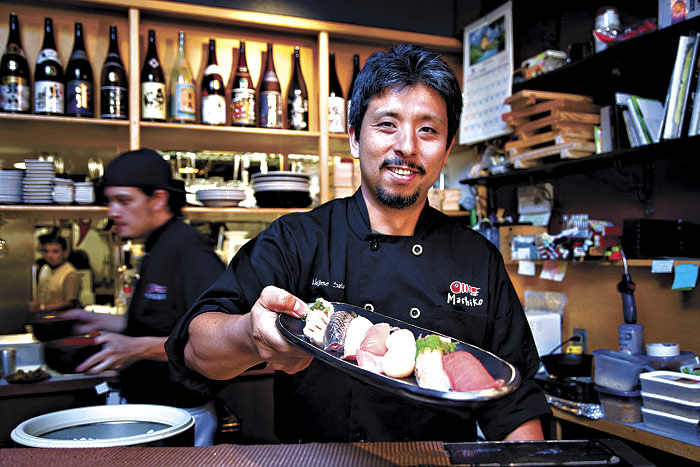
Now, in his second partnership, Trenor is returning home to do the same. He’s been working with Hajime Sato, owner of the 15-year-old Mashiko in West Seattle, one of the city’s most respected sushi purveyors, to revamp its offerings. They will launch the new menu August 15. “This is a pincer attack on the industry,” Trenor says. “We’re creating sushi restaurants that don’t allow diners to make mistakes.”
Sato seems a fitting candidate to take this step. A classically trained sushi chef from the outskirts of Tokyo, he has cultivated a reputation for being whimsically outrageous. His restaurant’s url is sushiwhore.com (his contact e-mail is sushipimp@sushiwhore, natch), and it’s as famous for issuing offbeat rules on the entryway chalkboard (“Soy sauce is not a beverage”) as it is for serving creative American-style rolls like the Ultraman (tempura onion, cucumber, seared tuna, spicy mayo) and the Southern (avocado, fried sweet potato, eel on top). This is a man who respects the rules and flouts them at the same time.
Sato first met Trenor in April of this year at a sustainable-sushi meal that Trenor put on, along with one of his San Francisco partners, at Diane’s Market Kitchen, a small downtown cooking school. (See our Best of Seattle profile.) What inspired him most about Trenor wasn’t his ideals so much as his economic success with Tataki. The two of them worked out an agreement, which Trenor stresses is independent of his work with Greenpeace, to transform Mashiko into a 100% sustainable sushi restaurant—the first one, Sato points out, to be run by a Japanese sushi chef.
Trenor is supplying Sato with the research findings and contacts he needs to replace unsustainable seafood with better choices, and demands final say on all Sato’s sourcing decisions. Mashiko ended up revamping a third of its menu items, including some of its best-known dishes. Part of the strategy was to find substitutes for the best-loved classics.
“For example, Mashiko’s signature dish was its ankimo, or monkfish liver,” says Trenor. “But monkfish is severely overfished, a red-list item on the Monterey Bay Aquarium Seafood Watch. But Hajime is good at working with the liver, so what does that mean for us? We asked what other potential fish with similar physiologies could have livers with the same qualities, and ended up using liver from local sablefish—it has a similar diet and similar habits to monkfish, though it’s totally unrelated. The liver tastes a little different, looks a little different, but creates a local dish.”
Bluefin is gone, of course, but Mashiko is still able to sell albacore. Hamachi is being replaced by amberjack—a less-buttery fish on the tongue, but with the same clean, easy-to-like flavor—and the unagi is being replaced by broiled catfish basted with a sea-eel-stock barbecue sauce. [UPDATE: Based on interviews with Trenor, this story originally said Mashiko would still be serving bigeye tuna and that hiramasa would be a replacement for hamachi. Sato says that is not the case.]
Other chefs told Sato he would have to sacrifice to go sustainable, but, he says, quite the contrary. “I found probably 20 more fish that no one uses for sushi anymore. My restaurant has so much more different fish that I can’t fit them all into the new menu.” And while the word sustainability usually equates to $$$, Sato says the only item he must raise prices on are the shrimp: wild-caught pink shrimp from the Gulf of Mexico in place of much cheaper farmed shrimp from Southeast Asia.
“My philosophy has always been if there’s a good source, there’s no chef,” Sato says. “What I mean by that is, you just have to bite into the really good heirloom tomatoes to realize you don’t have to do anything to it. If I find the right fish, I don’t have to do much.”
Farming eel and salmon and “ranching” yellowtail (which involves catching young fish from the wild and raising them in open pens in the sea) are not the solution, Trenor maintains. “That’s not challenging our demand patterns. We need to get real about our impact on the ocean, rather than artificially creating fish that are simply comforting because we’ve eaten them before.”
The question is: How will diners respond to the change? In my experience, there are two types of enthusiastic sushi eaters. The first group tends to stick with tuna, salmon, eel, shrimp, yellowtail—almost all of which are in the yellow or red column on seafood-watch lists. (If they’re feeling experimental, this group will order colorful, multi-fish American rolls that incorporate fried fish, fruits, and mayonnaise.) The second type is happy to try whatever the sushi chef hands them, be it sea urchin roe, baby sardines, or geoduck, but tends to prefer the traditional Japanese experience. And the ne plus ultra of that experience is O-toro, or fatty bluefin tuna.
Ryuichi Nakano, the sushi chef at Kisaku in Tangletown, another of the city’s upper-tier sushi restaurants, says “People like fatty tuna. It’s one of the premium fish that they expect at a high-end sushi restaurant. If I took it off, some people would understand. [Others] might look for someplace else where they can get it.”
And no wonder. I ate a piece of bluefin a few months ago—two pieces, in fact, at Miyabi in Southcenter (see our Best of Seattle pick), where I had one of the most exquisite omakase meals I’ve eaten in a long time. Masa, the chef, served us each one piece of raw O-toro (bluefin belly) and another that was lightly seared on top. I don’t think I even bothered with the soy sauce on my plate, but just popped it in my mouth. It was like holding a piece of cool butter on my tongue, which slowly melted across its surface. In my head, I asked forgiveness, but what emerged from my mouth was uncomfortably close to a moan.
According to Sato, though, bluefin isn’t true to the roots of sushi tradition. “One of the misconceptions about sushi that people have,” says Sato, “is that everyone [in Japan] is going for toro. But that started after the war. The Americans influenced our diet, and we started eating more beef, everything soft and fatty. Before that we [Japanese] were eating more whitefish, things lower on the food chain. That was what was available—we didn’t have huge boats to go after the big meat fish anyway.”
The impending disappearance of bluefin is a tragedy, but one that may finally attract enough attention to change the sushi industry—and perhaps even American ideas about sushi. Instead of memorizing the Japanese names of fish that swim far from our shores, someday, perhaps, we’ll ask chefs like Sato to prepare a spread of fish caught locally, at the height of their season and the peak of their succulence. Which, in truth, sounds a lot like what sushi is supposed to be.