After the peace movement of the ’60s, hippies became a tarnished brand, even a scary one. The alternative lifestyle, to outsiders, could resemble a cult. But two new documentaries look back fondly to the hippie heyday, which roughly coincides with SIFF’s founding in 1976. The first is It Takes a Cult, made by a former member of the Love Israel Family (aka the Church of Armageddon), which once had some 400 members and extensive real estate holdings on Queen Anne Hill and near Arlington, Wash., before 1980s lawsuits, financial mismanagement, and other charges against its founder led to bankruptcy and dissolution in 2003.
The second is Back to the Garden, which does a 20-year follow-up on eastern Washington hippie homesteaders with a very different model of association. Without a charismatic religious leader or central commune, these off-the-grid utopians have stayed out of the news while clinging to their agrarian ideals. But two decades of subsistence farming can take a toll on those values.
And their adult children, like those of the Love Family, are now reconsidering those ideals, and—contrary to all expectation—are in many cases embracing them. Both films posit a kind of hippie revival: apocalypse then, utopia now.
“Deprogramming,” and parents kidnapping back their supposedly brainwashed kids, became a media staple during the ’70s, particularly after the Charles Manson murders, Jonestown, and the Moonies’ move to Seattle. Included in It Takes a Cult is a startling CBS news segment, narrated by Charles Kuralt, in which an unidentified member of the Love Family is forcibly removed from his Seattle brethren by de-brainwashing specialists hired by his parents. Other grainy news clips show our popular fascination with these free-lovin’ Jesus freaks: the men all bearded, the women in demure, traditional garb, the children raised collectively without benefit of birthdays or—in the Family’s early years—public education. There are hints of polygamy, and worse. In addition to the local TV coverage, both Seattle dailies and Seattle Weekly (in Roger Downey’s Dec. 1, 1982 cover story) wrote extensively on the Love Family. Cults sell newspapers, especially when in 1972 two members of the Love Family fatally overdosed while huffing varnish remover in some kind of religious ceremony.
But that was six years before the birth of It Takes a Cult director Eric Johannsen, known within the Family as On Israel. Now 31, he arrived with his parents at the ranch in Arlington when he was less than a year old.
The wonderful old video and home-movie footage compiled by Johannsen—originally filmed by his father and other Family members—depicts a cheerful hippie paradise for youngsters. Kids ran free among the Love Family’s multiple houses, their fences removed. “It was pretty awesome,” recalls Johannsen, who lived on Queen Anne and went to the Coe School. But his parents split in the early ’80s—around the same time as the Love Family schism. (In brief: Love was accused of enriching himself at the expense of his followers, plus making a series of ill-advised purchases—including a helicopter and a mine sweeper—and real-estate investment blunders.)
Johannsen moved to Illinois with his father (who soon ended his ties to the Family), but returned for college at the UW. After graduation, Johannsen headed to New York and began working on the documentary in 2003, shortly after the Love Family declared bankruptcy. The old Love Family compound on Queen Anne has since been converted into townhouses selling—until the recent recession—for nearly $1 million per unit.
Contrary to what some viewers may want, Johannsen’s independently produced and funded documentary isn’t a repudiation or exposé of the “cult” in which he was raised. It’s more of a cultural artifact than a potential SIFF prizewinner. The great old footage isn’t well-organized; few interviewees, or those otherwise filmed, are identified by name. (It doesn’t help that the Love Family names are so confusing, or that former members tend to revert back to their birth names.) There’s no clear timeline, no delving into the sexual and legal issues that plagued the Family. Love Israel was accused of financial improprieties and polygamous sexual practices (he has 11 children by two women in the Family), but you’d never know it from the film. Johannsen’s voice is heard occasionally, but he doesn’t provide a narrative framework. He’s not an investigative reporter, nor does he pretend to be. Despite the wonderful source material, the film is more like a collage one might make from home movies found in one’s parents’ attic. But it’s a fascinating collage.
In a sense, It Takes a Cult normalizes a bizarre family (or Family) history. Treated as memoir or fiction—hello, James Frey—the material would be dynamite. But Johannsen seems intent on defusing that bomb, making the unconventional conventional.
Both his parents appear and speak in the film, as youngsters and oldsters. “It was all very Beatles,” says his mother (whose own parents clearly still disapprove). The Family’s religious beliefs remain a mystery: “Now is the time. We are all one. Love is the answer.” Which would sound more convincing as a John Lennon lyric.
The director—who will attend both SIFF screenings of his film—still maintains friendly ties to the Family (though his biological parents have left the Northwest). He’s shown it to those included and interviewed (though not Love Israel himself), and the response “has been generally pretty positive,” he says; “at first, I thought, to my own detriment, because no film festivals were accepting it.”
In other words, most viewers—most festival programmers—expect a takedown of a false guru: drugs and sex, the abuse of power, maybe even the abuse of children. But that’s not what Johannsen is offering.
Does he still consider himself a member of the Family? He sounds ambivalent: “Referring to yourself as a member or a nonmember is something that the second generation has entirely abandoned. It’s just about personal relationships.”
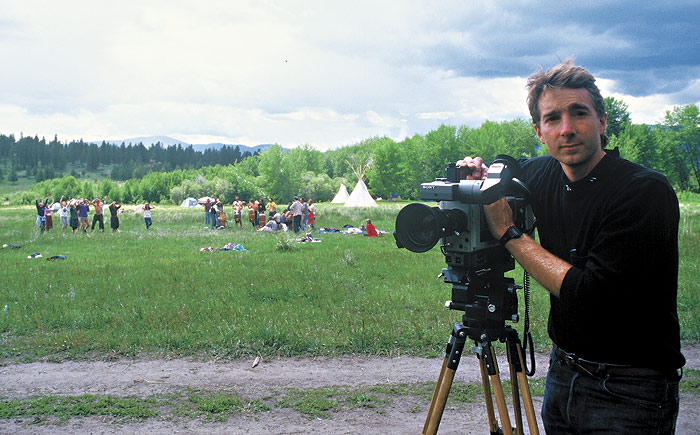
Driving across the Cascades on a 1988 road trip, Ballard filmmaker Kevin Tomlinson discovered a very different kind of idealistic enclave. At an Okanogan Valley festival, he met and interviewed several hippie rustics whom he today describes as “living the lives of our pioneer forefathers.” But his videotapes of these back-to-the-landers sat in the basement for 18 years while Tomlinson worked as a cameraman for PBS, CBS, NBC, and even Bill Nye the Science Guy.
Why did he let the interviews linger so long? In his voiceover to Back to the Garden, Tomlinson explains that during the Reagan era, “I thought people will laugh at this.”
But finally deciding in 2006 to make his first feature documentary, Tomlinson traveled back to the Okanogan and the Methow Valley, where most of his subjects have settled. Most are in their 50s and appear, in the film, to be remarkably fit from the field work, barn-raising, pot-smoking, and organic diet.
Six subjects gave him full access and cooperation with his project, which bears a certain resemblance to the great British 7 Up documentary series (albeit with a longer time interval). “That was a big influence,” says Tomlinson, who will attend his two SIFF screenings.
Showing his background in news, Tomlinson’s doc is much more organized and professional than Johannsen’s, but it too is not especially journalistic—more like an infomercial for the counterculture. Tomlinson sees the film—which carries the subtitle Flower Power Comes Full Circle—as a celebration and vindication of eco-values lately come back into bloom, as it were.
At Whole Foods and elsewhere, organic is the hippies’ revenge. One of Tomlinson’s subjects, a permaculture farmer called Skeeter, declares “Organic is accepted across the world now.” The documentary plainly endorses these aging rustics as prophets of the new eat-local evangelists (see Michael Pollan and his disciples). Tomlinson and his wife, the film’s producer, recently bought an off-the-grid parcel in the Methow; and he self-identifies in the film as “a tourist hippie.”
Still, not everything is roses in the Garden. One fellow is living in poverty in a van on Lopez Island. And most of these industrious, graying boomers have lived in self-imposed rural poverty for decades. (Skeeter recalls $2,000 in annual income during the ’70s.)
Then there are the kids, most now in their 20s and 30s—the second generation, like the Love Family offspring. “A clean white T-shirt was a luxury,” recalls one young woman of her girlhood. To which she quickly adds, “I never lacked for love. And I never lacked for food or shelter.”
Tomlinson recognizes the same dilemma for these tie-dye-diaper babies, now grown, as Johannsen experiences first-hand in his film: Who will carry the legacy? Of the next generation, he asks rhetorically, “That’s sort of the test—did they completely reject their parents’ values?”
The children we see in the film, those who agreed to be interviewed, seem remarkably well-adjusted: happy, healthy, outdoorsy—the kids any Bellevue stockbroker would love to have. Landscapers, river rafters, young mothers themselves—Tomlinson shows us the second-gen success stories.
Those who wouldn’t be interviewed only get a mention—like the conservative son who joined the Navy and is estranged from his mother. It’s hard to be certain whether the director is being selective about whom he shows, or just plain lucky with his subjects.
Still, the film is frank about some discontents. One grown daughter of the Garden circle notes that her single mom had four kids with four different men: “I feel like it was a really great deal for the guys, in that women were left to bear the burden.” It’s not a pattern the second gen seems likely to repeat. Organic fruit is one thing; free love is another.
Given current demographic trends, and the economy, Tomlinson envisions “aging hippie communes. I definitely see that as a possibility and a likelihood.” For empty-nester boomers entering their senior years, urban co-housing may complete the hippie circle.
So we can look forward to that documentary at SIFF 2020.