In the past 15 months, police in British Columbia and Washington have been counting potential crimes by the foot. The total so far is seven, all apparently washing up in sneakers on remote beaches. The first human extremity was discovered by a shocked 12-year-old Washington girl who came upon it on a cool, clear Monday, Aug. 20, 2007, along Jedediah Island, a rocky isle in the Strait of Georgia’s Gulf Islands. Curious, the girl picked up the man’s size-12 Campus brand sneaker off the beach, and out tumbled a wet sock. Inside was a decomposing right foot.
The find rated an intriguing news story in the Alberni Valley Times on Vancouver Island. Authorities were mystified. “There’s all kinds of scenarios and possibilities,” said Royal Canadian Mounted Police Cpl. Garry Cox, noting he was unsure whether the foot had floated in or was the product of some kind of beach mayhem. “It was a regular foot with the skin intact,” he said. “It didn’t appear to be there too long because it wasn’t that decomposed.”
Mounties bagged the foot and sent it to the British Columbia Coroners Service in Vancouver, where DNA testing commenced. That seemed that, and the story faded. Somewhere there was, presumably, a cadaver minus one foot. Officials could wait to see if the other shoe literally dropped.
It took only six days. The second foot was found on Aug. 26, a calm, sunny Sunday. It too was inside a sock, and in a man’s sneaker, and was a size 12.
And one more similarity: The second foot was also a righty. A case that had gone two feet forward suddenly took a step backward. “I’ve heard of dancers with two left feet, but come on,” the RCMP’s Cox told reporters, making it clear he had two separate floating-feet cases to investigate. And bizarre cases they were. “Finding one foot is like a million-to-one odds,” he said, “but to find two is crazy.”
And 40 miles apart at that. The second foot, encased in a Reebok, was discovered by a Vancouver couple strolling along a beach trail on Gabriola Island, known for its shellfish and limestone formations, located down the strait from Jedediah.
Another Mountie, Cpl. Brad Szewczok, seemed to be urging the media and public to stay calm. “My best guess,” he said, “is that they are from missing-persons cases. There have been people that fall off ferries, missing boaters, and a tugboat that went down within the last year. And people fall off fishing vessels all the time.”
B.C. law enforcement has about 2,400 missing-persons cases on the books, and Washington 2,000. Many in both jurisdictions are cold cases dating back years, even decades. They include abducted children, the homeless, runaways, and those designated presumed dead/body not recovered.
B.C.’s missing-person count is the highest of any Canadian province, according to a 2005 Simon Fraser University study, and many are thought to have drowned from accidents or suicides in B.C.’s vast waters. Some also might be victims of B.C. serial killer and pig farmer Robert Picton from 1997 to 2001. He was convicted last December, and is doing life for the murders of six women, parts of which he fed to his pigs. Officials say he once confessed to killing 49 women, the majority of them prostitutes and drug users from the mean streets of downtown Vancouver’s Eastside.
The second foot joined the first at the Coroners Service in Vancouver for DNA tests. But for a test to succeed, a matching sample is needed, and that’s not often available in missing-persons cases. Medical examiners did confirm the disarticulated extremities were from males, but where the flesh and bone came from and who the owners had been, authorities couldn’t yet say.
Within six months, that story also faded. Then came the third foot.
It was another male righty size 11, inside a Nike sneaker, found Feb. 2 this year on Valdes Island, a short drift south of Gabriola. That sparked new interest by the public, some of whom began combing beaches for sneakers bearing feet—and finding them.
The fourth foot, a female righty size 7, inside a New Balance, was found May 22 on Kirkland Island, across the strait from Valdes off the B.C. mainland, which catches the current coming out of the Fraser River.
The fifth, a male lefty size 11, inside a Nike, was found June 16 on Westham Island, near Kirkland Island; DNA tests later confirmed it was the mate to foot #3.
The sixth, a male righty size 11, inside an Everest sneaker, was found Aug. 1 mired in seaweed along the Strait of Juan de Fuca near Pysht, west of Port Angeles. That is more than 150 miles from foot #1, although Canadian currents flow that direction into the Pacific.
And the seventh, a female lefty size 7, inside a New Balance, was found last month, Nov. 11, near Richmond on the B.C. mainland south of Vancouver. Last week it was confirmed as a mate to foot #4.
By installments, newspapers tracked the carnage, which appears to total four male and one female footless victims, most discovered in the past 10 months along adjoining Canadian and U.S. waters. Forget Mountie Szewczok and his words of caution! It had become the Seven-Foot Mystery, a suspected epidemic of foul play.
That’s what some thought, anyway, particularly Seattle and Vancouver radio talk-show callers, Internet bloggers, and newspaper reader-commenters. With the seventh floating foot came a tide of conspiracy theories: The straits had become a watery graveyard for Vancouver’s organized crime; the extremities belonged to illegal immigrants murdered by their smugglers; a foot-fetish serial killer was on the loose. “All these feets, all the wackings, all these people getting kidnap [sic] 5 years ago,” wrote a Vancouver Sun reader/commenter last month, making reference to a Vancouver crime wave, “all coming up now.”
Actually, with the seventh foot, what’s coming up now are some answers, says former University of Washington oceanographer Curt Ebbesmeyer, Ph.D., known as Dr. Duck to the rapt audience of schoolkids he lectures on flotsam, jetsam, and buoyant body parts.
Sorry, says Ebbesmeyer, who has kept a head and foot count of the serial washups. “It’s not much of a mystery.”
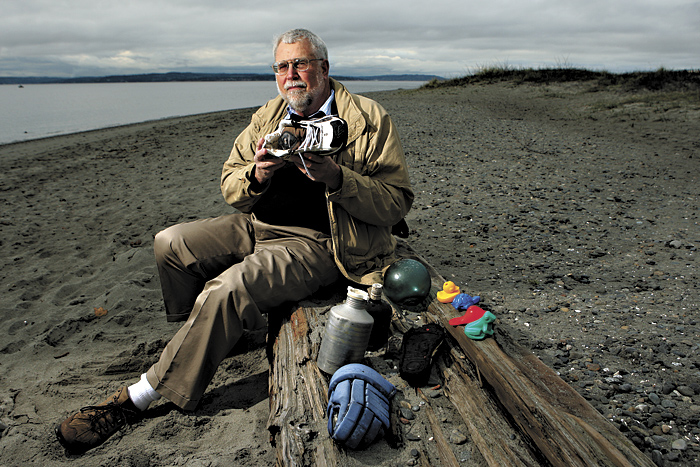
At 65, semi-retired Curtis C. Ebbesmeyer is busier than ever, he says, keeping one boot in salt water and the other in his workspace at home in Seattle’s Ravenna neighborhood. The gray-haired, trim-bearded Ebbesmeyer says his daily goal is “trying to make sense of science.” He’s a protégé of Cliff Barnes, the respected UW professor of oceanography for whom the school’s marine research vessel is named. When Barnes died in 1995, Ebbesmeyer cleaned out the professor’s office—then took everything home and recreated the office in his basement.
As a writer, leader of international science expeditions, and private consultant, Ebbesmeyer is immersed in the sea, specializing in its movements. He tracks surface currents and such watery curiosities as floating garbage patches and container spills to determine flow patterns. His unique research has helped such institutions as oil companies and the City of Seattle’s sewage treatment division chart the fateful drift of their products.
A sideline to his research now and then is to work with forensics experts to divine the travel time and distance of a dead body or its parts, when there is some mystery surrounding their discovery. He’s often queried by reporters on such stories, to the point that he now gets calls from the kin of drowning victims, asking for estimates as to where and when a body is most likely to surface and be recovered. He also gives school lectures that include the subject of floating appendages. “The kids get real quiet,” he says with a grin.
Over coffee at the Varsity Restaurant in Ravenna, Ebbesmeyer seems to brighten as he talks about one of his study cases, a man who, for extreme sport and without bungee cords, jumped 221 feet off the Tacoma Narrows Bridge in 1988. His friends were to pick him up at the beach below, but never saw him again until his funeral. He hit the water at 80 miles an hour, and washed up 32 hours later on Alki Beach in Seattle.
“He drifted south to Fox Island and came around and up through Colvos Passage,” says the oceanographer, adjusting his bifocals. “Quite a trip.” Ebbesmeyer and then–King County Medical Examiner chief investigator Bill Haglund wrote a paper on the case for the Journal of Forensic Sciences in 1994, to aid other investigators in tracking floating carcasses. They charted tides and currents and recreated the whirling trip through hydraulic trajectory modeling, Ebbesmeyer says, trying to keep the macabre stuff academic. “My wife doesn’t want me to talk about this kind of thing at home—it’s not something you can bring up at dinner.”
In a thoughtful tone, Ebbesmeyer rattles off a litany of the items found in recent years to have been sleeping with the nation’s fishes. “Let’s see. A head in Oregon, a complete skeleton in Hawaii, arms and legs in Texas, head in Florida…” And he knows this how? “I have a network of beachcombers worldwide, and they report in.”
Go to Ebbesmeyer’s Web site, beachcombersalert.org (he also issues a quarterly newsletter), and you can find the link to report oceanic treasure and trash. Ebbesmeyer depends on readers to keep him posted on the global arrival of messages in bottles, incoming glass balls, telltale driftwood, and the contents of container spills. The reports augment his studies of ocean currents and help him map out floating garbage patches and junk beaches. You can’t necessarily see the semi-submerged ocean patches when flying over them, he says, but a closer look would reveal a plastic island that includes floating refrigerators, TVs, computer screens, tires, smashed-up yachts, and you-name-it. “The patches are twice the size of Texas,” Ebbesmeyer says. “Plastic has helped make them a global catastrophe. We dump this garbage and it ends up in the sea and the sea life we live off. Basically, we’re poisoning ourselves.”
Also among the relevant oceanographic input is the migration of bathtub duckies, such as the 1992 toy spill in the Pacific. About 28,800 plastic ducks, turtles, beavers, and frogs packed in containers slid off a freighter; after drifting 2,200 miles, portions of the toy armada began washing up near Sitka, Alaska. Ebbesmeyer even tracked one frog and one duck in a watery trek across the North Pole to Newfoundland “where their paths diverged—one to Maine and the other to Britain.” The toys were still being discovered as late as 2004, helping him score some new hydraulic drift findings. The ducky is also now emerging as his personal logo: One is featured on the cover of his forthcoming book, Flotsametrics and the Floating World, written with local author and former Seattle Weekly staffer Eric Scigliano. The autobiography is due out in March from HarperCollins.
Ebbesmeyer sometimes alerts his followers to hazardous finds—an ominous aluminum cylinder floating north of Guam—and splendid encounters—a 90-foot beer tank bobbing off Scotland. He gives the scoop on weather balloons, too:Almost a thousand are scattered worldwide each day, bearing miniaturized electronic weather stations known as radiosondes. But 100,000 balloons and sondes annually end up in the ocean, to scientists’ chagrin. “Sondes signify our throwaway society,” Ebbesmeyer says, figuring they have left a billion bits of Styrofoam on Earth’s 382,000 miles of shoreline.
And, of course, Ebbesmeyer investigates floating sneakers, having made a big splash solving the Great Nike Shoe Spill of 2003. Global media tied up his phone line after he reported the spill from three shipping containers in the Pacific. One of his beachcombing correspondents had alerted him to the discovery of unmatched Nikes on the Washington coast near Queets and sent along the bar-code numbers. Ebbesmeyer broke down the code to determine the footwear was new. He e-mailed Nike headquarters in Beaverton, Ore., and heard from exec Dave Newman. “Three containers went overboard in December 2002 off the northern California coast,” Newman confirmed, about 35 miles off Cape Mendocino, Calif. Generally, Newman said, 5,500 pairs fit in a standard 40-foot ocean container. That was enough to outfit 16,500 high-school hoopsters, at $100 a pair.
Evidence in hand, Ebbesmeyer called up an Alaska science writer he knew, and the story broke on the front page of the Anchorage Daily News: Free shoes! Moochers stormed the beaches, and though no one was counting, scads of the shoes were found on the West Coast tides—with one catch: Nike forgot to tie the laces. Beachcombers would have to find matching mates on their own.
It was with that background that Ebbesmeyer approached the Seven-Foot Mystery.
Like all sneaker brands, plastic-and-rubber Nikes float soles to the sky, with or without a decaying human foot, and can bob great distances. In the 2003 Nike spill, they went almost 2,000 miles in 72 days, Ebbesmeyer deduced, from California to Rose Spit at the top of the Queen Charlotte Islands, B.C., near the Alaska border. Others curled around and went off to Hawaii, perhaps Japan.
Some surprisingly heavy objects ride the surf almost as well. “I’m constantly amazed at what floats and what doesn’t,” Ebbesmeyer says, thumbing through a small spiral notebook he keeps. “On the beach I came across a bowling ball once. ‘What’s this doing here?’, I thought, and pitched it into the ocean. It floats!”
Bodies, however, decompose in a comparatively short time, or can be partially or wholly dismembered by currents or eaten by marine life. “The head separates easily after a time in water,” Ebbesmeyer says, starting to shrug. “It’s just sitting here atop our spines.” He tilts his head as if making it fall off.
The head that washed up in Oregon belonged to a headless body that washed up at Westport, Wash., the result of natural decomposition, separation, and tides, he says. Ebbesmeyer gave a legal deposition on currents in that 1995 case, in which an Oregon woman named Linda Jean Stangel, 23, was convicted of manslaughter for pushing her boyfriend, David Wahl, 27, off a beach cliff.
But feet in particular detach naturally, below the ankle, and most important, through the aid and protection of sneakers, are more likely to drift off and be discovered—to the shock and suspicions of many. Examinations of the six feet found in Canada gave no indication of foul play, says Terry Foster, a spokesperson for the B.C. Coroners Service. “In all cases, these remains appear to have naturally separated from the body,” since no tool or trauma marks were found on the feet. That was also the case with the U.S. foot found near Pysht, Clallam County officials say. Yet the feet became serially linked by the media reports, and the assumption grew that they were related by a criminal cause of death.
The discoveries puzzled Ebbesmeyer in the beginning, too. But not today.
“It was baffling at the start—four right feet,” he says. That seemed to defy the odds, feeding suspicions of a serial killer leaving a calling card. “But then we started getting lefts and matches. And it began to look more commonplace.” With the seventh foot last month, he’s convinced there’s no widespread foul play. Actually, considering that thousands of people have been reported missing in B.C. and Washington, “I’m surprised we haven’t found more body parts,” Ebbesmeyer says. “We’re dealing with only a few people here, in an arbitrary period of time, and it’s routine for some to have fallen in the water and been there long enough for the feet to disarticulate and float away.”
No one can yet say how victims in the Seven-Foot Mystery might have died—understandably, given the lack of evidence. But Ebbesmeyer typically finds such cases lead back to sunken craft, missing swimmers, and other accident victims whose bodies were never recovered. B.C. authorities have been focusing in that area as well, attempting to match the feet’s DNA with drowning, boating, and aircraft accident victims, including five who died in a 2005 B.C. float-plane crash.
“The sensational aspect of this case,” Ebbesmeyer says, “the serial killer, was wild speculation. Quite a few people go overboard, jump off bridges, and so on—no crimes involved.” For example, the partial skeleton of a man found last year on a remote beach west of Point Lawrence, Orcas Island, was likely a drowning victim. Yet the seemingly benign find has now become part of the Seven-Foot Mystery.
San Juan County Prosecutor and Coroner Randy Gaylord says a hiker made the discovery in March 2007, five months prior to the first B.C. foot find. A forensic anthropologist determined that the nearly decomposed man, who had a gold inlay, was about 5 feet 9 inches tall and likely white, Native American, or Asian.
Gaylord and investigators found no evidence of foul play, though one arm and the other hand were missing from the corpse. Notably, so were both feet. That’s not unusual if the remains came in on the tide, says Gaylord. “Feet and hands are small and light,” he notes, “and with a wide range of motion and smaller connective tissue, it is part of the natural progression that they separate from the rest of the body.”
Did the feet float off to B.C.? Ebbesmeyer says currents from the San Juans are capable of carrying objects up into the gulf waters. And B.C. investigators, who belatedly learned of the Orcas finding—though Gaylord had publicized it last year—recently asked for a DNA sample.
B.C. Coroners spokesperson Foster says he doesn’t yet have any findings to release, and Gaylord says it’s his understanding that DNA profiling is still ongoing. (DNA testing, usually done on a priority basis, is delayed when no apparent crime is attached to a case.) Thus, Gaylord says, so far “nothing conclusive” links the Orcas remains with the Canadian feet, or the foot found near Pysht.
There was no indication the Orcas corpse and its feet were forcibly parted, adds Gaylord. “The word ‘severed’ showed up in some early stories in the Canadian press, and seems to me to be a source of why it is so sensational there, and got so much less interest here.”
Lost in the conspiracy noise is the understanding that Canadian authorities have made progress in their six difficult cases. They have matched shoes #3 and #5 as well as #4 and #7, and, thanks to DNA tests and a public tip, have confirmed the identity of the person whose foot started it all 15 months ago.
In July, they announced that foot #1 on Jedediah Island belonged to a B.C. man—still publicly unnamed at his family’s request. He was indeed listed in the missing-persons database, and when he disappeared in 2007 reportedly suffered from depression.
The possibility he was a suicide victim didn’t interrupt the serial count of extremities—his foot was included in the latest ominous-sounding reports on the seventh find, the sixth in Canada. But the mystery up north is in fact down to three unknown victims—the owner of foot #2 and the two owners of the matching pairs of sneakers. Still to be determined is any B.C. connection to the Pysht foot.
Should any of the Canadian feet match the Orcas skeletal remains, in U.S. jurisdiction, that could leave B.C. with just two unknown victims. “Two. Nothing unusual about that,” says Ebbesmeyer.
Of course, more feet could float in. In fact, Ebbesmeyer is almost certain they will. Blame it on style. People will die, he says, “and a lot of them will be wearing sneakers.”