Not a month after its opening, Matt Dillon and Wylie Bush’s new restaurant, The Corson Building, inspired one of the most fascinating exchanges I’ve ever read on Chowhound, the food discussion site. One diner boasted about his meal the night before, raving about the food and the communal atmosphere—with the exception of the couple next to him. He complained that these two poor souls, whom he named with initials, completely missed the point of communal dining, refusing to interact with the rest of the table. Right under his rant, the woman he bitched about responded with a post of her own, thanking him for ruining her memory of what had been a lovely birthday dinner.
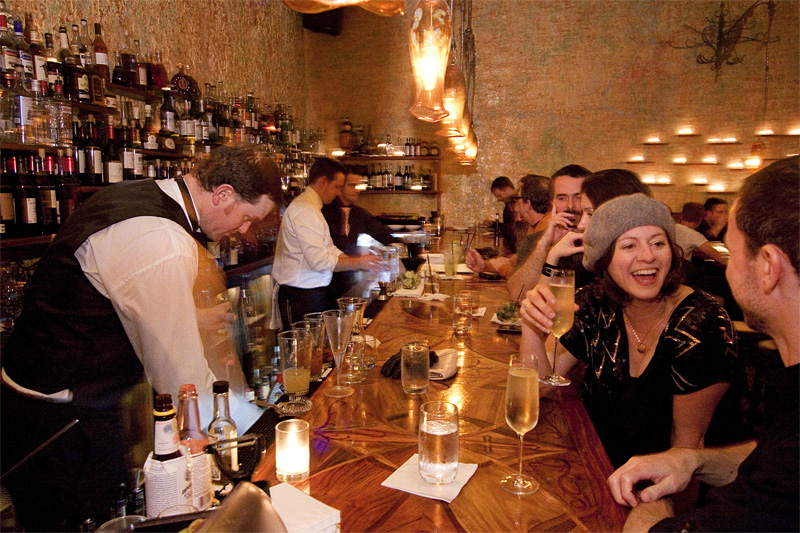
I remembered those diners two-thirds of the way through my four-hour meal at The Corson Building a few weeks back, when I was seated on the border between a joke-sparring group of out-of-towners—one an open W fan—and six quiet-spoken West Coast liberals of a classic stripe. The two sides would flick wary glances at one another, speaking only as they passed the platters of food, while I tried to make small talk with both sides. It was a testament to the mood Dillon and Bush created—and to the power of candlelight and the romance of the dining room—that both sides appeared to leave the table thrilled with an experience they had shared, at a per-person cost of $150.
In the ranks of 2008’s most-hyped restaurant openings, The Corson Building is right up there alongside Justin Neidermeyer’s Spinasse and Jerry Traunfeld’s Poppy—all three have occasioned glowing mentions in local and national pubs well before their opening dates. The excitement over The Corson is due to great ideas and a better pedigree, both of which can be attributed to Matt Dillon, the chef-owner of Sitka & Spruce, who made his name at the Stumbling Goat and the Herbfarm (as Traunfeld’s sous-chef) before that. Dillon teamed up 15 months ago with friend Wylie Bush, owner of Capitol Hill’s Joe Bar, to gut the building and reassemble it, plant the gardens, and bring to life their dream of a restaurant that is more than a restaurant—a center for Seattle’s food community.
The duo’s venture feels particularly Northwestern. Not just Dillon’s food—ultra-local, replete with homemade conserves and cured meats as well as rare finds from the chef’s frequent farmers-market runs—but also the restaurant’s eclectic, personal vision and the uneasy relationship among its idealism, its urbane-rustic aesthetics, and the money the business requires to sustain both.
There’s a Robin Hood quality to the dinners that the pair throws most Thursday, Friday, and Saturday nights, for which you’ll need to make reservations at least two weeks in advance: The Building charges $80 per person, plus $30 for wine pairings (at my dinner, one glass of sparkling rosé, a chenin blanc, a riesling, and a Côtes du Rhône), plus tax and tip. With the approximately $4,500 the restaurant grosses each of those nights—not a huge take, mind you, especially since the meal includes about eight courses—they fund their other projects. These include a nearby garden operated with the nonprofit Youth Garden Works, and cooking classes Dillon plans to start teaching once he establishes the fine-dining end of the business. And more modestly endowed Seattleites don’t need to spend $150: Dillon and Bush have hosted $25 picnics and $80 suppers to date, and plan to devote Wednesday and Sunday nights to more affordable meals. “I hope people will check the calendar on the Web site and think, ‘Oh, the Corson is doing a rosé and crab dinner for $30 tonight. We need to go,'” Dillon says.
The almost paradoxical tension between feeding the rich and feeding the poor isn’t the only one The Corson Building thrives on. There’s the whole urban-peasant dynamic as well. When my tablemate and I arrived at 7 for the dinner, we joined the other diners in the garden outside the 1910 Spanish-revival house, located just beneath an I-5 overpass. It was a gorgeous late-summer night, and we drank flutes of rosé as we toured the perimeter of the ironwork-walled garden, inspecting the hens and doves in their respective pens, Italian plums ripening on the tree, and beds of herbs and greens. Then we moved to the brick patio to inspect the other guests, the perennial Seattle blend of tucked-in and dressed-down. As we snacked on crostini with chicken-liver paté, a cucumber slice, and some pickled fava beans, a jet roared overhead so low that my hair vibrated. Then a two-car train rumbled down the tracks just behind the house, followed by the fat roar of a Harley motoring down Airport Way.
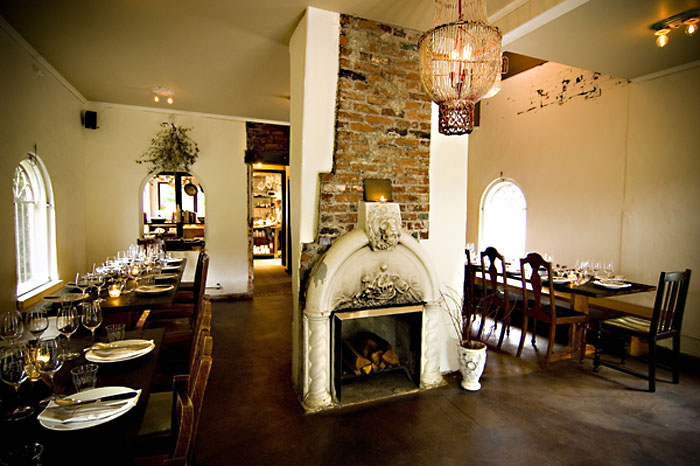
But once we entered, I discovered that the spell cast by the dining room included industrial-noise-blocking properties. Space-expanding properties, too: It looked like a tight fit for 32 diners, three waiters, and a couple of cooks, despite the fact that Bush and Dillon have knocked down a few of the walls separating the low-ceilinged rooms, and even removed half of a story in order to hang a woven-paper light sculpture above one table. Sitting along the heavy wooden tables surrounding the room’s central hearth, we felt ensconced, not cramped, in an ageless country house. I almost expected Dillon to come around belting opera and exhorting us to all eat, we were so thin.
The evening turned out to be charmingly formless: hospitable in that the courses came out communally like a dinner party, controlling in that there was no clue to what we would be eating until we were all seated. Of course, the chef did accommodate vegetarians around me, and would presumably do the same for other dietary restrictions.
Near sunset, the meal began with welcomes. First, Bush apologized for the acoustics of the room (a friendly warning to loud talkers), invited diners to come and go as they wished, and set the loose-limbed, personable tone of the service that would continue throughout the evening. Then Dillon emerged from his kitchen to recite the menu in grand West Coast tradition, citing farmers and fishermen as he talked. More wine came around. And finally, some food.
After all the hype and my memories of meals at Sitka & Spruce, I was underwhelmed by the first four courses, even as I was struck by the quality of the produce they showcased. There were gorgeous slices of air-dried albacore, its briny flavor perfectly cast against cold, sweet golden watermelon and then steamrolled by the hammy tartness of pickled red currants. There was a platter of ripe tomato, slabs of California buffalo mozzarella that crumbled into creamy curds as we spooned into it, the bitter crunch of three kinds of endive—and a mound of pickled chanterelles whose apricot-sweetness was canceled out by the fruity sugar in the tomatoes. After one plate of perfect mixed vegetables in an underseasoned anchovy sauce, we received another that included quickly sauteed okra, tender roasted eggplants, satin-fleshed baby beets, and fresh local peanuts. The description sounded great, the plate looked great, but the nuts, the candy-sweet beets, and the okra all seemed to take the palate in divergent directions. I seemed to be eating three ingredients in search of a chef.
Finally, with the meat courses, Dillon showed that when he’s not enraptured by the bounty of the farmers market, he cooks his ass off. In one brief moment of selfish joy, each of us devoured our own bowl containing a succulent halibut cheek, its flesh paradoxically creamy and filamented, with tender braised chickpeas and the velvety kick of saffron aioli. Roasted chickens, hacked into family-style portions, were tender from breast to thigh, washed with a chicken jus and surrounded by a garland of fresh nectarines, roasted red and gold peppers, and anise-scented hyssop leaves. I couldn’t deduce much flavor in the horseradish leaves that Dillon had rolled his pink-fleshed lamb around, but no matter. What with the yogurt sauce, the carrot-parsley slaw, the nigella-seed-flecked flatbread, and the meatily vegetal squash vines that came with the lamb—not to mention the sweaty, blueberry-soused romp of the Côtes du Rhône—it was a dish that perfectly captured both the rusticity and the elegance of The Corson Building’s ethos.
The three meat courses proved Dillon has technique to back up his virtuosic, improvisational style. That’s what makes the spectacle of the restaurant fun—but, in another paradox, only if you’re prepared to gloss over a few missteps.
During those four hours, the room’s power over us only increased. Looking down the table, past a dozen diners flushed with wine and candlelight, into the modern, well-lighted kitchen, where Dillon and his assistants were quietly spooning rice pudding into bowls, it seemed as though no amount of political tension or social missteps could be immune to the glamour of one perfect bite of food. Whether communal, culinary, or capitalist, that’s a vision that The Corson Building’s owners and any number of well-funded customers are sure to invest in.