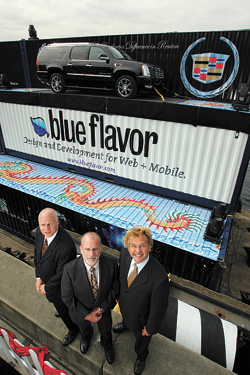
If you happened to be walking by Pier 66 on a certain August evening last year, you might have noticed an odd vessel plying the waters of Elliott Bay. Nudged along by a Foss tugboat was a flat barge carrying a half-dozen cargo containers. The containers were no different from ones that go in and out of the Port of Seattle every day, except that instead of bearing some bland shipping-company logo, such as Hanjin or Cosco, they were dolled up like colorful billboards. A pair of them were wrapped in an ad for Cadillac, and there was even an Escalade parked on top.
The event was the gala waterfront launch of a local startup business called China8. With backing from a prominent UW professor, several specialists in maritime communications and homeland security, a small army of publicists from APCO Worldwide, and former Washington Governor Gary Locke, China8 unveiled what it somewhat comically called a “never-before seen 4-dimensional advertising medium.”
China8 proposed that instead of piling blank rectangles atop one another on trains and cargo ships, those metal canvases should be put to work for corporate America. And it planned to start with the biggest worldwide advertising opportunity around: the 2008 Beijing Olympics.
“Big, hairy audacious goal!” So “roared” China8 executive John Anderson, as USA Today reported in an enthusiastic story about the event.
The company planned to send a couple thousand advertising-emblazoned containers off on a cargo ship topped with a dragon head for a months-long, attention-getting voyage from Tacoma to Beijing. Once in China, the containers would be installed at roadsides near the Olympic Village and other strategic sites. They might be stacked to form the world’s biggest iPod, or arranged into a skate park. China8 sponsors would gain “access to some of the last available advertising space for the 2008 Olympic Games,” the company said in a press release.
China8 even offered a humanitarian twist, promising to fill some of the cargo boxes with medical and educational supplies for rural China. Schoolchildren would be enlisted to decorate containers in a bid for global understanding. A portion of company profits would be donated to a charity supporting the construction of Chinese hospitals.
“Talk about thinking outside the box,” Anderson told USA Today. “We are denying the box exists!”
A year later, it is China8 that does not exist. The company and its containers never made it to the Olympics. Indeed, the effort fell apart within weeks. People who worked for the venture are now fighting in court to be paid. Former Governor Locke, who traveled to China on behalf of the company and called it “a great way to foster cultural exchange while showcasing incredible technology,” now downplays his previous involvement. And the mastermind behind the business, a onetime creator of fish-skin swimsuits named Paul Willms, who was bankrupt less than 10 years ago—and who at the time of the China8 launch was subject to cease-and-desist orders by business regulators in two other states—is moving on to his next venture.
Advertising was really only a tail-wag for China8. The project’s larger objective was to market a new anti-terrorism technology from a Willms company called Erudite, Inc.
With thousands of cargo containers arriving in the U.S. every day—largely unchecked—U.S. ports are widely recognized as one of our most vulnerable entry points. Erudite had developed a novel type of acoustical sensor that, when installed in a container, can detect whether it has been opened or its contents tampered with en route. The company had also created a GPS lock that can both track a container’s whereabouts and prevent it from being opened until it reaches its intended destination.
But how to get the shipping industry, or government regulators, to embrace the product? Shippers are frugal, observes Ty Graham, a vice president at Seattle-based SeaMobile, who’s on the Erudite board of directors. Most cargo haulers, unless they’re dealing in high-value goods, aren’t going to want to spend a lot of money to keep tabs on boxes of bananas.
That’s where advertising comes in handy. “It’s a way to underwrite the cost of the devices,” says Les Atlas, a UW electrical engineering professor who led the development of Erudite’s system. Selling the surface of the container as advertising creates revenue that can be used to pay for the security tracking, just as the ads near this article covers the cost of producing this newspaper.
In the case of shipping, the one technology supports the other. The ability to track the container is also essential to being able to sell advertising on it, as China8 project director Amanda Bakke explained in an interview last August. No one’s going to pay to wrap their name around a container if it’s only going to be buried under a hundred other boxes on a freighter in the middle of the Pacific Ocean. But if you can tell the advertiser what time, and for how long, a container will be traveling by train through a high-visibility urban area—and verify it—then the sale becomes more viable.
Thus was born China8, a joint venture between two Willms companies: Erudite and GBoards, which is in the outdoor-media business. The Olympics “presented an ideal stage for us,” said Willms last week in an e-mail. “The China8 Project would draw attention to the concept of cargo containers, alerting the public to the importance of detecting threats that may lie within and challenging advertisers to imagine the possibilities of a new medium to reach a global audience.”
It was also a chance “to beta-test the whole system,” says Shimon Liang, who worked as a consultant on the project. Advertising revenue, at $30,000 per container, would help pay for leasing out a couple thousand metal boxes, shipping them to China with devices installed, and seeing if it all actually worked.
But the challenges hardly ended there. In order to affiliate with the Olympics and place its containers in desirable locations nearby, China8 had to secure permission from communist China’s notoriously Byzantine power structure. And for that, the company turned to former Governor Gary Locke.
Locke, the country’s first Chinese-American governor, has long been a major promoter of local ties with Asia. During his two terms as governor, he led several trade missions there, including a 1997 visit to China, where he and his wife Mona were famously received with adulation. Since leaving office in 2005, he’s been a partner at the Seattle law firm of Davis Wright Tremaine, where he co-chairs the China Practice Group (link is to PDF).
Once hired by China8, Locke was closely associated with the project. His photo, along with “A Message From Gary Locke,” appeared on China8’s Web site. Among the other assistance he provided, according to Anderson, was visiting with the Beijing Olympic Committee and obtaining permission to use the official Beijing 2008 Olympics logo on China8 containers and humanitarian materials.
How firm those authorizations really were is unclear. As Anderson admits, “to go from a verbal agreement to actual permission” can be a treacherous road in China. But at launch time, Locke was given plenty of credit.
Citing China8’s Bakke as the source, the Puget Sound Business Journal reported that “Locke’s reputation in China helped the team sell the idea to the Olympic committee and Chinese government groups.” Locke’s chief of staff at Davis Wright Tremaine, Mary Tan, was even more effusive, telling USA Today: “Gary put everything in the right order so that it was possible to achieve.”
Today Locke is considerably more circumspect about his role. “We had a team of lawyers working with them,” he says in a brief interview. “Most of the legal work was done by others.” In fact, Locke says, his firm had stopped working for China8 even before the launch, and he had asked that the marketing materials with his image not be used.
Locke says he “knew nothing about Willms before he came to our firm.” But it appears the former governor soon learned more about this serial entrepreneur, who’s had an unusually colorful career.
A sometime real-estate broker, Willms made a bit of a splash on the fashion scene in the late ’80s and early ’90s with a Seattle design studio that created clothing and accessories out of fish skin. “Fish is the next animal to be hot,” Willms told the Seattle P-I in 1988. Willms used grouper and butterfly fish specifically, and called the material “sea leather.” Customers were enthusiastic, the article said, though store buyers were skeptical.
About a decade later, Willms, then 42, was running a business called 64K Internet Marketing and had fallen on hard times. In debt for almost a half-million dollars, he filed for bankruptcy. Ironically, Davis Wright Tremaine was among those to whom he owed money (though most of his debts were to individuals). He emerged from bankruptcy after a few months.
The paper trail on Willms next picks up in 2006. That’s when the state of Kansas issued a cease-and-desist order against him for violating securities regulations. The state of Missouri did the same a few months later.
The venture that prompted their response was, if anything, even more audacious than China8. Willms had sent out a letter to thousands of Mennonites in the U.S. and Canada, asking them to invest in a scheme to win back, and redevelop, roughly 500,000 acres of formerly Mennonite land, now within the borders of the Ukraine, that had been seized by the Bolsheviks during the Russian Revolution of 1917.
Willms proposed that his company, called Caobo, would seek restitution from the current Ukrainian government and then be “the corporate owner/steward overseeing [the land’s] long-term, profitable development.” He proposed transforming the acreage, in the Zaporizhzhya region, “into high-performing, quality real estate assets in several potential business sectors, including but not limited to agribusiness…and international shipping and transportation.”
“I am writing to invite you to invest in the private equity group launching the Caobo Company’s vision,” Willms said in the letter. “I ask you to join me now in honoring God by helping to restore the Mennonite lands of the Ukraine.” The cost of one share of common stock in the company: $1. The minimum number of shares required “to be a part of this historic group”: 1,000.
The solicitation was not warmly received by its target audience. The board of directors of the Mennonite Historical Society of British Columbia, for example, recommended its members reject the plan, saying it was not really a “restitution” project but “a highly risky business venture that does not have any direct economic benefits to former land owners.” And besides, the Society’s president wrote, an important tenet of Mennonite faith “is to forgive and move on rather than resort to legal means of redress.”
State regulators weren’t feeling quite that charitable. They deemed Willms’ letter a solicitation to buy stock, which requires registration with the state and numerous other disclosures to investors—including the fact (not stated in the letter) that Willms had filed for bankruptcy in 1999. Kansas and Missouri both ordered him to halt his activities.
Willms declined to be interviewed for this story last week, but he responded to some questions by e-mail. Asked for comment on the episode, he said that the land in question was “seized through tyranny and anarchy, much as the same activity going on in Georgia today…I decided to offer my leadership to my extended Mennonite family—Ukrainian expatriates living in the U.S.A., an otherwise leader-less people.” He said he was soliciting the funds “to begin a class lawsuit in Kiev and Brussels” and had simply sought to “notify the potential beneficiaries of my plans, and ask for their assistance with the lawsuit…No funds were ever received from these families nor any outside investor. No harm was done—and the good that was intended was brought to a standstill in the process.”
China8 soon came to a standstill as well.
Just two days after that USA Today story describing China8’s debut (written by Pulitzer Prize winner Byron Acohido, formerly of The Seattle Times), China8 had already come apart. All that synergy? Forget it. Anderson says the investors behind Erudite decided they didn’t want to be part of the venture after all.
On September 1, “China8 and Erudite ceased being affiliated companies,” says Anderson, who is still Erudite’s CEO. “We saw, and our investors saw, that the two companies really had different business models. China8’s is pay-for-placement based on traffic. Ours is a per-trip model. Our investors encouraged us to make sure the companies were separate. They wanted to see management clearly focused on one or the other.”
And it only went further downhill from there. Participants in China8 today offer a host of different reasons why the project collapsed—a lack of advertiser interest, a failure to secure necessary government funding, unfinished software, delays by U.S. Homeland Security officials in finalizing security policies, and more.
Willms, Anderson, and the UW’s Atlas insist that the main culprit was a severe crackdown by China on any advertising from companies that were not among the “official” sponsors. Restrictions of this kind aren’t uncommon in Olympics host countries, but apparently were taken to extremes in China, where, according to a report last month in Advertising Age, more than 30,000 outdoor ads in Beijing were torn down in the year leading up to the Games, “including more than 100 big billboards on the airport highway.”
That shift in policy “shot down the Olympic rollout,” as Atlas puts it. Says Anderson: “Suddenly all of the spaces China8 had negotiated” became uncertain. “We could have delivered everything China8 promised,” he insists. “But the conditions were unilaterally changed.”
Any hope that the company might win special dispensation from the Chinese government was dashed when Locke abandoned the project as well. He won’t say why Davis Wright Tremaine ceased representing China8, citing “the attorney-client relationship.” But according to Willms, Locke bailed out upon learning of his Caobo activities.
On Sept. 27 of last year, securities regulators in Washington joined the pile-on against Willms, issuing a Statement of Charges (link is to PDF). Mike Stevenson, director of securities at the state Department of Financial Institutions, says Washington caught wind of the Caobo scheme from Canadian sources, not from fellow domestic enforcers.
“Unfortunately for China8, Gary Locke’s leadership was lost at a crucial time,” says Willms in his e-mail. “We had hoped that his advocacy with the Olympic Committee and other China officials could have produced an acceptable way for China8 to complete its mission.”
By October 20 of last year, China8’s project director Amanda Bakke had also resigned. She’s now suing Willms and Erudite for $41,000 in salary that she says was never paid. John Robinson, who oversaw creation of China8’s Web site, logo, and marketing materials, is also suing, saying he and his subcontractors are owed more than $100,000.
“We work with start-ups all the time, and this was a pretty big shock to us,” says Nick Finck, a principal at Fremont design shop Blue Flavor, one of the main subcontractors. “Usually we’ll negotiate, we can find some other way of being compensated. They just said, ‘We didn’t get the advertisers, we’re not paying.’ I was like, ‘That’s what investors are for.’ The whole thing seemed kind of sketchy.”
By installing China8 under Willms’ company GBoards, and removing Erudite from the venture, the participants appear to have sought to insulate Erudite from China8’s bills. “GBoards has assumed operating control—and financial responsibility—for China8’s past and future efforts,” Willms wrote to Robinson in a letter last December. “Presently, GBoards has limited operating capital, but we met with promising investor interest and we expect to be adequately funded during the first quarter of 2008. Accordingly, GBoards expects to begin clearing its past obligations—including our unpaid invoices from your firm—as funds are received.” Robinson sued a few months later.
Meanwhile, both companies are moving ahead with new plans. Erudite, where Willms is still chairman of the board and majority shareholder, is busy conducting tests of its technology at the Port of Tacoma. The company is focused on a new acoustical-sensing device that can detect if a radiation shield has been placed in a container (in an attempt to mask a nuclear device). “It’s totally different from anything in the world,” says Anderson, who has an M.B.A. in marketing and says he’s spent most of his career in the field.
Willms, too, is optimistic. “Fortune 500 companies that were in discussion with China8 are looking forward to exploring traditional out-of-home advertising (LED screens, airport media, underground media, etc.) with GBoards,” he writes. “Looking ahead, the 2010 World Expo [in Shanghai] is in sight to pick up where The China8 Project left off.”