Spring Hill: Meet the New Northwest
Published 7:00 am Tuesday, July 22, 2008
As any Top Chef addict can attest, the bright young things of the kitchen world seem to have tired of Alice Waters’ ingredient-focused comfort food and are playing fast and loose with chemicals and devices. Inspired by Grant Achatz in Chicago and Wylie Dufresne in New York, they’re putting together some very odd flavors. Let’s pulverize this! Let’s sous-vide that! It’s an era of experimentation and grand ambitions.
But Seattle seems to be going against the grain. The new restaurants that have flourished here lately are the littlest ones, which sell indie cachet along with some very fine, very simple food, priced to be twice-a-month splurges rather than an annual pilgrimage. It’s food that prizes modesty and exquisite taste over big-picture urbane sophistication. Call it the cupcake effect. And call me a fan.
But that doesn’t mean grand ambition is dead in Seattle. Take Spring Hill, the new neighborhood bistro from Mark Fuller, former head chef at Dahlia Lounge, and his wife, Marjorie Chang Fuller. To me, it blends what’s finest about the national and the local trends: Mark, the chef, serves iPod food that looks simple but shows off very contemporary techniques. And like the city’s restaurant scene as a whole, its strength may be in its small gestures.
His grilled prawns and grits is one of the best dishes I’ve tasted in Seattle since moving here in 2006. It doesn’t look like much: a ring of grits, a poached egg, some grilled shrimp, a little mushroom sauce. But it was a study in perfect technique. One slash of the fork, and the yolk spewed golden over the grits and shrimp; we picked up the prawns by their tails and dredged them slowly through the saucy rings. Smoke from the grill clung to the prawns, and it anchored the flavors of the cream-braised grits, the sweet-tart morel sauce with shrimp stock hiding beneath its woodsy nose, and that luscious yolk. Before the bowl was half empty I was already relishing the prospect of running my fingers around it, feeling a little dirty about the prospect, when my tablemate spoke up. “You know how food can be sexy?” she asked. I grunted in assent, and then we didn’t speak another word until the plate was shiny and dry.
That was clearly Spring Hill’s sensual side. Attesting to Fuller’s other, experimental side was a quenelle, or football-shaped mound, of salmon paté mixed with smoked dill (a clever trick, smoking the herbs instead of the meat), which was set on powdered, dried horseradish (who dries horseradish?) next to a translucent fan of “mustard-brined” apple slices and a few amber cubes of pine-nut jelly (jellies, like foams and powders, are the trademarks of the new cuisine). This one promises to thrill me once the cooks up the pungency in the apples and the horseradish to offset the unctuousness of the paté.
With no desire to hang the food on hooks or present it on cushions of scented air, the cooks secreted interesting layers of flavor or texture in every dish, from the smoked hazelnuts sprinkled over a fan of beets and pears—they worked best as a bar snack between earthy, candy-sweet bites—and an olive-oil cake with a quenelle of whipped cream infused with lemon zest and pears poached in white wine scented with lavender.
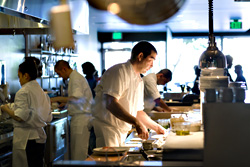
The room at Spring Hill reflects more of the scientist than the sensualist, with its pre-scuffed poured-concrete floors and its au courant plywood booths. Plywood slats hang from the ceiling in lieu of sound buffers—which is unfortunate on a Friday night, though the slats look great—and several walls are painted the color of fresh spring peas. While the bar area still feels like the unfinished look really is unfinished—it took about a year and a half for the couple to find the right space and do a complete build-out—the silvery open kitchen, spotlit for the audience to catch every gesture, looks stocked for some serious culinary research. It also shows off Fuller’s poise as he meditatively touches up plates while his staff darts behind him, diving for pans and shuttling garnishes.
Fuller, who worked for Tom Douglas for a total of seven years, says that at Spring Hill “I get to help figure out what Northwest cuisine is.” He often plays with fire—smoke is a Northwestern trait—using his applewood-fired grill and a smoker stocked with alderwood chips. Another defining characteristic Fuller has settled on is shellfish: His large menu includes several kinds of raw oysters served with a hops mignonette, a razor-clam sausage, and a tub—I’m barely exaggerating—of roasted Totten Inlet mussels giant enough to require a knife and fork to eat and custardy enough to make the buttery, herbaceous liquor at the bottom of the pail seem almost superfluous.
Along with the sensual versus the experimental, there’s another axis of tension in Fuller’s food: hearty and delicate. The bigger plates even verge on brawny. The weakest dish of my two meals at Spring Hill was a double-thick wood-roasted pork chop, evenly pink and too fleshy for my palate, with a dark-brown smoke crust. It was served with a grainy little sausage, white beans tossed with fresh tarragon and no salt, and an apricot puree whose fresh tartness didn’t cleave, as the tent revivalists used to say, to the flavor of the smoky meat like a man to his holy wedded spouse. The heartiness wasn’t always overdone—a veggie tagliatelle with fava beans, tomatoes, spring onions, and fistfuls of morels tasted like a springtime landscape painted by Gauguin. My favorite of the entrees I tried was a pan-roasted halibut fillet covered in a mixture of buttery bread crumbs, herbs, and chopped smoked clams, which would show up in the odd bite, a surprise gift. I enjoyed the dish, yet wished it were half the size.
That’s because the small dishes took the big, straightforward Northwest flavors like smoke and meat and contained them into tight little bursts of flavor that the chef could then pair with extremely delicate ones. To make a duck-egg raviolo, the cooks have very gently covered a large yolk in pasta, simmered it, then topped it with a few transparent panes of salty duck-breast ham and garlic chips. The raviolo is as big around as a coffee mug, but so rich that two or three people will need to share. And I had another Meg Ryan moment (I’m used to having one a month, not two at the same restaurant) over “the steak hot and cold” appetizer: Not the raw steak tartare, which came with puffy potato chips and too little seasoning, but the cooked, a ping-pong-ball-sized round of grilled steak paired with caper relish. The applewood smoke bathing its crust, the nuggets of coarse salt crunching between my teeth, the yieldingly rare center of the fillet, the sharp flick of the briny capers…As the meat disappeared, I parsed it into smaller and smaller bites to make sure I relished every gram.
Price CheckRoasted beets with hazelnuts $7Egg-yolk raviolo $9Steak hot and cold $12Roasted mussels $10Prawns & grits $14Halibut with smoked-clam panzanella $24Wood-roasted pork rack $24