Rubbing With the Stars
Published 7:00 am Tuesday, July 15, 2008
In the new millennium, we are all brands. The press uses poll results to talk about whether Obama’s “brand” is rising or falling. Only a decade ago, regular Joes like us were told to “build our skill sets” and “establish our professional networks,” but now the career-development pundits are telling us to develop “our personal brands.” And in the age of Top Chef and the Food Network, the heads of restaurant kitchens are expected to appear at farmers markets, charity events, and radio shows. The choicest few even delve into licensing.
If you’re a chef, tired of working 12 hours a day on your feet in an industry infamous for its narrow profit margins, putting out a line of branded products seems like a good way to make some extra cash and share your brand with customers who can’t afford to eat at your restaurant often. But branding your own products is not the safest of paths. Recently David Burke’s high-profile, heavily-invested-in flavor sprays disappeared from the markets; Todd English’s line of pans, sold on the Home Shopping Network, got slammed in a Wall Street Journal celebrity-cookware test; and Rocco DiSpirito has become so overexposed through his corporate sponsorships (Lincoln, Bertolli, his own cookware) that he’s squandered any cred left over after the disaster of his television show.
Seattle’s chefs have hardly done anything so audacious. But over the years, several of them have put their names on specialty foods that they’re selling in retail stores and tourist hangouts, on specialty-food Web sites, and at their own restaurants. I’m not talking about Cafe Juanita chef Holly Smith’s new farmers-market cart selling gelati or the small jars of fruit preserves and ketchup that Maria Hines has started selling at Tilth. I’m talking seasoned salts.
Seasoned salts are only a tiny portion of the gourmet-food market, but they’re not worth chump change. A May 2008 report from the National Association for Specialty Food Trade reported that annual seasoning sales in the United States rose from $366 million to $393 million between 2005 and 2007, and Tom Douglas, Kathy Casey, Don Curtiss, and Thierry Rautureau have all entered the market.
What better time to test our local chef-branded flavorings than barbecue season? I tasted a number of seasoned salts over the course of two meals—the first barbecue featured chicken breast and mahi-mahi fillets and the second lamb kebabs, all three meats accompanied by celebrity-chef-seasoned grilled asparagus and summer squash. I oiled the meats and vegetables, sprinkled or rubbed on the seasonings, and then grilled ‘n’ chilled. The sugary Salty’s blackening spice was rejected from competition because it proved to be designed for pan-frying, and I threw in a bottle of Lawry’s as a control. Here are the results, listed by performance:
Thierry Rautureau’s Spiced Salt Rub
Price: $14.24 (including tax and shipping) for a 4-ounce bag at Chefshop.com; $5 for a 2-ounce bag at Rover’s, 2808 E. Madison St., www.rovers-seattle.com.
Key ingredients: Coriander, mace, piment fort, lavender, peppermint.
Success rate: High. It took first or second place in most of the tests. I was concerned about the quasi-infinite number of herbs and spices in the ingredient list (one is “ras el hanout,” a Moroccan spice blend whose components can number in the triple digits). On the grill, though, the seasoned salt made each bite taste subtly different—here I got some star anise, there some cinnamon; this bite tasted Mediterranean, this bite almost Thai. One friend was put off by the way the peppermint lingered after bites of the mahi mahi, but we didn’t notice the same effect in the chicken, lamb, and vegetable trials. As the seasoner of meats, I would complain that the large, solid salt grains in the blend didn’t stick to the meat very well and, in the mouth, packed a hard crunch. Yet the food never came out salty.
What the salt says about the chef: I want you people to know I can cook more than four-star French food. Also, I have a phenomenal palate.
What the salt says about you: I get a thrill out of never knowing exactly what I’m going to taste when I put something in my mouth.
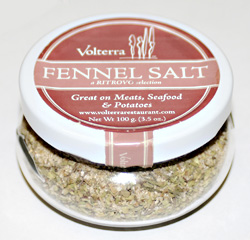
Volterra Fennel Salt
Price: $15 for a 3.5-ounce glass container at Volterra, 5411 Ballard Ave. N.W.; $18 (including shipping) at www.volterraproducts.net.
Key ingredients: Sea salt, fennel seed, orange zest, and “other natural flavors”—I caught a strong thyme presence.
Success rate: Moderate to high. The understated complexity of Volterra’s salt, with its dried herbs and lovely toasted fennel, came through best on the vegetables and the fish. I also enjoyed it on the lamb, but not as much.
Rejected varieties: I would have also liked to try Volterra’s porcini salt, but my budget for this review couldn’t accommodate two tiny $15–18 jars of seasoned salt.
What the salt says about the chef: I am tastefully restrained, subtly complicated, and not afraid to use consultants (the salt was developed with Ritrovo, an Italian company).
What it says about you: I search out premium ingredients and I’m happy to show them off.
Lawry’s Seasoned Salt
Price: $2.79 for a 4-ounce plastic shaker at QFC (8- and 16-ounce containers also available).
Key ingredients: Powdered onion, paprika, spices, tricalcium phosphate to prevent caking. Label advertises “Contains no MSG.”
Success rate: Moderate. Heavy on the garlic and celery salt, Lawry’s was too powerful for the veggies, but good on the fish and lamb and great on the chicken. Part of the reason is that, unlike many of the spice rubs I tasted, it had enough aromatics (garlic, onion, celery seed) to amplify the middle ground between the aromas of the spices and the base flavor of smoky meat. The spices stood out enough to taste, but not too much to take over from the meat. All the tasters who tried the Lawry’s-seasoned meats, including me, were surprised at how much we preferred it to some of the fancier rubs. (Here is also where I should confess that as a kid I used to love to sneak pinches of Lawry’s from my mom’s spice cabinet.)
What the salt says about the chef: We believe extensive product testing works.
What it says about you: I’m cheap and lazy, but I know a classic when I see it.
Rub With Love Chicken Rub
Price: $4.99 for a 3.5-ounce container at Whole Foods; $5.95 plus shipping at www.tomdouglas.com; up to $9 at tourist shops.
Key ingredients: Tom Douglas’s Rub With Love line of seasonings comes in 12 varieties. Of the three I tried, the common ingredients were brown sugar, coriander, smoked paprika, and black pepper.
Success rate: Moderate. I coated all of the meats and vegetables thickly with the Chicken Rub, which, like all the RWL rubs I tried, was slightly sweet and brick-red in color. The Chicken Rub mixed with the oil and meat juices to form an even, rust-colored coating—but I still ended up sprinkling more on afterward because the food needed extra salt. That said, the Chicken Rub was a hit on the chicken, fish, and zucchini. Sweet, slightly smoky, and spicy, it was the simplest of Tom’s rubs. Prominent among the (only) 10 ingredients were smoked paprika, red and black peppers, and the cinnamon, all nicely calibrated.
Also recommended: The Bengal Masala tasted more Tom Douglas than Indian, but the lamb kebabs did fare well under its influence.
Rejected: The Chinese 12-Spice Rub, based on five-spice powder but with very un-Chinese flavors like chipotle peppers and smoked paprika, was disgusting. Talk about clash of the titanic flavors.
What the salt says about the chef: I love flavor—lots and lots of flavor—from all over the world. I also like barbecue sauce.
What it says about you: I love spicy, slightly sweet grilled foods. Like barbecue.
Dish D’Lish French Seasoning Salt
Price: $8.99 for a 5-ounce container at Dish D’Lish, 5136 Ballard Avenue N.W., www.kathycasey.com; also available at Casey’s airport stand and selected grocery stores.
Key ingredients: Two types of salt, garlic, thyme.
Success rate: Moderate to low. The French Seasoning Salt smelled good—garlicky, herbaceous—and it had a lovely, ephemeral crunch thanks to a mix of kosher salt and fleur de sel (an evaporated sea salt with a light, hollow crystalline structure). However, the seasoning salt disappeared into whatever meat I sprinkled it on; perhaps the ratio of herbs to salt wasn’t high enough. It did settle beautifully into the flavor of the grilled asparagus and zucchini, giving their vegetal flavors added dimension.
Rejected: Dish D’Lish’s Fragrant Star Anise Rub, which also smells great in the jar, had huge chunks of spices that made for some unpleasant crunching and that easily fell off whatever they were sprinkled on. While several of the tasters enjoyed the anise rub on the mahi mahi, I found its mix of sugar and anise cloying.
What the salt says about the chef: I am focused on fragrance.
What it says about you: I believe in chefs who refer to themselves as “culinary divas” on their packaging.