Maury Island/Glacier Fray Back as Election Issue
Published 7:00 am Tuesday, June 3, 2008
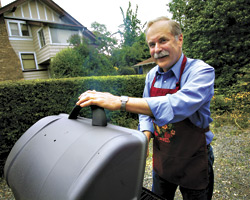
Peter Goldmark is running for lands commissioner as someone who can relate to the struggles and sensibility of the eastern side of the state. And he fits the part. Goldmark’s a rancher, rugged and mustachioed; more comfortable in jeans and boots than slacks and loafers. His campaign Web site displays him on horseback, comfortably sporting a cowboy hat. And if elected this fall, Goldmark would be the first in this statewide position to have cut his teeth on the drier side of the Cascades.
But the Okanogan-bred Democrat and rural firefighter isn’t all country. He’s a molecular biologist and former state Director of Agriculture who’s also pitching himself as the greener of the two candidates—and he thinks Glacier Northwest’s mine on Maury Island, an open wound in these parts, will help him make his case.
Goldmark will likely be playing up his environmental bona fides this weekend, when he’ll be the guest of honor at a Vashon Island fundraiser hosted by Rep. Sharon Nelson, a Maury Island resident and founding president of Preserve Our Islands, a nonprofit that’s long battled with Glacier.
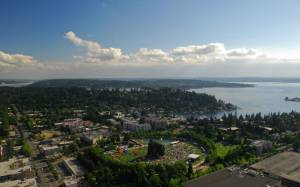
Connected to Vashon Island by a narrow isthmus, Maury is home to about 2,000 people and the site of a bitter decade-long battle over whether to allow Glacier, a concrete and cement producer, to expand its gravel mine and ship the materials it extracts off the island.
Entrenched in this debate is the eight-year incumbent commissioner, Republican Doug Sutherland, long criticized by environmental groups as being too cozy with the timber and mining industries. “Maury Island is really a poster child for what’s wrong with the Department [of Natural Resources] right now,” says Amy Carey, current president of Preserve Our Islands. “It’s an aquatic reserve that’s being proposed for an industrial operation.”
Lands commissioner is a statewide post that oversees more than five million acres of public land, including that which lies under the waters of Puget Sound. While Glacier’s proposal is tied up in a complicated web of permission that touches many levels of government, the state lands commissioner will have the final say on a critical aquatic lease the company needs to expand its output. Glacier’s permit currently allows for extraction of around 10,000 tons of material per year. The expansion they’re seeking would allow the company to remove up to 7.5 million tons per year, which would make it one of the largest sand and gravel mines in the country.
Opponents of the mine point to a number of things Sutherland has done during his tenure to assist Glacier’s efforts. One is an exemption Sutherland added in the current aquatic reserve plan for Glacier’s Maury Island dock, a facility the company hopes to expand for barge use in the future. Another is his resistance to a study, included this year in the state’s supplemental budget, to determine whether the state has ownership rights to minerals on the island.
Sutherland says the exemptions made to the aquatic reserve weren’t just for Glacier, but included other areas, like marinas, where there is a working waterfront. He also adds that the protection plan was completed with full public input. On the minerals-ownership question, Sutherland says sand and gravel have not been considered minerals in the same vein as gold and zinc since Washington became a state in 1889.
“There’s a lot of thrashing around, trying to figure out whether that was right or not right,” Sutherland says. “The legislature wanted to take a look at history. Our folks have already looked at it.”
This isn’t Goldmark’s first shot at public office: He garnered 44 percent of the vote in a 2006 bid to unseat Congresswoman Cathy McMorris Rodgers, who represents the eastern third of the state. Now as then, the hope is that Goldmark, like Montana’s recently elected Senator Jon Tester, can be a new kind of Democrat, one who can speak about horses as easily as hybrids.
Raised in Spokane, Sutherland made his career on the west side of the mountains. He served as a council member and mayor of Tacoma for a decade before being elected Pierce County Executive in 1993, and often touts his ability to work across party lines in a state where most of the top jobs are held by Democrats.
As lands commissioner, Sutherland survived a spirited challenge from Shoreline firefighter Mike Cooper, who received 47 percent of the vote in 2004. Sutherland says he’s weathered criticisms of being a pal to industry before and he’ll do it again. “My opponents have been trying to paint this picture of me for a long time and it’s never stuck,” he says. “There’s a reason for that.”
But Goldmark argues that on the mineral rights issue, it’s clear Sutherland’s playing politics—and protecting his “old boys’ club” in Olympia.
“You would hope that the commissioner of public lands, as the ultimate trustee of the people of the state, would see that it’s his fiduciary responsibility to see that the public’s interest is protected,” he says. “This is another example of where he’s helping his political supporters and donors. There certainly appears to be a conflict of interest here. It’s very regrettable.”
For this race, Sutherland has already collected donations from Glacier totaling $2,800, the maximum amount that was allowed when the company gave in 2007. More critically, he was flagged by mine opponents last session for giving a heads-up to a lobbyist for the Washington Aggregates and Concrete Association (which represents Glacier) about the mineral-rights study. “I understand there’s some talk about legislation regarding Maury Island,” Sutherland wrote in an e-mail. “You may want to run your ground wires.” When asked about the note, Sutherland says he was simply sharing information, and that he’d do the same for his “Democrat friends.”
Rep. Nelson says the battle over the island demonstrates the basic difference between the two candidates. “Doug Sutherland is backed by mining and timber, two of the industries he’s supposed to regulate,” she says. “He’s given the mining community what they wanted, and he’s taken an environmental program and destroyed it. I don’t think Peter Goldmark will do that. I think he will listen to the citizens.”
However, while Goldmark’s quick to criticize the incumbent for getting cozy with industry, he sounds more politician than champion when asked for specifics about the Maury situation.
Would he close the loophole in the aquatic reserve plan? “Obviously I would entertain that,” Goldmark says. “That would depend largely on the vision and the plan for recovery of [Puget] Sound.”
Would he do what he could to stop expansion of the mine? “I’m skeptical as to whether that activity will be consistent with the recovery plan of the Sound, but I don’t want to put myself in a position that would prejudice myself before I see the entire range of issues involved in that particular project,” Goldmark says. “I’m very concerned about it.”
But environmentalists, at least for now, are willing to give the Eastsider time to get up to speed. “He’s going to obviously be a little cautious,” says Peter Goldman, director of the Washington Forest Law Center. “He’s not an environmental renegade; he’s a rancher. The environmental community doesn’t have a slam dunk with him. He’s going to require a lot of education…but he’s not going to hold back change and fight science. That’s what Sutherland has done very successfully.”
Clifford Traisman, state lobbyist for Washington Conservation Voters, agrees. (Goldmark landed WCV’s endorsement earlier this month, in part because of his interest in Maury Island.) “We’re not expecting to have some long-haired liberal as our next commissioner of public lands,” says Traisman. “We want someone who’s going to give us a fair and even approach.”