The fact that Pacific Northwest Ballet now has a trove of Jerome Robbins’ work in its repertory is mostly due to artistic director Peter Boal. A Robbins protege back when he danced for New York City Ballet, Boal is now in his third year running the Seattle ensemble, past the initial thrill and well into more complicated challenges. Beside the repertory additions, he’s added some glitter to the performances, recruited several new dancers—most of them former colleagues or students from NYCB—and reached down into the corps de ballet for some of his major casting decisions. Like many younger ballet directors, he treats the group more like a contemporary company, an ensemble of equals, rather than following a strict hierarchy.
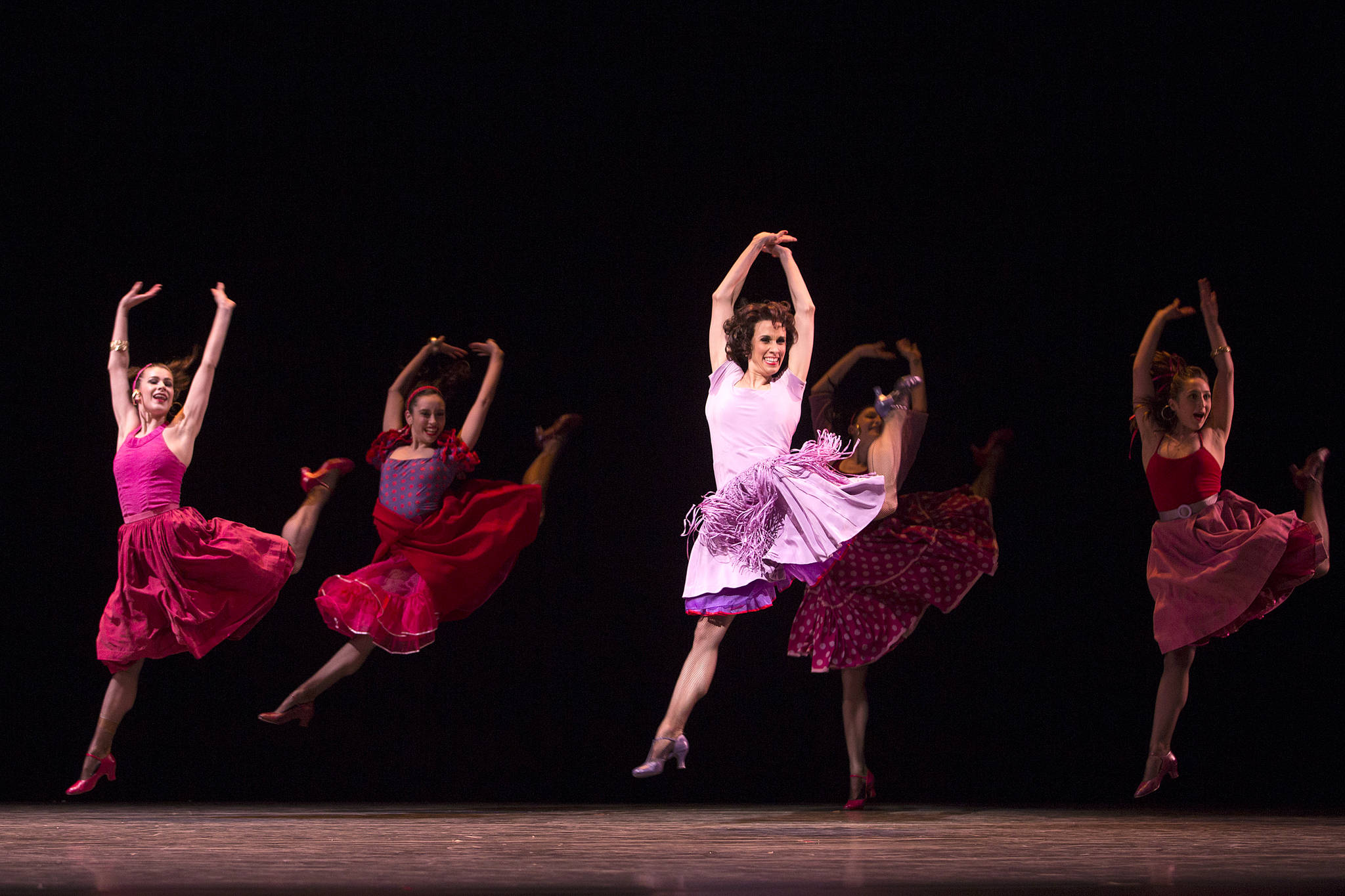
That was in evidence during PNB’s “All Robbins” program—especially the second night’s performance of Fancy Free, Robbins’ first-ever ballet, with music by Leonard Bernstein, which premiered in 1944. While the first night’s cast (including principals Casey Herd and Noelani Pantastico, who are leaving the company at the end of these performances) gave a polished reading of the sailors-on-shore-leave plot, the second night’s cast really sparkled. Corps de ballet dancer Kiyon Gaines handles the athleticism of his role easily, and his attention to acting puts his version over the top. When he finds himself the odd man out, his reactions are dead-on, thumbing his nose at the slight. And as the “shy” sailor, fellow corps de ballet member Jordan Pacitti is just right, the sweetness of his legato phrasing in his solo melting our hearts. Principal Jeffrey Stanton’s rhythmic skills as a tap dancer play into his rhumba-influenced solo (Robbins’ own, originally), so that there is a true connection between dancer and conductor.
The three couples in Robbins’ In the Night, a 1970 piece by Robbins set to the music of Chopin, represent three aspects of love, and the relationships between partners run the gamut from volatile to formal. Young love dances in unison—long, spinning turns with arms wrapped around themselves, sweeping across the stage—while mature love steps regally through a polonaise. The passionate couple rushes together and parts, over and over again, until finally, in the ballet’s most exposed sequence, she walks across the stage to him and kneels at his feet. When he picks her up and carries her offstage, we wonder how happy an ending this actually is. In the first two casts Pantastico and Maria Chapman are both charming as young lovers, Carrie Imler is very self-possessed as mature love, and both Kaori Nakamura and Louise Nadeau tear up the stage in the passionate role.
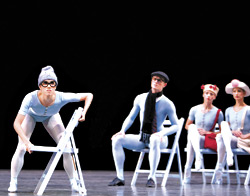
The underlying gimmick of The Concert—that we watch the audience at a piano recital act out their fantasies and desires—gives license for all kinds of silliness: wife-murdering husbands, a rubber-limbed ensemble of out-of-sync ballerinas, and a stage full of butterflies chased by a net-wielding pianist. Nadeau and Miranda Weese both stand out as a wafty music fan, Jonathan Poretta chomps his cigar with relish as the husband, and Benjamin Griffiths cringes nicely as a young man forever in the wrong seat. And Jodie Thomas, who showed wonderful comic timing as the Nurse in Romeo and Juliet earlier this year, continues to grow here, her portrait of an obsessed audience member deftly riding the line between realism and satire—I wasn’t sure if I’d giggle at her, or avoid her on the street.
Boal’s moves entail a certain amount of risk. His repertory choices are becoming more heterodox, with a significant chunk of work coming from modern choreographers like Marco Goecke and Victor Quijada, as well as crossover artists like Twyla Tharp and Mark Morris. Designed to appeal to a young audience—and long overdue in a company of PNB’s size and reputation—the changes in repertory have the potential to alienate the core of the subscribers and donors.
Plus, any change creates a certain amount of chaos, and we’re seeing that in play right now. With Herd and Pantastico leaving, and other principals out on medical leave, there’s a strain on the remaining dancers. Then there’s the regular challenge of pleasing every segment of a large group of artists: Apparently conductor Stewart Kershaw was less than impressed with one of Boal’s first schedules, asking: “But what about the trombones?” For that, they’ll have to bring back Balanchine’s Stars and Stripes—it’s to Sousa and it’s been in the PNB rep for many years.