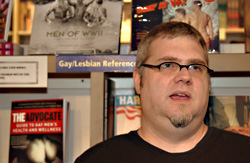
“My building just went condo last year,” says Michael Wells, a gay man in his 40s who heads the Capitol Hill Chamber of Commerce. After 12 years in the same red-brick apartment, Wells found himself a victim of what might be called the de-gayification of Capitol Hill, a familiar lament from his customers at Broadway’s Bailey/Coy Books. “I hear that more and more,” Wells confirms. “I think it is happening to more and more people.”
Wells is still a Capitol Hill resident for now, seeing in the neighborhood the same virtues that have made it a tolerant mecca for young, educated people—gay and straight—moving to Seattle over the past 40 years. “There are so many rental buildings, and there’s so much happening,” he maintains. “And you don’t need a car. In the early ’90s, we were as gay as gay could be.”
But now, as Wells is well aware, apartment conversions and tear-downs are creating a condo boom—Trace! Brix! Press!—that’s displacing some of the Hill’s traditional residents. Over the past eight years, the median price for a condo in Capitol Hill’s 98102 zip code has risen 62 percent to $322,000, according to the Northwest Multiple Listing Service. That’s well beyond what your average waiter or part-time actor can pay.
On paper, at least, the gay and lesbian market would seem well suited to the Capitol Hill condos coming on line. According to Community Marketing Inc., a San Francisco consultancy, the median national gay and lesbian household income is $80,000. Home ownership rates are 59 percent for lesbians and 41 percent for gay men (versus the national average of 66 percent). And when it comes to living alone in a condo, versus sharing a larger home, 42 percent of gay men report themselves as single, as opposed to 23 percent of lesbians. (Nationally, 26 percent of the population lives alone.)
And 98102’s concentration of housing, located within a golden commuting circle so close to downtown, makes it an ideal area to invest those dollars in residential real estate. Yet Capitol Hill may be getting less gay as the city and suburbs around it become more diverse.
“The gay and lesbian community, specifically in the past 10 years, has really assimilated a lot,” says Wells. “Moving to the suburbs is in some ways a revolutionary act.”
If you’re gay and can afford to buy real estate, do you really want to make that investment in a neighborhood where small, independent bars and shops are fast disappearing, street kids hang out on the sidewalk all day, and your friends can’t find a place to park when you invite them over for dinner? Suddenly, Ballard and West Seattle look pretty gay-friendly. And where, really, are you more likely to be harassed by a carload of drunken frat boys when you’re holding hands with your same-sex significant other: the Pike/Pine corridor or Market Street? Which feels safer at night? And which is closer to Whole Foods and PCC, or—for the fast-growing number of gay and lesbian parents—nearer to playgrounds and good schools?
Nationally, there’s a dispersal going on from traditionally gay urban enclaves, an incremental reverse gay migration (see accompanying article by Laura Onstot). From Chelsea to the Castro, the decline of the old “gayborhood” has many alarmed. Capitol Hill is now subject to the same insidious market dynamic: Gays come, settle, and spur neighborhood gentrification. Real estate values go up, and the younger, poorer gays get priced out. Meanwhile, older, wealthier gays who can afford to stay may, in fact, not want to.
Sympathetic to both sides, Wells sees generational and economic forces at work. Boomer gays may have aged and matured to a different idea of fun than during their freewheeling 20s. “I think it’s less about the bar life than the changing culture,” says Wells. Bailey/Coy isn’t a specifically gay bookstore, he notes, and it used to be one in a row of independent, somewhat upscale retailers along Broadway. “We need to attract a stronger retail mix,” he adds.
Wells deplores what he calls “the dumbing down of retail” on Broadway, along with commercial rents that have escalated to favor the likes of American Apparel, teriyaki stands, and check-cashing joints. (Tellingly, even the old Taco Bell is now being replaced by a mixed-use condo development, along with the vacant former QFC block.)
In the old days, Wells recalls, Broadway’s clientele was split between local pedestrians and housewives from the wealthier 98112 zip (east of 15th) who drove their Volvo station wagons west to Keeg’s for home furnishings and Bailey/Coy for books. Now he sees an analogous division of wealth in the increasingly dispersed gay community: “I can tell you that those gay boomers with their SUVs who don’t want to park on Broadway aren’t so different from those [housewives] over by 15th. Twenty years ago, you never would’ve compared those two, and now they’re similar.”
Of course, there are different benchmarks of what makes a neighborhood gay—not just the bars and clubs, but the overall mix and sensibility of residents and merchants.
“I think an Apple store on Broadway would be fantastic!” says Wells. But such a desirable urban mix of the tasteful, the chic, and the well-chosen may likelier be found in Fremont, Ballard, or even U Village than on the Hill. How gay is that?
Scan the Sunday Seattle Times real estate ads, and inevitably, between the smiling blond heterosexual couples, there will be the single guy, handsome and well-groomed, perhaps posing with a pug in a stylishly appointed loft.
“Sometimes you see two guys in the photos,” says Mark Gutkowski, a broker associated with Coldwell Banker Bain, who runs his own Web site, urbanHOMOwner.com He has the same problem showing gays or straights anything affordable on Capitol Hill—affordable meaning anything under $400K. Less well-off clients he steers north to Lake City and beyond, or south to Kent.
But Gutkowski doesn’t see Capitol Hill’s demographic changing overnight: “There’s always going to be the gay rental component, [but] some of that inventory is going to go away.” Citywide, the sudden spike in condo conversions—which began in 2005—has slackened somewhat, according to the Department of Planning and Development, and state measures are expected this year in the Legislature to further protect renters in endangered buildings. However, local consulting firm Dupre + Scott Apartment Advisors has tracked a steady decline in the city’s rental vacancy rate from 7.5 percent in 2003 to around 4 percent last year. Over the same period, the firm has charted a steady rise in rents—which tends to drive distressed renters to either move or buy.
Then there’s the matter of what prosperous, professional gay men living in half-million-dollar condos want to do with their limited free time. “The bar scene is starting to get smaller,” says Gutkowski, alluding to the closures of neighborhood faves like Man Ray, Pony, Thumpers, Blu, and Tugs on Belmont. “The need for gay bars is lessening—for some people.”
While gay bars won’t disappear from Capitol Hill tomorrow, their winnowing speaks to a parallel socioeconomic trend. Twenty years ago, when rents were cheap and condos rare, there was also no Internet—i.e., no quick and easy means of hooking up without a physical meeting place. (Nor were there any well-paying tech jobs for gays at, say, Amazon or RealNetworks.) Apart from personal ads, gay bars and clubs were a primary means of connecting, part of the social glue that knit the community together, the Stonewall tradition preserved in bricks and mortar.
Today, if two young gays connect online from bachelor pads in, say, Columbia City and Greenwood, they might still meet for the first time in a Capitol Hill gay bar—or a Starbucks, for that matter. But if they get serious, fall in love, and opt to buy a shared home, there’s not going to be much nostalgia steering them back to the Hill. If they’ve got the money to buy a luxury one bedroom, maybe—but if they want space to barbecue in the backyard, there’s always Kent.