
What’s a 6-foot-tall, half-Norwegian, lesbian self-defense expert to do after losing her lover? If she’s Aud Torvingen, the answer is clear: leave Atlanta for Seattle with a friend who’s looking to expand his chain of cafes. If you’re Aud, of course, the answer is always clear. And Always is a fitting title for the third book by British-born, Seattle-based Nicola Griffith to star noir-hero Aud Torvingen.
After inheriting $70 million from her father, Torvingen—who practices aikido at damn near dan level—makes the mistake of purchasing industrial real estate in Seattle, which is soon being used to shoot a movie, one that’s doomed by a rookie director and complaints from both OSHA and the EPA. She soon finds herself embroiled in a whodunit involving real estate, zoning permits, and a film project gone awry.
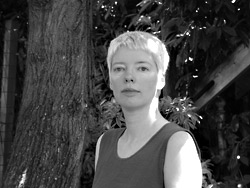
A few autobiographical echoes are clear. Griffith moved to Seattle in 1995 after six years in Atlanta, the hometown of her partner, the writer Kelley Eskridge. (The two met at Clarion East, a sci-fi workshop in Michigan.) Griffith first made her name as a science-fiction writer, and she’s edited three volumes of Bending the Landscape—gay and lesbian works of science fiction, horror, and fantasy. Griffith created Aud after wondering what kind of character she could write about who had neither hesitation nor regrets. And Aud’s story gets better with each book, as the plot moves closer to Griffith’s home turf.
Griffith, who once earned her beer money by arm-wrestling, peppers the novel with chapters from a self-defense class—”not just a skill, it’s a worldview”—she taught back in Atlanta. Here, the classes offer her ample opportunities to rail against the patriarchy and women’s learned helplessness: “You have been trained to seek approval, to please….It’s powerful training.”
Griffith seems to take pride in being able to describe each move: “I reached forward and down with my left hand and then under my right knee, almost a scooping motion, until my left forearm…” And so on. One early review touted all of the “bonus self-defense lessons,” but to me, describing the angle of each joint is less Elmore Leonard, more Martha Graham than necessary. It’s tempting to say that these spurts of research—I’ll spare you the industrial-zoning bylaw passages—are unnecessary to the story but key to understanding Aud.
Only after she unwittingly ingests “MDMA, barbiturates, amphetamines, opiates, psilocybin, and PCP, and some other substances that haven’t yet been classified” in a spiked pot of coffee does Aud dance in Pioneer Square in the middle of the night and wind up in the hospital, finally a victim herself. Alas, Torvingen’s intense introspection and self-analysis are but theoretical; she’s only truly shaken up after a drug-induced flashback. Even Aud’s infatuation with Victoria “Kick” Kuiper, the on-set caterer and former stuntwoman whose kiss makes Aud’s toes curl, gets parsed down to its essentials: “garlic and ginger made the mucous membrane of my inner lips tingle pleasantly.” Or the observation: “When an ovulating woman offers herself to you, she’s the choicest morsel on the planet.” If that ain’t love, shoot me now.
Even the women in the self-defense class earn no empathy: “I had encountered ignorance before in my brief stint as a community liaison officer,” says the apparently omniscient-since-birth protagonist, who sees all but her own runaway ego.
While Torvingen meets the criteria for the perfect noir hero—tragic past (lover killed last year), no day job to clock into (hefty inheritance), and smart as a whip—she also has a sense of brusque efficiency to rival a slaughterhouse’s. This failure to make (or admit to) mistakes of her own doing prevents the reader from viewing her as anything but a precise kick-butt machine that’s more Terminator than lovable character. Right when Aud intimates the idea of melting and falling in love, Always ends.
Despite Griffith’s increasingly layered portrayal of the recurring characters—and those lessons on self-defense classes, independent-movie financing, and industrial zoning—all that’s left to visualize are the coldly clinical renditions of the scenes. In other words, what the movie will be based on. But maybe that’s just the point.