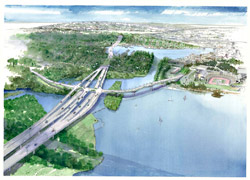
Rob Wilkinson is on a mission. Kind of like Richard Dreyfus with the mountain of mashed potatoes in Close Encounters, he sees something he’s sure is there, could be there—if only he could make other people see it. His obsession? The Evergreen Point Floating Bridge, and more specifically, the 520 interchange that connects I-5 with Bellevue, and Montlake with the University of Washington. In its place, the designer-turned-activist envisions a sleek array of lanes soaring over the water. A work of art, not just a way to get to work.
In the middle of his Montlake backyard studio office—”the war room”—is a model Wilkinson created with an architect and his 85-year-old mother-in-law. Curls of on-ramps and off-ramps connect to a bridge, like a spring onion in ice water. It’s a big contrast with the state government’s plans, which as Wilkinson puts it, have “all been variations on the theme of huge and ugly.”
Like the Alaskan Way Viaduct, the state Route 520 bridge is aging, is heavily used, and was damaged in the 2001 Nisqually earthquake. Gov. Gregoire has declared the replacement of the 44-year-old structure a priority. And as with the viaduct, the project has been stalled amid a morass of vocal competing interests, financial shell shock, and political paralysis. But unlike the viaduct, there is not endless citywide discussion and “I Heart 520” bumper stickers being sported around town. While the city focuses on the waterfront, the eastern corridor—equally important, busy, and vulnerable to earthquakes and windstorms—is not engendering the same passions. At least, not for most people.
Next week, the Seattle City Council will pass a resolution outlining its hopes and aspirations for the new bridge. While the resolution does not endorse any particular design, sponsoring council member Richard Conlin supports Wilkinson’s, and is “pretty convinced this is the right solution.”
“We specifically crafted the resolution…[to say] what are the things we want to see happen, as opposed to endorsing one plan or another,” says Conlin. “We don’t want to get ourselves caught up in that situation—like we got caught up in the viaduct—where essentially we’re out front saying, ‘We want this,’ and then all kinds of other complications emerge. What we wanted to do is lay out what are the criteria, what are the steps that we think are important in making the project work. It’s the state’s clear responsibility to select an alternative.”
Worry about the state Department of Transportation’s aesthetic deficit is precisely what got Wilkinson and his neighbor, Jonathan Dubman, a Microsoftie, into this debate. In 1994, the two had a look at the state’s proposals for the bridge replacement and were horrified. “If we didn’t do anything, we were going to end up with this basic six-lane disastrous alternative,” says Dubman, referring to a proposal that’s come to be known as Base Six. Recognizing that “this is something we’re gonna have to live with for years,” Wilkinson and Dubman came up with a design they dubbed the Pacific Interchange and formed an organization to spread the word: BetterBridge.org.
Over the past 10 years, the two have attended endless planning meetings and have earned the ear and respect of local and state officials. “[Wilkinson’s] been a great guy to deal with,” says Patrick Clarke, a structural design manager for the Washington State Department of Transportation. “He comes with solutions instead of road blocks.”
Wilkinson, 59, knows a thing or two about design and artful architecture. A furniture designer with an urban-planning background, he has also photographed public art throughout the world for the past 24 years for his business, Art on File. “This neighborhood is no longer blue collar as it was in the ’50s,” he says of Montlake. “There are people who live in million-dollar homes. You can’t put something in there that’s ugly without a fair amount of push-back. I can’t imagine that people would accept Alaskan Way Viaduct–quality design.”
Plans for the new bridge have been kicking around for about 10 years now, through two governors and various designs. Last December, Gregoire announced that 520’s replacement should have six lanes, thus eliminating the four-lane options that were once on the table. What’s left is BetterBridge’s Pacific Interchange option and Base Six. One look at the competing plans, and there’s no contest. Base Six curls chubby tentacles around Montlake and spills out chunky swaths of concrete. The Pacific Interchange sends sleek lanes soaring upward in a streamlined flow. (Both designs can be found on the BetterBridge Web site.)
Two elements in particular distinguish BetterBridge’s design from the other option: It incorporates a connection to the new light-rail station planned for Husky Stadium, and includes an appeal to a world-class designer to step in and make this bridge a landmark. Someone on the order of Santiago Calatrava, the Spanish engineer and architect known for his stunning and graceful white structures that match function with elegance. His bridges and buildings are airy and natural, evoking wings and vertebrae, ridges and shells, often bird-inspired forms. His work has been commissioned throughout the world, from Tenerife to Bilbao.
“Calatrava is a very good example of someone who brings poetry to a very prosaic field, which is public engineering,” says Richard Andrews, the director of UW’s Henry Art Gallery, a Montlake resident, and a friend of Wilkinson.”We should be clamoring for structures that are aesthetically valuable in our public landscape.” The Henry hosted an exhibit of Calatrava’s work in 2004. At that time, Andrews gave the artist a tour of the area and the 520 bridge, and asked him if he’d be a part of the project. Calatrava said he would consider it, once they have a more tangible project in hand. “It would be incredible to have him involved,” says Andrews.
Andrews mentions Calatrava’s 2004 Sundial Bridge, a steel, granite, and glass cable-stay pedestrian bridge that angles upward into a giant sundial. It has helped define the relatively small town of Redding, Calif. (pop. 87,000), and cost $23 million. “This could have been a simple engineering task, but instead he created…a centerpiece for Redding,” says Andrews.
For 520, Wilkinson envisions a “metaphorical nest”—the entanglement of the interchange—out of which “flies the bird”—the wingspan of lanes. “Calatrava does those great zoomorphic designs. So you have the bird flying out of the nest. Why not?”
There’s one giant “why not,” of course: cost. Wilkinson and Dubman’s plan is the most expensive option on the table at $4.4 billion. Dubman feels the state has underfunded the project so far but hopes private donors will step forward. “It’s clear there is a passion in Seattle for good design.” He cites SAM’s Olympic Sculpture Park and the Rem Koolhaas Central Library as examples of successful public and privately funded ventures. “Things are looking pretty good right now, except we still need $2 billion, which,” Dubman laughs, “is a lot of money. But there’s a lot of people interested in it.”
A good design is likely to cost more, says Clarke of WSDOT. “They usually do.” He adds that “Calatrava-type bridges are notorious for cost overruns.” Clarke admits to being more of a meat-and-potatoes, “form follows function” guy, but also states that “bridge engineers always like to take pride in what they build.” While aesthetics are a consideration, the key issues are “safety and mobility,” says John Milton, WSDOT’s project manager for 520. But he does allow that “Calatrava is one possibility.”
“When have you been on a bridge and been thrilled, where you turn off and want to go over it again?” says Andrews of the Henry. “It seems that we could aspire to some level of poetry in the structure.” And then someday, we might see those bumper stickers crop up around town.