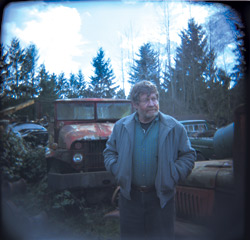
A sign recently appeared outside Chuck Pillon’s house that’s raised the eyebrows of his neighbors. It reads: For Sale.
“I don’t think it’s for real,” says Julie Hardebeck, who runs the Coalfield Boarding stables next to Pillon’s property. “I think it’s just to throw the county off.”
Julie and her husband, Jack, have a right to be incredulous. Pillon’s been their neighbor since 1977 in the Coalfield section of May Valley, an unincorporated area of King County east of Renton. So far, all of Pillon’s movements have indicated a process of entrenchment, not a wait-for-the-sweet-development-deal-and-cash-out maneuver. After he moved in, for instance, Pillon flattened his hilly property with dirt and various refuse materials.
Julie thinks Pillon’s landscaping job opened up an underground stream, because her stables promptly flooded. “The horses were standing in water in their stalls,” she says. “Every year since then, it’s been a problem.”
Then the rubbish haulers started coming. Broken-down automobiles would appear at the base of Pillon’s driveway—then vanish. Lawn workers would chug up the hill with loads of debris and come away smiling with empty truck beds. A friend of Julie’s who visited Pillon’s place gave her an insider’s view: “He said there was a guy sitting there in the middle of the driveway with a chair and a table, taking money from people,” she recounts.
That guy turned out to be a Vietnam vet named Skippy, one of several homeless people who had taken to living on Pillon’s land.
As time passed, the Hardebecks were alarmed to see an advancing wall of commercial washing machines, semis, and sailing vessels—patrolled by barking dogs—threatening to crest onto their own land. Beyond, the verdant rural pasture had died. In its place came twisted construction material subbing for shrubbery, truck hulks for boulders, sandblasting material for grass, and horse poop for dirt.
The locals began referring to Pillon’s project as Iron Mountain. It was not a slope for beginners. Bonfires flared up on its face, sending smoke columns miles into the sky and firefighters into their engines. A nasty lavalike liquid flowed through, too. Susan Clarke, a water-quality compliance manager for King County, tested one of the ponds Pillon built in his junkyard and came up with nearly 500 times the fecal coliform count present in average storm water. She believes the contamination was a result of Pillon’s composting efforts.
“His feeling was by mixing this barn waste and taking these cars he’s wrecking and putting them in this pile,” Clark recalls, “the metals and bacteria are all going to work together and take care of each other.”
County inspectors gave Pillon his first fine—a lien of $16,000 for the hill flattening—in the early ’90s. At that point, Pillon took the opportunity to tell The Seattle Times: “If the county wants a war with Charlie Pillon, they’ve got a war with Charlie Pillon.” Nowadays, the war tab’s up to about $120,000 in fines and two criminal charges, with at least seven county and state agencies breathing down Pillon’s neck. “One time, they brought seven code-enforcement officers up my driveway,” says the 66-year-old Pillon. “It was like a field trip, a training day.”
For all its threats, the government’s impelled the junkman to pay just $13,623. Pillon continues to accept solid waste and vehicles against legal decree, and has also humiliated area bureaucrats by tackling public-safety projects that he claims certain agencies are too lazy or stupid to do themselves. These include dredging flooding wetlands, destroying salmon-conservation projects, and building a new highway turn lane from scratch. He hasn’t been jailed for any of these alleged malfeasances.
If indeed there is a war on, all signs point to Pillon winning. Except for that For Sale sign on Pillon’s property: Jack Hardebeck reports that the real-estate company listed on it is legit. Could it be that the King of Iron Mountain is poised to wave his white flag after all?
On a January afternoon, Pillon conducts a tour of Iron Mountain. Using a road fortified with old carpet and ground-up roofing material, the brawny, bearded ex-cop stomps through crusted waves of mud, his work gloves flopping in his butt pocket.
He points out a truckload of asbestos-tainted roofing material, which he plans to dispose of “as soon as I can afford the dumping fees.” Beyond that is his million cubic feet of compost, which is enriched with a bucket, a boat, and a bulldozer. Farther off is a triple-drum yarder. Pillon towed the big rig home himself, navigating the narrow streets in a less-than-professional fashion. “We took off every mailbox from May Valley Road to my house,” he boasts.
Pillon finally arrives at his most treasured possession: a 1941 Mack fire truck. About 20 years ago, one of Pillon’s many tipsters—a guy named Snodgrass—called him up and said, simply, “I got a fire truck for your ass.” Pillon and his younger brother, Kenny, a lieutenant with the Renton Fire Department, planned to restore it and ride it in local parades.
“We used to laugh about who was going to get to drive the goddamn thing,” says Pillon. “I told him I’d drive, and he could run the hoses.”
But Kenny died before he’d get the chance: A machine tipped over and crushed him while he was working on a rockery. Now Pillon has a fire truck that can’t shoot water and a “fire station” (i.e., a shed) that causes him to choke up when talking about it. The junkyard’s full of emotional bombs like that; Pillon says he’s ready to let it all go.
“It’s just time to get hold of life again,” he says.
There is, however, one bit of unfinished business for Pillon: proving that Iron Mountain is, in fact, a valuable public amenity—something his detractors have refused to believe. Pillon claims he and his junk-addled fiefdom have gotten abandoned cars off the road, provided refuge for the poor and sick, and even helped solve drug cases. Pillon plans to bring all these community assets to light in a federal anti-harassment suit he’s filed against King County, which could go to trial in a matter of months.
“The fact that I lost control of this thing over time is simply my bad luck,” he says. “But it serves a real purpose, as neighbors will tell you.”
Pillon has long suspected that his clump of stuff could be of wider use to humanity. He got the opportunity to prove it in 1994, the year after his brother died.
There was an intersection of Highway 900 that was known for its above-average rate of car crashes. The Washington State Department of Transportation had a plan to fix the problem with the road, but progress was being held up by a patch of protected wetlands. “There are probably three million extra acres of that stuff out here in East King County,” says Pillon. “And yet these twits—and I’ll say that in good humor—were holding out: ‘Oh no! My God! You might lose some grasshopper or snake or some damn thing if you encroach on those wetlands.'”
The impossible stupidity of the government was front and center in Pillon’s mind back then, an opinion no doubt influenced by the code-enforcement officers already sniffing around his property. At Leonard’s Bar & Grill, Pillon would ridicule the petty tyranny of bureaucrats among a group of like-minded friends he dubbed the Coalfield Boys Club.
It was after a few drinks at Leonard’s that Pillon realized he had all the equipment necessary on Iron Mountain to fix the intersection himself. He soon went to get his rubber-tired backhoe, then contacted a friend at a gravel pit and told him to leave his gates unlocked. Over the course of a couple weeks, sometimes working at night, Coalfield Boys Club volunteers poured gravel and installed iron culvert. When they were done, there was a functional turn lane where once there was only environmentally sensitive land.
The DIY effort is still lore among civil servants. Says Lorena Eng, regional administrator for the Transportation Department: “It’s like somebody not liking your yard and coming out and saying, ‘Well, geez, it’d look better if you graded your yard a certain way,’ and they come out with a bulldozer.”
“We had to block it off because it wasn’t appropriate,” she adds. “We had to correct what he did.” There hasn’t been a fatal accident at the intersection since the government fine-tuned Pillon’s pro bono construction work, according to the Transportation Department. “Because we fixed that intersection,” Pillon claims, “we saved lives.”
That incident marked the beginning of Pillon’s career as a freelance Mr. Fix-It, government permission be damned. Whenever he got a whiff of danger from the lowlands, he’d “start walking around in circles,” he says. “Then I have a beer. And then I think, ‘Ah, fuck it. I’m going down there.'”
In 2001, the May Valley Creek was flooding over onto 164th Avenue Southeast. Pillon didn’t possess the proper equipment to subdue the gushing, but he had friends in the construction industry who did. Piloting a steel-plated trackhoe to the offending tributary, Pillon scooped out 500 linear feet of silt, trash, and beaver dams before driving back home, the raised arm of his trackhoe tearing down “about eight phone lines.”
But despite his self-proclaimed heroic deeds, the government wasn’t about to overlook Pillon’s own questionable property. In 2002, troopers from the Washington State Patrol served a search warrant on Iron Mountain, finding nearly 100 junked cars as well as homeless people living in ramshackle trailers. Another raid in 2006 revealed that little had changed. Trooper Willie Hernandez, who led both raids, wrote in a report last October that Pillon “feels that he does not need any licenses because he is trying to be a nice guy by having the public drop their vehicles on his property for disposal.”
“It’s just a sewer up there,” Hernandez says now.
After the latest raid, Pillon was charged with a gross misdemeanor for wrecking motor vehicles without a license. (Pillon has pleaded not guilty and will appear in court to address the charge on March 7.) And recently, Pillon’s watchful eye fell upon salmon conservation installations known as “large woody debris”—basically logs the government sticks into streams to slow down water and provide shelter for fish.
To Pillon, they’re death traps: Swimmers and tubers get sucked under them, and one girl almost drowned. So last July, Pillon and a buddy brought a chain saw to Cedar River, where children had nailed a diving board to one such installation. Kids stared from the opposite bank while the two men cut through the debris and dragged it—along with the diving board—from the river. The stunt earned Pillon a felony charge of first-degree malicious mischief.
“They’re out there,” says Larry Fisher, a habitat biologist at the Washington Department of Fish and Wildlife. “Way out there.”
Pillon grew up in the Yakima Valley town of Wapato, with parents who’d lived through the Depression. One of his earliest memories involves straightening bent nails with a hammer and brick for his dad, who wanted to reuse them. “Charles,” his father said, “if a man made it, a man ought to be able to fix it.”
Eventually, Pillon decided he wanted to fix society, too, and in 1964 joined the Seattle Police Department. As a cop, he combined equal parts Columbo and Rambo. His first line of attack was good-natured engagement of his perps: Pillon refused to talk down to junkies and used his squad car to shelter packs of prostitutes from the cold. His humanistic reputation led to invaluable tips, he says.
“He was a great narcotics officer and knew how to talk with those people,” says John Sullivan, a retired cop who served with Pillon and now runs the city’s police-pension program. “He would’ve cleaned up the whole damn city and made it a lot safer had he been given a free rein.”
But then there was Pillon the action figure, crashing through the door of one house and recovering stolen goods and a gun, only to realize afterward that the house he was supposed to storm was located down the block. A photograph Pillon still carries from his cop days shows him with his foot to a door; it’s captioned “Knock Knock.”
“I loved the element of surprise and good humor,” he says. “I loved getting the dopers, and then sitting down with them and having a laugh about it afterward.”
But Pillon sometimes fell behind on the more mundane aspects of police work. “He didn’t have time sometimes to follow the rules that hamstring a lot of police,” says Sullivan, such as the timely filing of drug evidence into the property room.
In 1987, Sgt. Pillon received a transfer to SPD’s communications department, which he didn’t take kindly to. Pillon instead went on vacation, thinking, “I’ll be home. When you got a patrol assignment, give me a call.” No call came, and he was fired the next year for going AWOL.
Pillon retreated to his 10 acres in May Valley, planning to dot them with new homes and perhaps a mining-oriented theme park. But he found the county had restricted his zoning: Where once he could build 10 homes, now he could only build two. Again, Pillon was screwed.
But one day in the early ’90s, a logger named Steve Hansen walked into Leonard’s Bar & Grill carrying a dilemma. He had left a trailer park because he couldn’t get along with a nettlesome associate and needed a place to dock his 35-foot fifth-wheel. While he was asking the bartender for leads, a stranger stepped up to him and told him the search was over. It was Pillon. “He said, ‘Yeah, you can park it up at my house,'” says Hansen, now 55. “‘You don’t have to worry about paying no rent. Just work a couple of days—I got plenty to do up there.'”
Hansen towed his trailer to Pillon’s place and, in one astonished glance, discovered how Pillon had been spending the years since his dismissal from the police department. Scores of cars were lined up on the dirt. Men were running over them with bulldozers and knocking them in the head with trackhoe arms. Then they’d scramble to pick up the valuable metals that fell off. Iron bins stood nearby, full of scrap waiting to be sold. In the middle of the commotion was a towering house that Chuck and Kenny Pillon had built, in part using recycled lumber from a Seattle pier.
“I thought it was pretty cool,” remembers Hansen. “Anytime you needed a car part, you just walked out the door and looked around a couple different directions and you’d find it.”
The logger parked his ride among other trailers and RVs surrounded by a picket fence. This encampment constituted the realm of serfs in Pillon’s monarchy. Hansen paid Pillon rent; others were more or less squatters. There was Wayne, an alcoholic with throat cancer, and Vietnam vet Skippy, who used to sleep in a car behind Leonard’s. When not taking money from yard-waste haulers, Skippy would relax outside his trailer on a chaise lounge. He spent many a day in that fashion, his Agent Orange–wrecked body baking in the sun, sharing beers with a dog named Moe.
For Pillon, who was coming off his second divorce, having people around meant something. “Rather than see these poor bastards once the bars close in the weather, I said, ‘Well, c’mon—Christ,'” he says. “Four guys at a time was the most I ever had at once. I realized then that’s too many drunks even in a big place, because they’d get to quarreling and fighting and screaming and shit.”
Pillon needed the extra hands to manage his material accretion, which had begun with the selective acquisition of vintage cars and machinery but ended in the wake of his divorce with near-indiscriminate collecting. His son John helped a little, fixing autos with his dad when he wasn’t working at a local mechanic’s shop. John died last year of cancer, and Pillon keeps a boardwalk-style caricature of him in his house: a handsome young man carrying a wrench and a woman in the background cooing, “WOW. Look at the size of that tool.”
But there was always too much work to do. Pillon had earlier assured himself of a stream of trashy autos by contacting May Valley’s notorious illegal dumpers and telling them to dump their vehicles at his place instead. The cars piled up, with Pillon’s crew racing to scrap them for about $50 each.
The operation wasn’t without its flaws, a notable one being the mixing of an imbibing workforce with large, powerful equipment. Wayne was the primary offender. “He’d be on the machines with a maniacal look on his face,” says Pillon. “He’d be running backward when I said forward and would crush [stuff].”
Pillon once watched Wayne roll over a nice utility trailer so that it looked like “somebody had torpedoed a jungle gym.” He waited until Wayne had come to a stop, and then pounced. “I jumped on the track next to the cab of this thing and I grab him by the fucking throat,” Pillon says, “and I threw him right off the thing, and I said, ‘That’s it. You’re not running the fucking trackhoe again.'”
“That was back in rodeo days, man,” says Hansen. The junkyard regulars would build bonfires with trash, drink beer, and shoot guns, the ammo from which sometimes rained down on the neighboring Coalfield stables. Just as their bonfire started raging, the fire department would invariably come up the hill to put it out. At moments like that, Hansen remembers Pillon getting philosophical.
Says Hansen: “After they’d leave, he’d throw the beer can in the fire and say, ‘Jesus, we had a really good fire going, too. I don’t know why they keep coming by. They wonder why I got such a mess up here, but they won’t let me burn it up.'”
A county helicopter hovered over Iron Mountain in 2002, taking pictures. A few blocks away, a man known as Crackhead Keith jumped out of his house window. He thought the chopper was coming for him and spent the rest of the day hiding in the woods.
Pillon knows this story because he heard it at Leonard’s from Crackhead Keith. He’s got open lines of communication with May Valley’s drug users—lines that snake through his pile of debris.
Iron Mountain is strewn with the vehicular collateral of addiction. Many are still property of the owners: Pillon just held on to them for a little cash on a temporary basis—much in the way a pawnshop would—to help the owners pay court bills, child support, or personal expenses. The blue Bronco in his driveway is such a car. Its previous owners show up to haunt it every once in a while, taking a few salable parts away when they leave.
Pillon didn’t need to advertise to reach this kind of clientele. It came to him, one form of desolation seeking out another. “They are absolutely walking dead, victims of the drugs that have consumed them,” he says. “I am the terminus of their desperation.”
When he walks through his junkyard, Pillon often encounters the same breed of hard-core dopers that he did walking around South Seattle as a cop. He treats them with sympathy. Faced with a junkie trying to swap a hubcap for a motor, Pillon will sit the man down, have a beer and a chat, and maybe send him off with a lesser car part. “Without naming his name, one of my kids got cranked up on dope,” says Pillon. “This shit hits every family.”
His association with May Valley’s underworld puts the junkman at the receiving end of a lot of snitching. When he gets a juicy tip, he’ll pass it to the cops. Or, as often as not, he’ll attempt to follow up on it himself.
Pillon has been extending his cop career without official recognition for over a decade. He and another activist closed a crack house in Beacon Hill in 1989, an event written up in The Seattle Times, and Pillon’s been on a roll ever since. “At 7 in the morning, he’d be walking up the road, whistling,” says Jack Hardebeck. “This valley became his beat.”
In 2002, the junkman helped clean out a Renton motel known for drug activity. Around the same time, Pillon quieted drug trafficking at a private residence when he walked into the house and confronted the “homies” himself. “I reminded them that my roots in the Central Area of Seattle go back at least as far as theirs,” he says. “And I would consider it a maximum sign of disrespect if they kept bringing this dope out here, because I was retired and didn’t want to refight the Central Area battle.”
Pillon is now working on a suspected drug house where a neighbor counted 229 different vehicles pulling in and out during a recent 35-day period. That neighbor’s been forwarding license-plate information to police for weeks, but finds that the cars keep coming. Pillon is using a different tactic: He’s taking the house’s occupants to court under a nuisance-property statute, bolstering his case with testimony he obtained from two “crackheads” who have a car stored on his property.
“Now do you understand why we really like ‘Hang ‘Em High Chuck’?” says the neighbor, speaking anonymously. “There’s a certain value in harassing these people out of the state of Washington.”
Such is the brunt of Pillon’s anti-drug efforts. He’s like the annoying, tagalong guy who everybody wants to ditch but can’t. “He sneaks around all the time,” says Jeff Willard, a junkyard regular and former drug user. “A friend of mine was renting a duplex, and the guy in the bottom was screwing around with dope. And shit—Chuck, all of a sudden, he just magically appeared in the middle of the night and scared the hell out of him.”
“Sometimes the information he provides is helpful,” says Sgt. John Urquhart, spokesperson for the King County Sheriff’s Office. “And sometimes what he does is a little over the top and not helpful.”
This past January, Pillon demonstrates how Iron Mountain PD gets its man. The procedure begins around midnight in a bar, where Pillon quaffs a few beers. Then he climbs into his girlfriend’s Volvo and sets off to his target: in this instance, the suspected drug house. He drives slow and straight down a poorly lit part of Highway 900, passing a billboard for The Purpose Driven Life, and arrives around 1 a.m.
In front of him is the suspect’s trailer, which neighborhood scuttlebutt has concealing a meth lab. The trailer sits on a pair of axles that came from Pillon’s own collection. Pillon sniffs the air. What’s he smell? “Nothing yet,” he says. “That’s what predators do, though.”
A man emerges from the house. He wears overalls and talks in a quick, rough monotone. He knows Pillon is behind the court order that could have him evicted in weeks, yet the two are cordial. “Nobody’s ever approached me with [accusations] except for Chuck here,” explains the man. He says his neighbors have a different, potentially more damaging attitude: Call 911.
“Last night they had that fucking chopper out there,” he complains. “Everybody takes pictures of me 24 hours a day, accusing me of having a meth lab.”
“Where you headed?” asks Pillon. “Let’s grab a beer at Doofer’s.” (Pillon no longer conducts his meetings at Leonard’s, as the bar recently closed. Doofer’s is the new Leonard’s, and Pillon finds it doesn’t have the same ring. “Doofer’s is kind of uptown, if you will,” he says later.)
“I don’t drink beer, and I don’t hang out too much in the bars,” replies the man.
“How are the axles?” asks Pillon. “Are they mine or not?”
The two eventually set up a meeting for the next day. Pillon ends the night by barking at a dog and yelling, “It’s time to kick ass!”
The other day, Pillon found a piece of junk on a remote part of his property that’s covered with blackberry brambles. It turned out to be the Ford Escort that Skippy once used to pick up beer and smokes at a nearby store. Pillon crushed it.
Skippy died a couple years ago. The junkyard occupants found him in his trailer, an apparent victim of alcoholism. Pillon and friends attended his funeral and poured a six-pack of Bud on his grave. “Skippy, he was here to stay,” says Pillon. “I knew that.”
Death is never far away in the junkyard, which shouldn’t bother an old street warrior like Pillon. “The death I had to deal with as a cop almost put a callous on that, I felt,” he says. At homicides, he’d disregard rules about crime-scene contamination and allow the victim’s family a peak. “I’d take the mother in and let her sit there for five minutes and just soak up the reality of it. I got my ass chewed a couple times.”
Today, though, Pillon seems to have developed a deeper sensitivity, probably due to the death of his son. John’s souped-up pickup still sits in the yard, a reminder of the junkyard’s own inevitable demise. “I apologize to nobody. I was always hoping that John could run a home business from here,” says Pillon. “Then, when he was gone, it just became time to take a second look.”
There’s been a flurry of activity in the past few years on Iron Mountain. It might be imperceptible to the county, but the flow of junk has been slowly reversing. Pillon is jettisoning things that years ago he would’ve shot intruders for stealing: scaffolding, I-beams, homeless people. When a young man came up his driveway recently asking for a place to stay, Pillon turned him down. That leaves Iron Mountain with a homeless count of one: a friend of John’s who works on cars.
“[Chuck’s been] calling us, telling us what he’s trying to do,” says Jack Hardebeck. “He’s being real friendly,” adds Julie.
There have even been yard sales—though, of course, these aren’t your normal affairs with Grandma’s china and a lemonade table. Signs recently went up around May Valley advertising a paint blowout at Pillon’s place. “One of the girls here, a [horse] boarder, she went up there to buy paint and she got bit by one of their dogs,” says Julie. “It bit her right in the stomach.” (Pillon says he’s unaware of such an incident.)
As for the prospective sale of his property, a John L. Scott Real Estate representative says he’s negotiating a $1 million–plus deal for Pillon’s property with a local developer. And supervising the cleanup of his property—listed as one of the State Department of Ecology’s “hot sites” in 2003—doesn’t worry him. “I could make $10,000 cleaning it up, just selling off the metal and stuff,” he says. His compost blend will remain where it is, as good humus goes for $10 a cubic yard. “I’ll be bargaining around that when I finally sell the place,” he notes.
Pillon plans to spend his immediate days off Iron Mountain on vacation, maybe touring the United States or dipping into some hot springs. Then he wants to settle back in May Valley, where he’ll finally be able to work on all the neat machinery he hasn’t gotten to play with yet.
“I’ll have the money to start putting some of this stuff together and restoring it,” he says. “And it’ll be better.”