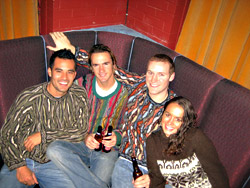
Andrew Coates and his father, Peter, are drinking beer and watching basketball in Andrew’s cluttered Lake Union condominium at approximately 9:30 on a Friday night. Both men are wearing garish, multicolored cable-knit sweaters, known in pop culture parlance as “Cosby sweaters”— so named for the famous comedian and his eponymous 1980s sitcom. On the dining room table are a half-dozen more, which Andrew’s friends—among them soccer star Kevin Sakuda
of the Seattle Sounders—will eventually slip on before heading to the Del Rey in Belltown for a night out.
Twenty-five-year-old Andrew claims Belltown is the best place to don Cosby sweaters because the clientele there is more uptight and fashion-conscious than in other areas of town. Whereas Coates and his posse might get a smattering of startled looks were they to walk into a neighborhood pub in, say, Wallingford, at the Del Rey, they’re viewed as circus freaks—an element Andrew is fully conscious of as he and his crew form a dance circle toward the back of the bar as it begins to fill.
The dance circle’s rules are relatively simple: One person does a single dance move, which is emulated by the next person in the circle, who follows said mimicry by adding a move of his or her own. This proceeds until someone cannot properly perform, in sequence, however many moves have just been executed. If the Del Rey is a pint of Guinness, then Coates and his crew are the shot of booze seeking to turn it into an Irish Car Bomb.
“Did you guys plan this?” asks one curious onlooker. “No,” replies Andrew. He’s lying: Wearing Cosby sweaters out on the town has become part of the 6-foot 8-inch former Ivy League basketball player’s regular weekend arsenal.
“They’re a social magnet,” he says. “People either ask me whether I really like the sweater or tell me it’s hilarious.”
Then there are the clubgoers who let Coates know just how much they hate what he’s wearing. “I like it when people get upset,” says Coates, the sort of person who will cheerfully cop to enjoying the hell out of dueling piano bars. “It’s asinine to me that what I’m wearing could be offensive to them. I don’t take myself seriously, and I find it funny when people take themselves seriously. I just want to lighten everybody’s mood. [The Cosby sweater] is a great icebreaker, but it’s also, ‘Hey, I don’t take myself too seriously, and neither should you.'”
Me? I hate sweaters. I consider them to be a totally impractical garment in a climate as mild as Seattle’s. When I get a sweater for Christmas, as I inevitably do, it is shuttled in short order to the Union Gospel Mission, tags and all, where some poor fellow who sleeps on the sidewalk might actually wear it in lieu of a suitable nighttime blanket.
Yet on this night in Belltown, I’ve agreed to walk a mile in one of Peter Coates’ sweaters, a mock turtleneck with a purplish palette from the high-end Australian manufacturer Coogi (a lone Coogi sweater can retail for upward of $400). Its pattern can best be described as a grotesque play on retro– video game chic: It looks as though Ms. Pac-Man ate all the fruit in her maze and then puked it back up on my chest. As I take a solo lap around the Del Rey, all eyes focused a short distance beneath my neckline, I begin to experience what Drew Daniel of the San Francisco–based electronic music outfit Matmos considers the Cosby sweater aficionado’s chief esoteric attribute: “the thrill of the perverse.”
On Oct. 21, about a half-mile south of the Del Rey, Matmos took the stage at Seattle’s Triple Door nightclub. Acclaimed for their collaborations with the eccentric Icelandic pop singer Björk, the band is fronted by Daniel and Martin Schmidt, who hates Cosby sweaters. Daniel, meanwhile, has come to embrace them, which explained the ultracheesy, bejeweled piece of knitwear he wore throughout that night’s performance. (“He just likes ugly stuff,” says Schmidt of his partner. “It possibly explains his enduring love of me.”)
“I rock a slightly femmier, African-American secretary type of sweater,” says Daniel, who, like many enthusiasts, broadly defines the Cosby sweater to include just about any crewneck number with an inordinate amount of graphic flair (a classification that includes Christmas sweaters). “I like the bedazzled ones that have jewels and gems on them. It’s a little faggier. Our guitarist, Nate, was also rocking one onstage. It didn’t make him look like a drag queen—it made him look like a wizard.
“[People] feel like they have to say something. Even if you’re on a bus, people are like, ‘nice sweater, man.’ They’re certainly eye-catching, and I guess maybe troubling. It doesn’t scan as punk rock or metal. It’s kind of unto itself. It’s not right for me: I have a Mohawk at the moment. But I’m 35, and I don’t want to be dressed like Fall Out Boy onstage. The Huxtable position is easier for folks in their 30s.”
Postal uniforms, mesh hats, bowling shirts, wool-lined jean jackets, snap-up cowboy shirts, platform shoes, polyester bell-bottoms, wife-beater tank tops, and tight vintage tees: It seems that, in the realm of hipster apparel, virtually any garment, however dated, is capable of a tongue-in-cheek encore. But if the Cosby sweater catches fire, it could signal the apocalypse of ironic fashion statements. Yes, there’s a fine line between utterly unfashionable and superhip—but the Cosby sweater may well mark the end of that line.
“[There’s] always a watermark for what is, fashionwise, unsafe,” says Daniel. “And the Cosby sweater is sort of the ne plus ultra of bad taste.”
Anna “Banana” Lange, owner of the Capitol Hill boutique Pretty Parlor, first started noticing the roots of a Cosby comeback “about a year ago,” she says, and was “completely startled” by the sweater’s reappearance.
“I went to high school in the ’80s, and that’s exactly what I wore,” says the 33-year-old Lange, who grew up in Montana. “Guys wear them to fit and a little more preppy, whereas girls wear them a little more Valley Girl—with an edge. But it hasn’t fully come back; there are still a lot of ‘ew’ comments. It’ll take a while, but by next year at this time, oversized cable knits with belts and leggings will be in.”
Dressed in a yellow CBGB OMFUG T-shirt and sporting pink-dyed hair, Lange sits at the register of her vintage clothing boutique on Summit Avenue while a co-worker named Ruthie sews a customized wedding dress for a client she refers to as “the mother of the bride.”
“There’s a fine line between ugly and hot,” says Lange, who credits urban women in their early 20s as the pioneers of the still-embryonic Cosby resurgence. “And it takes cool people to turn ugly to hot.”
One of those people is Whitney Gould, a clerk at Red Light Vintage on Broadway who moonlights as the synthesizer player in the local band White Gold. Gould, whom Lange refers to as “the epitome of a straight male fashion icon,” has been known to don Cosby sweaters and firmly believes they are “primed for a comeback.”
“It’s kind of a ripple,” concedes Gould. “But on the Hill, people have been wearing them more often, and girls have been wearing the ugly thick-knit sweaters for quite a while. The more hideous, the better.
“The Christmas sweater is a term used by people who aren’t aware of the power of the Cosby sweater,” adds Gould. “The Cosby sweater is a rare gem with all kinds of patterns and colors. You can still wear pretty normal clothing otherwise, yet you have this nice piece of flair that can be covered up by a jacket. But once that jacket opens up, the whole world is in awe.”
While Lange says that “if shoulder pads come back in, then we have a problem,” neither she nor Gould believes that the Cosby sweater represents the Armageddon of ironic fashion statements.
“That’s where underground style comes from: the ugliest you can be,” says Lange, who predicts flannel and thermal underwear grunge fashion will eventually pick up where the Cosby resurgence leaves off. “The indie-pop crowd wants to wear what no one else is wearing.”
And where to find clothing that no one else is wearing? Low-end thrift stores like Value Village, whose Capitol Hill outlet currently devotes two full racks to used cable-knit sweaters, roughly half of which are deserving of the Cosby classification. From here, sweaters made by Coogi wanna-bes such as Crossings, Northern Isles, Saturdays, Traditions, and Lord Jeff will be thrust forward in the boom-bust-boom fashion life cycle, likely ending up in the Pretty Parlors and Red Lights of the world before moving on to Urban Outfitters and the Gap.
“Once it gets sold at Target and K-Mart, it’s a trend,” says Lange. And, of course, once it’s a trend, the cool people have long since moved on to their next reclamation effort.
Now an accomplished musician and spoken-word performer as well as actor, Malcolm-Jamal Warner gives all credit for the Cosby sweater’s rise to pop culture prominence to The Cosby Show‘s costume designer, Sarah Lemire, who Warner says had to stake out a middle ground between the real-life Cosby’s paradoxical fashion affinities.
“Mr. Cosby would always come to work in sweats and sandals,” says Warner, who played Theo, the only son of Cosby’s character, Dr. Heathcliff Huxtable. “And when he went out, he’d always be in a suit.”
While Lemire confirms it was her idea to outfit Cosby in what would become his signature sweaters, she gives the legendary comedian credit for insisting that the show, which aired from 1984 to 1992, feature a wardrobe in the here and now—a counterintuitive strategy in the TV world. (Through a publicist, Cosby declined to comment for this story.)
“He wanted people to talk about the clothes,” explains Lemire, “so that’s why the show is so very, very ’80s. Most TV shows, you try not to do that so it has a little longevity in reruns. But that stuff [in The Cosby Show] was pretty trendy, and that was on purpose.”
There was also a technical reason Lemire chose to outfit Cosby in those gaudy sweaters: Unlike blouses made of more free-flowing fabrics, the tight-knit sweaters rarely rumpled from take to take.
“[Bill] would ad-lib on the show,” recounts Lemire. “The director would go crazy if he couldn’t use a take he really loved because of clothing problems [i.e., lack of consistency in the way a garment looked in different shots]. I couldn’t have stuff moving around on him, and the sweater was pretty controllable.”
Around the end of The Cosby Show‘s run, the Museum of the Moving Image in Astoria, Queens—located across the street from the Huxtable family brownstone depicted in the show—began collecting and displaying Cosby’s sweaters in an ongoing exhibit.
“He was the icon, not the sweater,” says Rochelle Slovin, the museum’s director. “To be honest with you, this kind of sweater was a very typical suburban style during the time of the show. In the suburbs, you could have gone anywhere where there was a middle-class man of a certain age, and those middle-class men were wearing this sort of highly patterned pullover. The fact that those sweaters were worn by a very important American comedy performer was the motivation for our collecting [them]. Had he been wearing white T-shirts, we probably would have collected white T-shirts.”
Still, say Warner and Lemire, there was something about those sweaters.
“The ’80s were really corny, but we thought [the sweaters] were really cool,” says Warner. “Now we look back and say, ‘oh, geez.’ But back then, they were the shit.”
“They became wearable art,” seconds Lemire. “One sweater I used in the show was based on a Gauguin painting from his South Sea Island period.”
Ironically, Lemire swears she never put a Coogi—the high-end Australian brand that has become virtually synonymous with “Cosby sweater” in the cultural lexicon—on Cosby’s back on the set of the show. But that didn’t stop Coogis (pronounced KOO-jeez) from experiencing a meteoric rise in popularity—especially among African-American athletes and the people who admired them—at exactly the same time Cosby was on the air. Bryan Burwell, a sports columnist for the St. Louis Post-Dispatch who covered the New York Knicks for Newsday back in the ’80s, witnessed the Coogi explosion firsthand.
“It was like every other urban fashion phenomenon: You’re not really sure how it gets started, but once it gets started, it catches on like wildfire,” says Burwell. “Everybody had one.”
Former Sonic center and current assistant coach Jack Sikma charts a more Darwinian course when explaining the Cosby sweater’s popularity in the NBA during the 1980s, when Sikma was one of the league’s elite post players.
“It was a time that a lot of guys were wearing sweaters with big figures, swirls, and colors,” says Sikma, taking a break during warmups before a recent home game against the Orlando Magic. “We were in between ’70s patterned shirts and the suit and tie. I think the turning point was when [Gordon Gekko–like Laker and Knick head coach Pat Riley] started wearing tailored suits, and coaches realized that a more professional statement probably meant more money, too.”
While Cosby sweaters dropped off the fashion map when the show went dark in 1992, the late Biggie Smalls and other rappers kept them afloat in black hip-hop culture into the ’90s, wearing and name-checking them in music videos.
“Where I’m from, a lot of younger guys wear Coogis,” says Duane King, a young black businessman (and former basketball teammate of Andrew Coates at Penn), who moved to Seattle from his native Louisville in August. “A lot of it has to do with rappers. That’s how IZOD came back: Jay-Z wore it in the “Fiesta” video with R. Kelly, and it blew up.
“The Coogis have a high price tag, so it’s also a status thing,” adds King. “But we don’t associate them with Cosby at all these days. We associate them with hip-hop.”
Peter Coates munches on his salad in a Tukwila Applebee’s, wearing a multicolored Coogi sweater. Coates’ wife, Treacy, hails from Tamworth, the country music capital of Australia, and he credits her with turning him on to the brand. But because a single Coogi sweater costs so much, Coates owns only two of them. They, along with multiple Coogi knockoffs, are in heavy rotation in Coates’ wardrobe—mainly by virtue of utility.
“They’re colorful, have interesting patterns, and aren’t very heavy,” explains Coates, who earned degrees from both Yale and Harvard before settling in Sammamish. “It’s not cold enough here to wear wool sweaters very often.”
While Peter Coates hasn’t been back to Australia since 1989, Treacy visits her birthplace at least once every two years. Two trips ago, she was asked to fulfill an unusual request: After years of ribbing his dad for wearing Coogis, Andrew wanted one of his own.
“It surprised me because, when I bought it for him, I thought the time for Coogis had passed,” recalls Treacy. “But he wears it, and he looks really cute in it.”
Initially, the Coatses failed to catch the wink-wink motivation for their son’s peculiar desire. Having since been clued in, however, Peter nonetheless seems unruffled by his son’s desire to publicly send up what his father considers to be a perfectly normal, functional garment.
“I don’t think it bothers him,” says Andrew of his dad. “At some point in his life, that was legitimately the coolest thing for him to wear. So he just kept running with it.”
Indeed, if there is a portion of the population that is more or less tone deaf to the whims of fashion, it’s white male baby boomers with adult children. Peter Coates is a card-carrying member of this group, as is fellow Coogi enthusiast John Arthur Wilson. Now a public affairs consultant, Wilson (who was a staff writer at Seattle Weekly in the early ’90s) purchased his first Cosby sweater back when he was working as a correspondent for KING 5, the local NBC affiliate which aired The Cosby Show.
“Because I didn’t need to wear a suit every day, I’d wear the Coogi,” says Wilson, a husky man, over a bowl of miso soup at the Noodle Ranch. “They’re perhaps not the ideal sweater for a guy my size, but they demonstrate that I’m large and in charge.”
Over the years, Wilson would travel as far as the Saks outlet store in Auburn to seek out the hard-to-find Coogis. Then, seven or eight years ago, he made what he calls “the ultimate pilgrimage” to the Coogi flagship store in downtown Sydney, Australia.
“It’s a very brightly lit store with all these sweaters in it,” Wilson reports.
Wilson sees the Cosby sweater as “kind of funny, sort of retro—like a VW Beetle or Mini Cooper. We’ve gone through enough drabness in the last six years that maybe it’s time for some color again.”
Or, says Seattle Central Community College apparel design instructor Hisako Nakaya, maybe it’s just a telltale sign that the days of a top-down, monolithic fashion industry determining what’s in or out are over.
“You can’t really dictate what people wear anymore, especially with the recycling of clothes,” says Nakaya. “[My students] are exposed to a lot more than they used to be. People just wear what they want now. I don’t think you can really tell them what’s in fashion.”