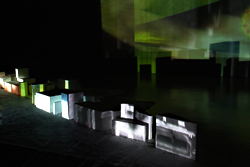
You need to pass through two closed curtains and stand in darkness staring at the floor to experience Floating Plaster/City Motion (pictured), a sleek and vivid installation experiment by video artist Robert Campbell and sculptor Yuki Nakamura. The piece is both contemplative and visually stunning. Two white forms on the floor are fragmented by sharp spaces into puzzle pieces, yet form the shape of what looks like rudimentary clay mockups of ships. Or perhaps blunt topographies of cities. Three projectors on the ceiling drape various images across these surfaces in an unpredictable sequence, slicing along them with pure white light, sending strobes across them, flickering an array of moving color images on each surface fragment. It is fascinating, yet not mesmerizing. The movement of the light demands too much from the eyes to lull them. If you look away, prisms of color appear when there aren’t any. Your brain has been tricked. Watching the whole cycle may well leave you feeling slightly motion-sick, though you didn’t actually go anywhere. It’s as if you have indeed experienced all the energy of a city—a Joycean experiment in compacted moments, here rendered in abstract visuals. It’s technically quite amazing that the projections are so precise. The show’s other collaboration is The Flattening and Opening of Space by sound artist Carrie Bodle and painter Margie Livingston. Cubic grids of white string are tethered floor to ceiling. Light projects through them, casting intermingling shadows, bringing three dimensions to light, combined with sound. The idea of the New Works Laboratory was to pair experimental digital artists with those working in more traditional media and see what transpires. Here both results are intriguing, but it’s Campbell and Nakamura who have, deservingly, been selected by the Henry Art Gallery to develop their piece for a show in November. That will be something to watch for. SUE PETERS
Brilliant Collaborations
Digital experimenters are paired with traditional artists, to dazzling effect.