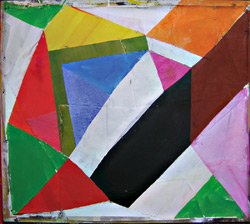
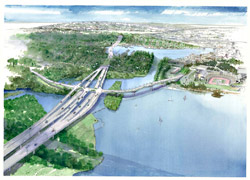
Usually the term “New Work” is a vague catchall phrase for whatever an artist happens to be doing at that moment. In the case of painter Michael Howard, though, he really means it. Normally Howard, 43, currently based in Milwaukee, paints pictures of recognizable buildings in muted oil tones. Suddenly he’s splashing canvases with luminous acrylics, slicing them into geometric shapes, and stapling them back together. “I wanted to be more straightforward with this work. I wanted the questions and work to be more immediate. So instead of using architectural imagery, as in past work, I wanted the work created in more architectural terms,” says Howard. Some of his creations are no longer paintings at all, but sculptural rectangles of colored fabric sewn together and hanging from wooden posts like banners. Yet this isn’t entirely a departure for him. A closer look at his previous paintings, notably his “Site” series of buildings in progress, reveals the same crisscrossing angles and forms—he’s applied a virtual zoom lens to focus on those angles and then pull them apart, wave them like flags. The forms are reduced to their abstractions; the solid framework of a house becomes fluid, limp, a kite awaiting the next breeze. Vivid yellows, reds, and green acrylics give the work a youthful, guileless air. It’s a jubilant exercise in deconstruction from an artist who was once focused on construction. “In the drapery pieces, I find the lines, the drapery—the tense suspension, relaxed folds, very dramatic, and all in the most clear and simple terms, but also in something fresh, like an exuberant graffiti form,” says Howard. “I find them very primitive, fresh and hopeful. It’s an attempt towards further developing a visual language.” Old fans of the artist may be startled or perplexed by this latest work. Perhaps that’s exactly what Howard intended. SUE PETERS
Michael Howard