The Rat Patrol
Published 7:00 am Monday, October 9, 2006
If you find a rat in your toilet, try to remain calm, counsels Don Pace. He is one of two workers who kill rats in Seattle’s sewers, and he says the first thing you should do if a rat shows up in your toilet is shut the lid. “They can jump out,” he says. Next, with the lid closed, take a bottle of dishwashing soap and squirt it into the bowl by using the opening between the seat and the rim of the toilet. The dishwashing soap makes the bowl and the pipe below it slippery, making it hard for the rat to get any traction. Then flush the toilet. Usually the rat goes down and doesn’t come back.
When Pace began working at Public Health–Seattle & King County, the agency actually responded to homes where rats found their way in through the pipes. On one of his first days on the job, Pace was responding to such a call when he encountered the biggest rat he has ever seen. “This lady was panic stricken,” recalls Pace. The rat’s “hands were underneath the lid, holding on to the rim,” he says. That foiled the normal flushing method. Pace was trying to figure out how to kill the rat in the bowl without letting the animal get out. Armed with a toilet plunger, he laid a towel over the bowl and prepared to plunge down. He knew he had only one shot at the rat. Neither hunter nor hunted could see the other because of the towel between them. Pace plunged down. He missed. The rat jumped out of the bowl. The homeowner screamed and slammed the door to the bathroom shut. Says Pace, “Now I’m trapped in the bathroom with a giant rat. I’m trying to hit him with the plunger or stomp on him.” Pace says rats make an odd noise when you are trying to crush them under your boot. “They do make a high squeal, like, ‘Don’t step on me!'” he says. Eventually, Pace squished the rat, but it wasn’t pretty. “I won,” he says, “but I was shaking when I came out of the bathroom.”
Nowadays, such an event elicits elaborate poison control of nearby sewers but no actual help with the intruder. There were about 65 calls in Seattle last year to Public Health–Seattle & King County about rats in toilets. Public Health only deals with rat-in-the-toilet complaints within the city, where the expense of setting out poison is covered by Seattle Public Utilities. If you live in the suburbs or unincorporated King County, refer to the first paragraph of this story and hope for the best.
If Seattle has a self-image of a clean city free of the pests found in teeming metropolises like New York, it’s wrong. Rats live all over, in neighborhoods rich or poor, dense or suburban, new or old. Says David Williams, a health and environmental investigator with the Environmental Health Services Division of Public Health–Seattle & King County: “You can find rats anywhere. You don’t have to look too hard.”
Rats come up in toilets in Blue Ridge. They run along telephone wires in Magnolia. Rats live in abandoned houses in Laurelhurst, scurry through the sewers on Beacon Hill. Rats overran Pacific Place mall three days before it opened. (Williams says the manager called him. “He said, ‘We just saw a rat running across the front of Tiffany.’ I said, ‘Was it wearing a tennis bracelet?’ The phone got cold in my hands.”) Rats eat the garbage accumulated by human “hoarders” in Wallingford, the Rainier Valley, and Ballard—those people who can’t bear to throw anything away.
There is no census of rats in Seattle and King County, so we don’t know how many there are, but there are certainly thousands upon thousands. Says Williams, “It might be several million.”
Williams and colleagues Teri Barclay, Carole Coombs, David Christensen, Mike Reed, and Pace are the members of King County’s Rat Patrol—the vital frontline workers who stand between us and rodent infestation. Some work to help educate the public about how to keep the rat population at reasonable levels throughout the county. Others kill the rats in Seattle sewers. But as Williams says, “You can’t bring in enough poison to kill them all.” People need to keep the rat population down by limiting the rodents’ food supply. The chief culprits are bird feeders, pet food, and garbage. When it comes to rats, ignorance is dangerous—for your health and your property. Come along. The Rat Patrol tells you what you need to know.
The outwardly normal appearance of the offices of the Environmental Health Services Division of Public Health–Seattle & King County is deceptive. On the seventh floor of the Wells Fargo Building, there is nothing, at first, in a warren of cubicles to suggest that this is anything other than normal class-A office space.
Then you meet Bentley.
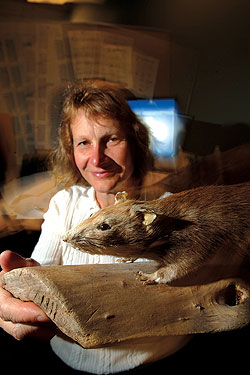
Barclay, a thin, middle-aged woman who dresses with casual elegance, carries Bentley, an enormous stuffed Norway rat, as though he is the most ordinary mascot in the world. The creature is repulsive, easily 20 inches from nose to tail, with a tawny brown coat, beady little eyes, sharp claws, and a great, fat belly. “He was well fed. He was old,” says Barclay with real affection.
Bentley was a wild rat that was captured, tamed, and abandoned by an unknown Seattleite. When a former Rat Patrol officer found him, he brought the animal back to the health department, where he was adopted and treated as a pet. When he died, he was stuffed. The dates and individuals are lost to history, but Bentley’s usefulness lives on. “He’s a good thing for education. We bring him to meetings,” says Barclay.
Bentley must be a good prop at budget time. There’s nothing like a 20-inch, 2-pound, disgusting rodent to remind politicians that appropriations for rodent control are important.
Barclay explains that the Norway rat, Rattus norvegicus, is the dominant species in King County and the rest of the U.S. It doesn’t grow quite as large in the wild as Bentley did. The Norway is called by various names, most derived from inaccurate human understanding of its habitat: the barn rat, the wharf rat, the sewer rat, the water rat, the house rat, and the brown rat. It is not always brown. Often it is gray or black. And most certainly, the Norway did not originate in Norway. Scientists believe it comes from Central Asia. The other rat in our area is Rattus rattus, aka the roof rat, the ship rat, the old English, or, most commonly, the black rat. This species is not exclusively black. It can be tawny or brown. It is typically smaller than the Norway, 12–14 inches at full maturity. In King County, the type of rat you have depends on what kind of food you provide. Says Barclay: “In neighborhoods where there are more garbage problems, you see more Norways. In neighborhoods where there is more feeding of birds, you see more roof rats.”
The black rat arrived in Europe before the Norway. Their skulls have been found in an English well that dates back to 300 A.D. Rats spread to North America by the time of the American Revolution and were recorded in every state in the union by 1926, according to Robert Sullivan’s book Rats. Rats live in the city, the suburbs, and the countryside. They spread disease with abandon both through their feces and by passing along the parasites that live on their bodies to other species.
Scientists have documented 55 infectious diseases that rats carry worldwide, according to Australian biologist S. Anthony Barnett in The Story of Rats—some viral, some bacterial, some fatal. The most famous disease is bubonic plague, but we don’t see much of that around the U.S. anymore. More commonplace these days are leptospirosis, a potentially fatal bacterial disease with flulike symptoms, and hantavirus, viral disease that attacks the lungs and can result in death, although rats are not spreading either in Washington currently. (This summer, deer mice have spread hantavirus into Whatcom County, and dogs have an outbreak of leptospirosis on Vashon Island, according to Barclay.) In King County, Public Health says rats have the potential to carry salmonellosis, a bacterial infection that causes diarrhea and fever; rat bite fever, which is caused by a bite or scratch from an infected rodent, causing vomiting followed by swollen joints; giardiasis, a diarrheal illness caused by a parasite; and tularemia, a bacterial infection that can result in pneumonia and skin ulcers. These diseases are rare locally, but Sullivan estimates that in the past century, rats have been responsible for 10 million human deaths.
The constant gnawing by rats is a bigger problem than disease outbreaks locally, says Public Health’s Williams. “Rats chew through wire. They cause structural damage that causes fire,” says Williams. Rats are always chewing on stuff, and scientists haven’t figured out why. Sullivan cites studies that say rats are responsible for 26 percent of electric-cable breaks and 18 percent of all phone-cable disruptions.
There are many exterminator companies out there that will help you with your rat problem—chiefly by poisoning the rodents. There are a couple of problems with this method. First, if the rat has been living in your house, it will eat the poison and crawl back into its burrow, where it will die and rot and stink. At that point, there is no sense in tearing apart your walls trying to find the dead rat. “You let it putrefy and desiccate,” says Williams. “It becomes a rat mummy.” If flies find the rat corpse within your walls and plant their eggs, then you’ve got another problem. Says Williams, “In the worst cases, you end up with maggots. One woman had maggots dropping out of the bathroom fan. The flies were really thick. It was a bad scene.”
That’s why Public Health recommends snap traps—characterizing them as “large, simple, cheap,” and “wooden.”
The second problem with the poisoning approach is that it doesn’t address the reason that most homes have rodent problems. The most important lesson that Public Health preaches is that humans have to remove the rats’ food sources. “Ninety percent of the reason that people have problems with rats are pets and bird feeders,” says Williams. “They provide a food source.”
When rats are not looking for food or eating or sleeping, they are breeding. A female rat can be fertile at any time except for the 21 or 22 days of her pregnancy. Twenty-one hours after giving birth, she can become pregnant again. Rats do not form couples. Instead female rats will copulate with many males within her burrow—up to 20 times a day. Under good conditions, this prodigious sex life produces many offspring—around seven to 10 pups per litter and as many as one litter per month. That’s why Public Health likes to ask: When does 1 + 1 = 29,560? That is the number of descendants a pair of rats and their issue can produce in a year’s time
Most King County Public Health house calls about rat problems are resolved with an educational pamphlet. There are a few, though, that prove to be a bit more intractable. Shafran’s Mobile Estates in Kent has one such problem. David Williams is on the job.
Williams, 55, is a short, wiry man with thick, spiky, salt-and-pepper hair covering his head. He has the strong, thick hands and fingers of someone who works with his hands for a living. Before Williams earned a degree in environmental health—”It’s like premed but with more math and science”—at the University of Washington and became a registered sanitarian with Public Health, he worked as a general contractor for many years. Before that he worked as a garbage collector, and as a vagabond youth he ate out of Dumpsters. He has a lively sense of humor, a keen intellect, and vast knowledge about public-health issues of all kinds. His combination of street smarts and university learning makes him a natural for his job as a sanitarian.
He also doesn’t have a fear of rats, which he ascribes to some early training from his grandmother. Williams was born in Seattle, but when he was 4 years old, he and his family went to live with his grandmother in France. His grandmother lived in an old apartment building that was full of mice. When Williams arrived, she matter-of-factly gave him a job to do when he woke up each morning: empty the apartment’s mousetraps. His grandmother instructed him to take each corpse, turn on the gas stove, and put the rodent’s nose into the flame to make sure the animals were dead. “That inured me,” he says with no trace of irony.
Says Williams, “There is a strong cultural element to the fear and loathing of [rodents]. Often I calm people down. By normalizing it, people will be more rational. People will do really stupid things to try to gain control. The first reaction people have is: kill, just kill. I urge people to take a step back and take a deep breath. The goal is a public-health one: mitigate impact. You can’t get rid of them entirely.”
Shafran’s, a 60-unit mobile-home park, is located across the street from the Riverbend Golf Course and the Green River trail and next to Russell Road Park. While someday it will probably be covered with fancy condominiums, currently Shafran’s features glorious views of Mount Rainier, $400-a-month rent, junk cars, children’s toys, and many rundown mobile homes. No home is in worse shape than number 27, the former residence of Mark David, who died in his bed last year around Thanksgiving.
David, from all appearances, was a compulsive hoarder. He didn’t throw anything out. His home was stuffed with trash. Hoarding is a psychological condition that is not understood very well and doesn’t have a generally recognized course of treatment. This particular case was complicated by the circumstances of a trailer park. The park’s owners own the lot that David’s trailer sits on, but they do not own the trailer or its contents. The mobile home and everything in it belonged to David and is now part of his estate. Shafran’s management says the David family has made it difficult to clean up and dispose of the trailer. For nearly seven months, the trailer sat, stuffed with trash, undisturbed by people. Guess who had a party?
In March, the rats became so abundant that you could see eight or 10 at a time dancing in the windows. Williams declared the trailer an imminent threat to public health.
On the day of his visit to Shafran’s, despite the fact that it is extremely hot, Williams is wearing thick corduroy pants and high, black leather boots. “You just don’t know what you are going to step on,” he says ruefully. “Some days the smell coming off my shoes is with me all day long.”
Williams, driving a white sedan with “Public Health” stenciled on the side, pulls up to the dilapidated beige trailer marked number 27. On the rickety green porch stands Rocky Rogers, the son of Arlene Woodall, Shafran’s manager. Rogers is over 6 feet tall and looks like he just stepped out of an outlaw biker movie. He has a long gray beard that hangs down to the top of his ample belly and a long gray ponytail hanging down his back. He has a dust mask resting on his forehead above his glasses, below a baseball cap worn backward. He is smoking a cigarette and looks hot and tired.
In the yard next door is the neighbor woman who discovered David’s body and called Williams about the rats. She is middle-aged with a large twist of gray-brown hair. She is holding a little dog in her arms and is talking over the chain-link fence to Rogers. Her yard is neat, with a little vegetable garden and pretty flowers. Two girls, a child and a teenager, wander in and out of her trailer.
Nobody greets Williams when he arrives. He shows no sign of discouragement at this lack of enthusiasm. Instead, he bounds up the walkway and congratulates Rogers on the progress that he has made. The trailer has been largely emptied of its garbage.
Rogers shakes his head and takes a deep draw on his cigarette. “You couldn’t see anything,” he says. David “was a clean person, but he never took his garbage out. Lots of pizza boxes and milk cartons.”
The neighbor woman says they always wondered why David barbecued so much—even in the winter months. “He couldn’t get to his stove,” she says.
Inside the trailer is a formerly beige rug that is stained dark brown and covered with what looks like miniature Raisinettes. They are rat feces.
Williams look unperturbed. “The only place I’ve seen more rat feces was a school in Seattle,” he says without emotion. (The school in question, by the way, was University Heights, and the rat feces were in the attic five years ago.)
There still are scattered cigarette butts, plastic milk bottles, cereal boxes, and juice containers. Against one wall is a big-screen TV that Rogers says weighs 2,000 pounds. Against another wall are two couches. Covered with filth, it appears they were once white. Between the couches is a dead Norway rat. “When you find dead rats, that means the population is so big that the sick ones are being pushed out,” Williams notes.
Williams sniffs the air. “If you are in a house and there are a lot of rats peeing, it’s like cat-spray odor. They are marking territory,” says Williams. “You can smell the ‘rattiness.'”
The air inside the trailer smells like a combination of mildew and some- thing icky and sweet. Williams says it doesn’t have the characteristic odor of rats, however.
In the kitchen, there are telltale signs of a severe rat infestation—long trails of grease marks on the wall. Rats prefer to establish their routes through the environment while in contact with physical structures like walls and curbs, rather than out in the open. Sullivan reports that scientists refer to this as “thigmophlic, which means touch loving.” Since rats have dirt and oils in their fur, as they skitter along their familiar paths, they leave a residue that records their routes.
As Williams is leaving, he asks Rogers if it would be helpful to write another letter to the city of Kent about the health hazard that the trailer continues to pose. Williams can also seek either civil or criminal enforcement and get the cooperation of other government agencies and jurisdictions.
Rogers says, “Letters do help.”
Over in the upscale community of Cypress Cove, Wendy Werner is hoping that Williams’ letter will help spur a community campaign against rodents. Says Werner, “It did freak me out when [Williams] said, ‘You have a severe infestation.'”
An image like Mark David’s trailer is undoubtedly what springs to most people’s minds when they hear “rat-infested home.” Werner’s community is the polar opposite. Cypress Cove is a private community built nine years ago—70 prosperous, suburban, single-family homes worth hundreds of thousands of dollars each. The houses are big, the yards are neat, and the streets are short. Werner’s home is on a cul-de-sac and has a lot of children’s toys on the porch and in the backyard. There is also a small vegetable garden and a cherry tree. In back of the house, there is a greenbelt that leads down to a stream.
Right next to the house’s foundation, there are some 15 mounds of dirt with holes next to them—rat burrows. “There is a lot of new development going on,” says Williams. “Farmland is being developed. They tear down the old barns. The rats invade the new houses. It’s all about food.”
Werner moved into her home when the community was built and put up a backyard bird feeder and started feeding her pets on the back porch. She quickly learned better. “I stopped feeding the birds because [the rats] were hanging out under the feeder. We don’t feed our dogs outside anymore,” she says.
Williams says the greenbelt in back of Werner’s home provides ideal habitat for the rats, and the blackberries growing there provide a food source during the summer months.
“I’m realistic,” says Werner. “They are there. It’s part of nature. We are not going to get rid of them. We are not the only ones having this problem. Two other neighbors have the same problem.”
Werner has hired a pest control company. They charged her $300 for the initial visit and $55 a month to maintain the service, but she knows she can’t reduce the rat population all on her own. “I might kill a few hundred of them, but they multiply faster than rabbits,” she says.
Werner is working with the board of her homeowners association to address the problem communitywide. “We should have some sort of help from the city or homeowners,” says Werner. If she doesn’t get the results she wants, Werner might run for an open spot on her homeowners association board.
Williams says, “They need to go on a community campaign. No one should be feeding their animals or the birds outside.” He notes with some frustration that he doesn’t have the time or the budget to jump-start such an effort, but he’s clearly hoping that Wendy Werner will take what she has learned from him and educate her entire neighborhood.
Williams says Shafran’s and Cypress Cove both represent problems that he deals with on a daily basis. “It’s representative of what I see,” he says. Williams seems to have only one regret about his job—that he can’t do more for each citizen that calls. “It would be great to spend more time at each site, but you can’t. There are only three of us for all of King County.”

On July 21, Pace, the sewer-baiter, stands at the intersection of East Hamlin Street and Franklin Avenue East, in the Eastlake neighborhood. He is following up on a complaint of a rat in a toilet nearby. Parked next to him is his white van, full of the tools of his trade, with orange lights that flash on top. A big bear of a man with short gray hair and a closely cropped beard, Pace wears aviator glasses with lenses that darken or lighten in response to the light and is dressed in jeans, a short-sleeved red shirt, and thick black shoes. He is a natural storyteller, with 13 years of rat stories. He’s worked for Public Health on and off since 1989. He used to do visits to homes that are themselves attractive to rats, like the trailer in Kent, but he prefers sewer work because, as Pace says, “When you respond to somebody who has had a rat in their toilet, they are always glad to see you.”
Pace says rats don’t mean to come up in your toilet. Rats find their way into homes’ sewer pipes a couple of ways. They use sewer lines to travel from place to place and to feed—either on scraps of food waste (preferably) or feces (if necessary). Sometimes, rats follow the scent of food from the main sewer line to a side sewer and into the pipes of a home. While crawling up the pipes, they are following a scent, looking for food scraps at the bottom of your kitchen sink. Maybe they make a wrong turn and end up in your toilet bowl. The other way they enter a toilet is by following the scent of a broken pipe in the side sewer. They dig down through the yard to the pipe, then try to trace that food smell back to its source.
Unlike when he started in this business, Pace no longer goes into homes to kill rats in toilets. He calls the resident and says he will be out within a week to put poison down into the sewer to try to reduce the local rat population and limit the possibilities of more rodent appearances in the bowl. That’s what has brought him to Eastlake on a hot, sunny day.
He takes a long steel hook out of his truck and adroitly puts it into one of the holes on the top of a sewer manhole. He pops the manhole out and pulls up a 13-foot string and notes with satisfaction that there is nothing on the end of it. That means that the rats have eaten the poison. He rebaits a small piece of copper wire on the end of the string with three blue, waxy rectangles. The active ingredient in the bait is Brodifacoum, which is the current poison of choice among rat killers. It is an anticoagulant that causes the rats to die from internal bleeding.
Pace pulls a huge, black 500,000-candlepower flashlight out of his van and shines it down into the sewer. There are many layers of brick below the street, six rusty rungs form a ladder on one side, and at the bottom there is a trough that the sewage water runs through. It smells like an outhouse. “I’m looking for droppings,” says Pace. Black, shiny rat feces are signs of recent activity. Gray, dull ones mean no rats have defecated in the area lately. Pace walks a couple of blocks south and goes through the same routine. He baits the manholes that are upstream and downstream from the site of the rat-in-the-toilet complaint. “It relieves the fear. You know somebody is out there. It gives [people] the feeling that they are safe,” says Pace.
When Pace is not responding to complaints, he is doing routine sewer baiting. He and his co-worker do 65 to 85 manholes a day. Block by block, neighborhood by neighborhood, they cover the entire city of Seattle in a two-year time period. Says Pace, “The thing about the sewers: There are no predators.”
It’s not certain how long the kind of poison Seattle currently employs will remain effective. Rats have become resistant to an earlier anticoagulant poison, Warfarin, and are developing immunity to Brodifacoum as well.
Rats have even survived nuclear bombs. As Sullivan recounts, there was a study of rats that were living on the Enewetack Atoll in the Marshall Islands during America’s nuclear testing program. The study found “that the rats had survived the blast by staying deep down in their burrows, and that, upon investigating, the only abnormality . . . was a change in the structure of the rats’ upper jaws, a change that did not seem to hinder the rat in any way.”
As a pest control firm representative once told Sullivan, “The bad news is rodents are going to win this war against humans. The good news is there’s a lot of business.”