Biker gang reformer? A little like taming lions, maybe. But El Presidente George figured to bring it off. The burly, goateed leader of the Bandidos Motorcycle Club promised peace for thunder road, vowing to steer the international organization toward a kinder, gentler reputation. Biker life ought to be more about chrome and oxygen and the open road, and less about indictments, he thought, having first fantasized about two-wheeling when he was a kid. Each day he’d walk past his neighbor’s shiny Harley Davidson, wondering what it was like to slide in the saddle, open the throttle, and fly away.
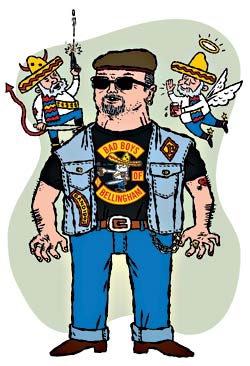
Appointed in 1998 by club leaders as president of the 2,400-member Bandidos Motorcycle Club, George Wegers, now 53, did launch a mini-revolution, putting an end to such warm biker traditions as pissing all over new members to make them feel wanted. Routine beatings, to show love and impart discipline, were also banned. He felt that the Bandidos nation, effectively operating out of Wegers’ Harley shop on State Street in Bellingham, could probably do with a little less speed, too–the kind that’s ingested, inhaled, or injected. At weekly church sessions, as chapter meets are called, Wegers ordained that the Bandidos, who favor Spanish titles and whose club colors feature a well-armed, pot-bellied Mexican, didn’t need no stinkin’ badges flooding through the clubhouse doors.
Yet in the end, there was the reputed good guy yakking away on the phone on April 28, 2005, stumbling down the path of imprisoned presidentes before him: “Make sure anybody, everybody, knows that we’re not talking to these people, and not talking to those people means not having any conversation with those people. . . . Them feds, ATF.”
Christopher Horlock, 44, a Bandidos national officer from Rapid City, S.D., listened quietly on the other end of the line as Wegers explained that U.S. agents were nosing around a Montana kidnapping case involving club members.
“All right, boss,” Horlock said finally, agreeing to conspire to tamper with witnesses in a federal investigation. “I’ll get it all straightened away.” Click.
Ultimately nabbed in a 19-count indictment, Wegers and 27 other Bandidos and associates were paraded into federal court last summer, later striking plea deals. Many were bearded and balding, some were in their 60s, prompting a courtroom media artist to stop Wegers’ attorney, Jeffrey Lustick, and say, “They look like a bunch of ol’ grandpas.” Wegers himself has heart problems and high blood pressure and regularly saw three different doctors. Divorced, with a grown son, two grandkids, and other family in Whatcom and Skagit counties, “George is intelligent, good humored, and just loved biking,” says Lustick.
Nonetheless, officials called the bust part of a takedown of dangerous motorcycle gangs in the Northwest. And it’s true that under Wegers’ control of a bureaucracy of local and national leaders, the Bandidos grew their membership and influence and were close to overtaking the Hells Angels as the world’s largest outlaw biker club. But Wegers also reputedly harped on reform to everyone—impressionable hang-arounds, eager bikers-in-waiting, and seasoned full-patch members. Members could still do their hairy-man thing, riding Harleys (the mandatory brand) through town with the ol’ ladies on board, drinking beer, and raising hell, just as long it never attracted more than a few patrol units. A minor larceny here and there could be balanced by a charity run. Otherwise, stay out of the papers was Wegers’ mantra.
More than 60 bikers and co-conspirators in two countries have been arrested from Vancouver, B.C., to Missoula, Mont., to Tacoma in the past year. In the United States, many charges stemmed from the Racketeer Influenced and Corrupt Organizations (RICO) Act. The busts included the Bandidos’ rivals, the Hells Angels, whose West Coast president, Smilin’ Rick Fabel of Spokane, and four other Washington bikers were arrested in February on charges of murder and racketeering. Fabel, 48, who ran the Angels’ empire from Nebraska to California, is also federally charged along with six other state Angels in a deadly 2002 biker melee at Harrah’s Hotel and Casino in Laughlin, Nev., which brought a total of 42 West Coast Angels indictments. In Vancouver, 28 Hells Angels face racketeering and gunrunning charges.
Canada, perhaps even more than the States, has been plagued by biker violence, including the April drug-deal murders of eight Bandidos in southern Ontario, essentially wiping out the local chapter. Mostly unknown to Americans, the Canadian Hells Angels and a Bandidos offshoot, the Rock Machine, have engaged in bloody battles around Quebec that have left more than 165 bikers and bystanders dead since the 1990s.
How does one reform that sort of behavior?
Friends insist George Wegers had only good intentions when he took over the Bandidos. A former cohort, ex-Bandidos national officer Edward Winterhalder, who has written a book about the club, says Wegers thought the Bandidos needed more members who simply were “men of respect, not pieces of shit.” Notes attorney Lustick: “One of the things we emphasized in the plea talks were aspects of how George Wegers has reformed the club. We were able to point to certain documents in the record, showing that federal agents recognized that George was known as a peacemaker.” But if Wegers in fact set out to guide the club away from meth and violence, he nonetheless ended up running “an organized criminal enterprise that virtually held communities hostage,” said U.S. Attorney John McKay when announcing the indictments last year.
Now that Wegers and all the other biker defendants have pleaded out, Todd Greenberg, an assistant U.S. attorney, last week called it “a significant case, especially because the international president, not just another club member, was convicted of RICO, using the Bandidos as the criminal organization.” Sheriff Bill Elfo of Whatcom County, Wegers’ home county where the Bandidos have reigned for two decades, believes the indictment of Wegers and the others will trigger noticeable declines in meth trafficking, thefts, and crimes of violence that “plague” his community.
Still, they ultimately didn’t get Bandido George on much: conspiracy involving stolen bike parts and witness tampering. Having pleaded guilty in April, Wegers is to be sentenced Sept. 22, says U.S. attorney spokeswoman Emily Langlie. In the plea agreement, prosecutors say Wegers conspired with fellow members to commit “offenses constituting a pattern of racketeering activity . . . including offenses such as conspiracy to tamper with witnesses and trafficking in stolen motorcycles and motor vehicles.” He could have gotten up to 20 years in prison for racketeering but is likely to get just a two-year sentence as part of the plea agreement. That might include more than a year of time already served. In contrast, 64-year-old Glen Merritt, Wegers’ Bellingham chapter president, is likely to get four to six years for distributing meth and trafficking in bike parts.
Some think the government was using a cannon—the RICO Act that is usually employed against Mafia chieftains—to swat a comparable gnat like Wegers. “When this case opened up,” says attorney Lustick, a former prosecutor, “he was charged with attempted murder, extortion, numerous conspiracies. Now he is pleading to one count of attempted RICO. They did not have the evidence they claimed.” Though the indictment sounded like the Justice Department had brought down the Bandidos worldwide, Lustick says, “This was mainly a Whatcom County thing.” As well, if it was a conspiracy, what about the rest of George’s top officers? The vice president, for example, Jeff Pike, 50, a Texas Bandido for 27 years, is now running the club. “Why weren’t they all indicted?” Lustick wonders. And 20 years ago, for a federal drug charge, Wegers got an 18-month sentence, while his RICO crimes of today merit a term just six months longer.
Former Bandido Winterhalder notes that Wegers’ proposed sentencing plan includes an agreement to allow the ex-presidente to travel to Bandidos functions after he’s released from prison on parole. “That’s unbelievable they’d allow that,” he says. Wegers has agreed to get out of Dodge—not to live or work in Whatcom County, where he was born and raised, when he’s paroled. But during two years of supervised release, he gets to keep his passport and won’t have to undergo drug testing. Some of his saddlemates ended up with much stiffer conditions. Why did George get such a good deal? “That was just part of his plea that we agreed to,” says prosecutor Greenberg, without elaboration. Responds Wegers’ attorney: “It’s because he didn’t do what they originally claimed he did.”
Winterhalder’s nickname is Connecticut Ed. At 51, he’s been a biker most his adult life. He’s eaten more bugs than all Fear Factor contestants combined. Chatting on the phone from his home in Oklahoma, Wegers’ ex-buddy recalls that “George was building a team, trying to change the direction the club was going. It’s a hard thing to do, diverting a runaway train.” Though the media believe the Bandidos have some kind of organized crime structure like the Mafia, Winterhalder says just 10 percent to 15 percent of members ever show up on the police blotter: “basically, individuals trading guns and stolen bike parts and doing drug deals—that’s how they’ve decided to make ends meet. Most members have regular jobs; they’re paycheck-to-paycheck, regular ol’ guys who come home to family. It’s the others you see in the media, the stereotypes.”
Where did George the reformer fail? “Two things are behind it,” says Winterhalder. “Drugs, and the behavior resulting from using them. They call it meth, but it can [be cut with] lye, battery acid, mercury, antifreeze, wonderful things that would do wonders if you ingested them on their own. Meth was originally designed by the Nazis in Germany to keep their troops wired, awake, and alert for days. George had a divine opportunity to get rid of the meth, and he tried, but it started coming around again,” says Winterhalder. “It was déjà vu, same thing the club went through in the mid-1980s. I don’t know what was going on in his mind. But his outlook on life changed. He forgot his values, the nontraditional changes he talked about. Absolute power corrupts, what can I say.”
Winterhalder reels off a history of the club presidency—Wegers’ predecessors—that sounds like the Teamsters Union: “The very first one, [the late] founder Don Chambers, went up for a double murder in ’72. The second, [the late] Ronnie Hodge, went to federal prison for conspiracy to commit murder with a bomb. James Lang went to jail for drugs—he’s still in. Craig Johnston went to jail for drugs. He’s getting out next year, but he’s got health problems.” Which leaves El Presidente Wegers perp-walking in their footsteps. Too bad, because “everyone liked him,” says Winterhalder. “He seemed to have a good business sense,” too.
Now a businessman himself, in construction, Winterhalder thinks the crackdown on the Bandidos could temporarily cripple the 40-year-old club, which has 170 chapters in the United States and 15 other countries. Though its leader lived in Bellingham, the Bandidos Motorcycle Club has always been considered a Texas enterprise, where it was formed in 1966 by defiant Vietnam veteran Chambers. But it’s long been prominent in the Northwest. Of 90 U.S. chapters, 14 are in Washington. There are more than 50 patched members in Bellingham, Bremerton, Wenatchee, Everett, Mount Vernon, Tacoma, the Tri-Cities, and Yakima. (Most outlaw clubs allow patched members to have puppet members, a group of budding club bikers who swell the ranks well beyond the official count.) There are three chapters in the Seattle area, and though leaders at two of them didn’t respond to requests for comments, other members told me that most bikers are in it for the camaraderie and the love of chrome. Seattle Bandido Strokker Al calls the group a “true brotherhood, a motorcycle club, not a gang or any other type of organization that some bureaucracy wants to attempt to label for their own selfish gains.”
The largest club—in prosecutors’ words, the largest criminal biker gang—is the Hells Angels, with 227 chapters in the United States and 29 foreign countries and 2,500 members; there is one chapter, the Nomads, in Washington, with about 10 patched members. The Angels were started in Fontana, Calif., a successor to the late-1940s club Pissed Off Bastards. Taking their name from a Howard Hughes movie, Hell’s Angels, they gained notoriety in the 1960s under Ralph “Sonny” Barger—now an author, brewer of Sonny’s Mean & Lean Lager, and cancer survivor. The Angels, particularly remembered for their violent security work at the Rolling Stones’ 1969 Altamont, Calif., concert, were popularized in part by author Hunter S. Thompson, who, looking for a dramatic angle for his book, purposely got beat up by bikers.
The Bandidos have not been similarly romanticized. And though Wegers built the organization into a larger empire—from about 150 U.S. members to possibly 600 today—it may now be backsliding. “The bigger picture going on here,” theorizes Winterhalder, a onetime paralegal who is compiling federal documents and following the Bandido indictments closely, “entails one or both of the following: Either other Bandido indictments are coming in other jurisdictions, or the feds are going to use this new law, 4472, to crack down further.” House Resolution 4472, the Violent Crime Reduction Act, has passed the House and is being debated in the U.S. Senate. It’s a multipurpose crime-fighting measure to protect children, ensure the safety of judges and other officials, and reduce and prevent gang violence. In particular, it adds new sentences for biker-related crimes and could take more riders out of the saddle for longer periods. Canada passed a similar anti-gang law in 2002 to control biker violence.
“I don’t think the Bandidos realize they could lose everything,” says Winterhalder.
Winterhalder has written a book about his Bandido days, Out in Bad Standings (Blockhead Press), a reference to a biker who is on the outs with the club. “Some of us, who had previously been members of other motorcycle clubs, wanted to make sure we did not repeat mistakes that had been made in the past,” he says. “We had no intention of beating people up for no reason at all.” For sure, the club could have used some better world press. Even in mild-mannered Scandinavia, biker turmoil ensued. In the late 1990s, both the Finnish and Swedish Bandido presidents were shot and killed in a war with the Hells Angels that included homemade bombs, hand grenades, and antitank rockets.
When Wegers replaced inmate Craig Johnston as president, the shift began. Wegers even organized a historic sit-down with the Angels, Pagans, Outlaws, and Sons of Silence, leading to a temporary détente among the nation’s wild ones. As a Harley shop owner, where he made $100,000 a year, according to court papers, Wegers believed in balancing club and life and work. But “only a third of the members thought like George,” Winterhalder writes in his book. “Another third were dinosaurs that thought the Bandido ways of the sixties should continue forever. The last third was stuck somewhere in the middle.” Winterhalder knew Wegers “was going to be a good El Presidente, as long as he kept focused on his plan to change the club and the members that hated him did not kill him.”
In our interview, Winterhalder says outlaw biker life is a constant trip between the road and reality. “It’s all club in the beginning, and that’s fine and dandy when you’re younger,” he says. “The bikes and camaraderie are unequaled, and when it’s good, it’s really good. But hell, you really had to have a job, too. It’s expensive being a Bandido. There’s dues, and a lot of traveling, besides the cost of buying and maintaining a bike.” Membership costs include $275 paid to the national treasury, $275 for a new patch, and $500 for any member whose Harley is inoperable for more than 30 days. In the Seattle Hells Angels indictment, prosecutors say, “Each member was also typically required to pay a percentage of proceeds of, or to surrender some of the assets derived from, his criminal activities, such as motorcycle or motor vehicle parts, or other contraband, to his respective chapter.” The Bandidos have a similar levy, prosecutors say in court papers. Evidence taken from the home of William James, secretary-treasurer of the Bellingham chapter, along with wiretaps of calls between him and chapter president Merritt, showed “Merritt has paid to James, as well as the Bandidos [national] organization, a ‘road tax’ for his involvement in the trafficking of motor vehicles.”
Wegers and Winterhalder both believed that “long term, methamphetamines would eventually cause the total destruction of the club unless something was done to prevent its use by Bandidos members,” Winterhalder says. But Wegers ultimately couldn’t—or wouldn’t—control club drug use and sales. Wegers’ attorney says the Bandidos leader “has had a reputation for several years that he does not associate with people who deal in drugs and carry weapons. He was adamant about getting drugs out of the club.” But according to search warrants from 2005, four handguns and 33 knives were found at one of two Bellingham homes owned by Wegers, although three other men were visiting or lived there at the time.
Eventually, Wegers and Winterhalder had a falling out. Winterhalder was replaced as national chapter officer, which, in his view, cost Wegers a trusted ally. “On the Montana [kidnapping] deal, if it would have been assigned to me, I would have gone there by myself, never taken a bunch of people to pull patches,” Winterhalder says today. “That was George’s mistake. They pulled guns, put them in a truck, kidnapped them, 15 crimes for something that doesn’t really matter. All these big battles, including those over who’s controlling the drug turf—that’s all about who has the bigger dick. The Rock Machine battle in Canada, that’s what that was all about.” The Rock Machine joined up with the Bandidos in 2001, an assimilation overseen by Winterhalder. Within three years, the Canadian Bandidos were crippled by crackdowns, and the next year, Winterhalder retired, followed thereafter by Wegers’ arrest. Both ride an unbeaten path today—Wegers as the sidelined president, Winterhalder as a semiretired biker. “Originally,” says Connecticut Ed, “we were parallel. I guess we’ve both reached a fork in the road.”