In the last third of the 20th century, the cassette tape breathed new life into African field recordings. Whole music scenes, from capitals like Dakar, Cape Town, Addis Ababa, and Nairobi, shot onto the international scene via the tape trade. As cassettes crossed the Atlantic, first to places like Jamaica and into America, the continent slowly remixed. Rock and roll entered the equation, reggae, trance, and hip-hop all got dubbed in, universal sounds crossed back and forth.
Mali was central to unification. A quadrangle of sound formed around it, with Guinea, Senegal, Nigeria, and Ghana becoming important Highlife regions that heightened interest in African music. Legions of multiethnic artists who currently outsource from Brazil, Pakistan, the Bronx, or equally distant hemispheres owe huge debts to the tapers who documented the surge forward.
But through the years, many, perhaps too many, African comps came out, and it seemed that no single band could, in 60 minutes or so, capture the spirit of so many musical languages crisscrossing. It became amusing to watch bands from Ireland and the U.K. vie for best-band-in-the-world status, when so many more sounds were available.
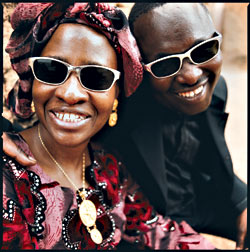
Then in 2003, the Malian duo Amadou & Mariam, themselves veterans of four buzz-generating cassettes recorded in the ’80s and early ’90s, put together an album of stunning virtuosity, released in 2005 on Nonesuch in the U.S. Dimanche à Bamako, produced by Manu Chao, was hailed as the most original African release in years, ringing together an earthy and forward-thinking world pop. The result is a song cycle owing more to James Brown and Stevie Wonder than Malian contemporaries such as Ali Farka Toure, Toumani Diabate, and Boubacar Traoré.
“Music needs to be mixed to say something universal,” Amadou Bagayoko says from Paris through a translator when asked about the group’s development. “Whether you come from north or east or south, it’s the music that creates the same reaction. In Africa, when you sing a song, it’s always to say something. You want to talk to society.”
Interest in Western music developed early, and the duo’s decision to continue looking elsewhere for influences was almost blasphemous: Farka Toure, in particular, was an icon in Mali.
“Each neighborhood had one or two records [of Hendrix or Pink Floyd], although it was very difficult to find,” Amadou recalls. “We were born with modern music—it was a sign of modernity.”
For years before their first record deal in the late ’90s, Amadou & Mariam toured the Ivory Coast and Burkina Faso extensively. Their spirited interpretations of Malian blues held down residencies, though restrictions by the state left them in arrears. They wanted to develop their sound but were stuck by law performing cautious renditions of regional standards. Once in while, they tried originals, if not songs, then solos at least.
“They may not have liked the messages, but they liked the music for the underlying sounds,” Amadou says.
On its surface, the duo’s music points homeward. Acoustic blues and desert drones, along with soulful island influences, are immediately obvious. But listen closely to Dimanche (as well as earlier recordings) and Western influences percolate. There’s the hip-hop-driven “Senegal Fast Food,” the grime sounding “Artistya,” reggae horns on “Djanfa,” the Eno-esque ambience of “La Fete au Village,” and the psychedelic “Gnidjougouya.” Traces of buzzing punk rock in the guitar playing and melancholic shoegazer draw you into “Camions Sauvages,” another hip-hop song. The longest song is just over five minutes; the chord progressions are simple and pop-driven.
You realize how all-encompassing Amadou & Mariam have become when you come across “Taxi Bamako” on Dimanche. After a background of voices settles, you are transported to a Parisian cafe. A bellowing horn lulls over a single voice repeatedly asking for a lift to Bamako. It’s classic cocktail music. The song shifts from the single blues-struck Malian vocal to a down-tempo Paris, a city that still singes many Africans for its role in the colonial-era slave trade. “Taxi Bamako” is a two-way stop. You either get caught up in the history, or you move on.
“The historical fact is because of colonialism we share the same language,” Amadou says. “In life, there are different stages—there is the stage of colonization and now democracy, and that is the message.”