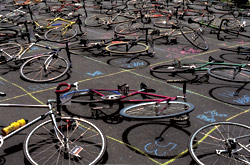
Like most towns, Seattle has ambivalent feelings about bicyclists jockeying on city streets among the cars. Inevitably called a “bike friendly” city in the national press, the perspective is a little different from the road. I ride most days to work (not the same thing as riding for a living), and I’ve had my share of close calls. I developed an aggressive riding style in New York City, where I considered taxis a menace and bike messengers the ballsiest species on the planet—doing things I would never dare. Seattle’s messenger community seems comparatively sane and courteous (particularly toward pedestrians), less diverse, a little behind the Manhattan fashion curve. That’s where bike messengers were first discovered by fashionistas, where cleated shoes were first worn on the catwalk, where messenger bags became ubiquitous even for the footbound. It’s one of those ephemeral New-York-in-the-’70s things, now an article of retro cool celebrated both in the book/DVD set Pedal (powerHouse, $29.95) and at the Design Commission Gallery exhibit of those images.
Photographer and filmmaker Peter Sutherland documented New York’s 2005 Cycle Messenger World Championships (CMWC) in his book Pedal, which shares its title with his 2001 bike-messenger documentary (it has played on the Sundance Channel and elsewhere). He plainly admires these two-wheeled tribalists, most of them young, pierced, and tattooed, all of them bearing various scars and scrapes in varying stages of healing. They ride and race hard, but the asphalt is harder.
Although action shots figure in Sutherland’s color images, this isn’t a Sports Illustrated gallery. The actual messenger race is more like a road rally than NASCAR’s neat laps. Competitors zig and zag from A to B and C to Z to deliver their parcels. The affair is governed less by the stopwatch than one’s own internal GPS system—setting the most efficient route between multiple waypoints, allowing for traffic lights, one-way streets, and potholes.
It’s the cyclists in repose who really catch Sutherland’s lens, some dozing on the grass (empty cans of Bud and spoke wrenches strewn around them), some staring straight back at the camera in formal portraiture. A commercial shooter for XXL and VICE (among other Gen-Y publications), he has an eye for the unpretty model’s indifference that invites you in. Urban athletes, these messengers are somewhat awkwardly still off their mounts (those cleated shoes certainly aren’t meant for walking). There’s an impatient quality in the suspended air—”Don’t bother me, I’ve got someplace I need to go. I’m paid to deliver things, not stand around.” Sutherland captures these riders with a certain lankness, the sweat just dried, the pose not quite settled. Just as most of his subjects were born since the ’70s, he’s working in the tradition of Nan Goldin by way of Dov Charney’s American Apparel spreads.
Then there are the accessories, the pure fashion aspect. All bicyclists, from Lance Armstrong on down, are obsessed with gear. Messengers have developed their own anticonsumerist mix-and-match aesthetic which, of course, Pedal is now selling back to us. (Seattle bag manufacturer R.E. Load is also an event sponsor.) It starts with the bikes—mostly minimalist fixed-gear models that amount to little more than bare frame, wheels, and chain. (A front brake is optional, and not always effective—hence the many oozing bandages, also a fashion accessory.) There can be no such thing as no-logo in biking; traditional brands like Campagnolo, Sidi, and Cinelli mix with vintage T-shirts and race jerseys from obscure European events and sponsors. One’s lock and chain must be worn around the waist. An enormous dangle of keys must be tethered to one’s forearm. The bag, buckle, and strap must be adjusted up high on the chest. Designer anything is a big no-no, even if you’ve got a carbon-fiber road bike secretly stashed inside your Brooklyn basement apartment.
If the DVD version of Pedal isn’t about consumerism, it’s certainly about money. Riders are paid by delivery, and their dispatchers charge extra for express jobs—like “a triple rush.” Most of the messengers Sutherland interviews go by their street names (one even sleeps down in the subway tunnels), and they’ve got a New Yorker’s mercantile bravado about them. “Look at the legs, man! You can’t keep up with me,” says one guy. Exactly—his legs are money. But another laments, “I’m turning into a spinning robot,” which any working stiff can relate to.
Moreover, nobody here likely has health insurance. (Although the New York Bike Messenger Foundation, see www.nybmf.org, and other groups are lobbying for union benefits.) This is all the more remarkable and frightening when Sutherland sends his frame-mounted camera in pedaling pursuit behind some of the city’s most skilled and fearless riders. It shows what his still photos can’t—slaloming between delivery trucks (some riders trim their handlebars to be no wider than their pedals to make the tightest squeezes), running most every red light (again, not always with benefit of brakes), and engaging in “the battle” with each and every taxi cab. (“They’re a menace,” one driver grouses.)
That’s not to suggest there isn’t joy among this fraternity. The rush, the “flow” (as many call it) of riding so seamlessly in traffic goes along with the risk. Says one guy, “There’s nothing like coming down Ninth Avenue from the 50s, all the way through the fucking teens, on one green light.” So light and fast, they’re like vectors of information, electrons on the great computer chip of Manhattan. E-mail and the Internet haven’t eradicated this tribe, though technology may have culled it, made it even swifter.
Seattle’s own hearty messenger community will likely be represented at the Heavy Pedal group ride, organized in conjunction with the gallery show. It’s open to the public (helmets are strongly encouraged), but don’t call it a race (I think). Though messenger races have been conducted here (including the 2003 CMWC event). Among the pedaling mob, you might even see Christine Pacheco and Vanessa Alarcon, locals who placed among the top 10 in New York last year, then find their portraits on the gallery walls.
Outside the gallery, it may be impossible to find a place to lock your bike. Chain them all together, of course, and the local messenger community becomes that much stronger. But please—no Lycra, no carbon fiber, and none of your fancy-ass wraparound sunglasses. That would give messengers a bad name.