LONG BEFORE his lifetime achievement Oscar this March, Robert Altman knew the value of the human voice—halting, overlapping, disputing, undermining, mocking, even mumbling. The script is one thing, from M*A*S*H to McCabe and Mrs. Miller to The Player to Gosford Park to A Prairie Home Companion, and the instrument is another. At 81, with another person’s heart ticking inside his chest (just a casual aside delivered at the Academy Awards), he remains the movies’ master of letting dialogue slide, allowing actors to push and pull their verbiage like so much taffy. Chewing is more enjoyable than swallowing, after all, and it was in that spirit that we recently spoke to the director by phone in New York.
First off, I mention, he was involved in another Oscar project: the award-winning A Note of Triumph: The Golden Age of Norman Corwin, a short documentary about the radio pioneer, whom Altman lauds in the doc. “Well, he’s my idol,” Altman answers, recalling a pre-TV era when radio dramas and variety shows grounded America’s cultural landscape. Companion looks back to those days, of course, as the film jumps between fragmentary backstage conversations, musical performances onstage, and the somewhat unifying—but never imposing—presence of host Garrison Keillor. It’s very much an aural, conversational film. So, I ask, are we film and TV viewers now out of touch with the original, unifying power of voice that the movie celebrates?
“Yes, I think we are. Yes, sir,” says Altman. “They lost the audience 35 to 40 years ago. My first love was radio. Radio lasted for about six years. And television came along, and suddenly you had I Love Lucy.”
The irony—not quite ruefulness—is implicit: Altman got his start in TV during the ’50s, when the medium was more tied to radio, and theater, which he’s also directed. He’s even ventured into opera. So, I ask, does Companion maybe remind us how the distinction between radio and movies isn’t—or oughtn’t to be—that great?
“It’s all theater, you know,” exclaims Altman. “Norman Corwin and Arch Obler and some of those writers during the war, in the late ’30s . . . they became poets, and the radio became really a great medium because the audience participated. They created the image. You heard the door squeak—but for each person, it was their own particular squeaky door.”
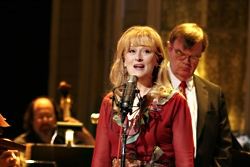
Indeed, in the loosely scripted Companion, Altman derives great delight from a bit of business where Keillor’s longtime sound- effects man, Tom Keith, frantically improvises to augment a stopgap shaggy dog story by Lily Tomlin after the script goes fluttering to the floor. It’s a cute, funny scene because we can both imagine how it’d sound on radio (the squeaky doors, screeching jungle birds, gunshots, etc.) and see the stage business of it being produced live.
“What we did with Prairie Home Companion was more theater,” Altman continues. “Because [Keillor’s] show is delivered to a live audience. It’s not just a studio show. So that made our task a lot easier. I wasn’t going into a territory that frightened me.”
Although there was the matter of what to write, what story to tell. Keillor’s script provides a kind of premature eulogy for his show, as its players prepare for their very last broadcast. (In fact, of course, it continues, having first aired in 1974.) The mood is both morbid and cheerful, and the division is felt most acutely when the nervous, flustered performers emerge from backstage (actually below stage) to crack jokes and sing to the microphone. (See Sheila Benson’s take on the movie; it opens in theaters Friday, June 9.)
Altman elaborates the story line, “We created the last show. It was a statement about death, and the death of things. That angel [played by Virginia Madsen] was quite important in that, I felt.”
Does the director think Keillor is somewhat nostalgically looking back to radio’s golden age? (Keillor originally drew inspiration for his show while researching a New Yorker piece on the Grand Ole Opry in the early ’70s.) “I think he’s very au courant,” Altman replies, firmly resisting any suggestion of themes or meanings. (Hey, it’s his movie, which a critic has got to respect.)
And, certainly, the technology of Companion is très courant: Altman shot it with all his cast wearing microphones, using the latest high-def digital video format, he explains. “It gives me more cameras. It’s an expense thing, really. I can put three or four cameras onto a situation, turn them on in the morning, turn them off at night, and it didn’t cost me anything.”
Which, ironically, lends to Companion‘s old-timey feel. Yes, you’re really hearing Tomlin and Meryl Streep singing “Softly and Tenderly,” Lindsay Lohan belting out “Frankie & Johnny,” and Woody Harrelson and John C. Reilly joking their way through “She Is More to Be Pitied Than Censured.” Companion is at least half a musical.
“I’m really happy with the soundtrack,” Altman concludes. “I’m happy with the movie, too. It’s variety show is really what it is.”