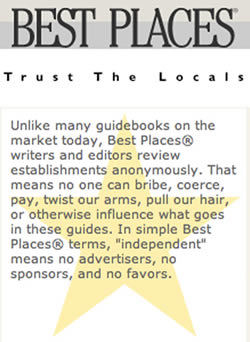
Through 30 years of publishing and millions of guidebooks sold, Seattle-based Sasquatch Books and a cadre of Best Places reviewers have adhered to a vow of chastity, until very recently spelled out loud and clear on the publisher’s Web site, www.sasquatchbooks.com:
Unlike many guidebooks on the market today, Best Places writers and editors review establishments anonymously. That means no one can bribe, coerce, pay, twist our arms, pull our hair, or otherwise influence what goes in these guides. In simple Best Places terms, “independent” means no advertisers, no sponsors, and no favors.
But as early as Feb. 3, that obviously had changed when Kate van Gelder, a writer hired to contribute to Best Places Northwest‘s 15th edition, due out at year’s end, sent an e-mail to a Tacoma restaurateur, the text of which was shared on condition of anonymity: “I would like to arrange to have dinner [at your restaurant] on Monday, February 6, at 6:30 p.m. if that is possible,” wrote van Gelder. “We ask that you comp the meal and wine for me and my husband. As you probably know, there is no guarantee that in exchange we will write a favorable review, or any review at all. But based on what we know of [name of restaurant omitted], we will be pleased with our visit.”
Incensed at what he perceived as an unethical overture, the restaurateur contacted Sasquatch Publisher Chad Haight, who confirmed the accuracy of the policy outlined in van Gelder’s e-mail. “Her letter is the current policy,” says Haight. “We found ourselves starting to lose a lot of money, so that was a compromise we reached and a change in policy.”
Until Saturday, April 29, Sasquatch’s Web site still trumpeted the no-favors pledge. “It’s just been enacted, and we just haven’t gotten around to it,” Haight explains. “We still intend to be completely independent in the reviews. It’s just a way to help compensate for the increased expenses of restaurants and lodging. I’m prepared for a backlash from people who may comp a meal and expect quid pro quo.”
Haight might not have to wait for that backlash, because judging from what a handful of prominent local restaurateurs think of the new policy, reviewers are going to have a tough time getting tables.
“I think it’s totally unethical,” says Le Pichet chef and co-owner Jim Drohman, who was presented with the text of van Gelder’s e-mail while not being told which publication she writes for. “With freelance writers, you’ll get calls saying they can’t put you on their list unless they get a free meal because they have to pay. And I won’t do it. I think it’s wrong. If you’re truly a freelancer, the cost of doing business is built into your business, so you don’t need to put the thumb on restaurateurs like that.” Agrees Susan Kaplan of the Boat Street Cafe: “I don’t think that would be a legitimate review.”
“I think it’s unconscionable,” says a longtime North Seattle restaurant owner, who spoke on condition of anonymity after being told that this was a policy being undertaken specifically by Best Places. “If they called me and said they’d eat there for free and maybe they’ll put us in their book, I don’t think that’s cool. If it’s for Best Places, they should just put you in the fucking book. And if they want to come in and try it, they should pay.”
What really gets the Tacoma restaurateur who got the Feb. 3 e-mail is the fact that Sasquatch continues to trumpet its pledge of anonymity, months after he complained to Haight. “I told him they didn’t need to come by and review us,” says the restaurateur. “When your Web site says you do things anonymously and never accept things for free, and you do the opposite—that certainly crosses the line.”
While policies vary slightly from publication to publication, critics at periodicals including Seattle Weekly and the daily newspapers visit restaurants anonymously, multiple times, and pay for their meals. The idea is to assess the food and service any normal customer would receive and to eliminate real or perceived influence inherent in complimentary meals.
That’s harder than it sounds. The longer a critic restaurant hops, the harder an everyman anonymity is to keep, say restaurateurs and critics. “Once you’ve been in this town long enough, you just get to know the critics,” says Le Pichet’s Drohman. “You get to know their faces—you see them at various food-related events and charitable things, and they’ll eat out a lot on their own time. It’s hard to stay secret for very long.”
Kaplan’s Boat Street partner, Renee Erickson, points to the time she nailed Seattle Times (and ex–Seattle Weekly) critic Nancy Leson. “I’ve been fortunate enough to have other restaurateurs in the restaurant when critics have been here, which has blown their cover,” Erickson says. “People pretty much know who most of them are.”
Leson is well aware that even the darkest sunglasses don’t work sometimes. “I always go anonymously, but I probably get busted 8 to 10 percent of the time,” the Times critic concedes. “People working in Tom Douglas’ restaurants who don’t recognize me by the time the fourth restaurant opens probably don’t get it.”
Which is somewhat unfortunate, says the aforementioned North Seattle restaurant owner.
“I came in after an Ultimate Frisbee game one time and saw [ex-Times critic] John Hinterberger sitting at one of my tables,” he recalls. “I instantly knew who he was, so he got different service than a normal customer would—which kind of defeats the purpose. These guys have so much power.”
Every so often, this power is egregiously abused. Take ex–Tacoma News Tribune critic Bart Ripp, who, in 2004, was forced to resign after editors discovered he’d been insisting on free meals and making reservations under the not-so-thinly-veiled pseudonym “Senator Ripp.”
“I was definitely uncomfortable with the way he operated,” says the Tacoma restaurateur of Ripp. “The first time he came into our restaurant, he handed me his business card on the way out. I was pretty surprised: Why was this guy identifying himself? He came in three or four more times, and there was no way we were going to ignore him. It made me uncomfortable, and probably influenced the way I felt about [the Best Places] reviewer’s request.”
Seattle Post-Intelligencer food critic Rebekah Denn is something of the anti-Ripp. “I never use a credit card with my own name on it,” says Denn, revealing a common trick of the trade that could be foiled if servers simply asked for identification when given the plastic.
The demand for reviewers to all but ambush a restaurant over the course of a given week to meet deadline can be a dead giveaway, too. “Generally, they do the power attack—come in Tuesday, Thursday, and Friday and order everything on the menu,” says the North Seattle restaurant owner. “You can tell it’s a different kind of guest.”
Says Boat Street’s Erickson: “If there’s only two people and they order a lot of food, that raises some eyebrows.”