
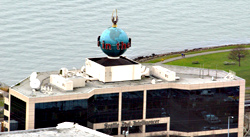
After three costly years of head-butting in court, the Seattle Times Co. and Hearst Corp., owner of the Seattle Post-Intelligencer, are pinning their papers’ destiny on an outside arbitrator. But their proposed arbitration agreement depends on a pair of very unstable elements: Hearst’s commitment to Seattle and Frank Blethen’s ego.
Seattle’s dailies, which are yoked under a federally sanctioned monopoly called a joint operating agreement (JOA), want to shift their internecine battle out of the public arena of King County Superior Court. The two closely held companies would prefer to conduct the fight in private, before retired King County Superior Court Judge Larry Jordan. Under the plan, Jordan would decide by May 31, 2007, whether The Seattle Times may legitimately claim three consecutive years of financial losses under the JOA. The P-I challenged that notion in a 2003 lawsuit.
Binding arbitration is a good deal for the Times, which has been seeking closure all along — both to the courthouse battle with Hearst and, literally, of the smaller P-I, which it says is a burden that assures consistent losses under joint operation. The Times handles the business end of things and owns the printing presses in Bothell. If Jordan validates the Times’ loss claims, the new agreement gives the company a firm time frame of 12 months to negotiate closure of the P-I.
If Jordan rules against the Times, Hearst says it will continue publishing the P-I under the JOA. What Hearst gains from that outcome is less clear. The P-I would remain the city’s second paper, continuing to steadily lose circulation and money, and Hearst would lose the tactical advantage of wearing down the locally controlled Times with protracted litigation. So why the rush to judgment?
Hearst normally ignores questions like that, but in an unusual explanatory note to reporters, the New York-based media conglomerate declared, in effect, that it decided to go the arbitration route because, somewhere deep in its corporate body, it has a heart.
Since the Times has filed loss notices for three different sets of years — 2000-02, 2002-04, and, last week, 2003-05 — Hearst says JOA rules and federal antitrust regulations would force it to immediately put the P-I up for sale. And that, it explained, would create mass angst for P-I staffers and readers.
Under the JOA, Hearst would get 32 percent of Times net profit until 2083 if it agreed to shut the P-I. But before it can do that, Justice Department antitrust regulators require proof that no one else wants the paper. And to meet that requirement, Hearst says, it would have to put the P-I on the block right away. Arbitration, P-I Publisher Roger Oglesby explained in a written statement, “brings a measure of certainty to a situation that has generated a lot of confusion and anxiety for newspaper employees and readers for some time.”
Perhaps. But Hearst didn’t show much concern about its staff or readers when it put the P-I up for sale after the Times filed its first loss notice three years ago. Hearst was clearly going through the motions, using the offering as a public relations tactic to cast its rival as the heartless bad guy. According to those who read it, Hearst’s offering prospectus for the P-I amounted to little more than the rotating globe atop the paper’s rented newsroom. Predictably, there were no takers. Hearst whisked the paper back off the market as soon as Superior Court Judge Greg Canova blocked the Times from dismantling the JOA.
Nor does Hearst’s history of closing and consolidating newspapers — in San Antonio, Houston, and San Francisco — smack of deep concern for readers or staffers.
A more likely focus of Hearst’s interest is the Blethen family and its controlling stake in the Times Co. Before Hearst agreed to amend the JOA in 2000 to let the Times into the morning market to compete directly with the P-I — almost surely dooming the smaller paper — it insisted on a side deal that pays the Blethens $1 million a year for first-refusal rights if they decide to sell.
Since then, Hearst has pumped just enough life into the P-I‘s news hole to keep it from appearing moribund, while hoping for a sign the younger generation of Blethens will lose interest in the Times and run with their share of the company’s estimated $600 million street value.
So far, that sign hasn’t appeared. The Times Co. recently moved two fifth-generation Blethens up the management ladder, putting Publisher Frank Blethen’s son, Ryan, on the boards of the company’s Yakima Herald-Republic and Walla Walla Union-Bulletin and naming Rob Jr., son of Times marketing vice president Robert Blethen, to the board of the Maine newspaper unit.
In any event, rolling the dice on arbitration might not be such a long shot for Hearst. If it loses, the new agreement still gives it the right to continue publishing the P-I online, without any additional investment here, and collect 32 percent of the Times net for the next 77 years.
The arbitration path isn’t much of a gamble for the Times Co., either. The state Supreme Court has already validated its 2000 and 2001 loss claims, and Hearst might also have trouble challenging Times JOA loss claims for 2003 to 2005.
That’s because under the JOA’s odd formula, a Times JOA loss doesn’t necessarily mean the paper has to lose money. All the JOA requires is that after the two papers pool their annual revenue, and the Times is paid for printing, trucking, and marketing both papers, they split the remainder with 60 percent going to the Times Co. and 40 percent to Hearst. If the Times’ share is less than newsroom expenses for the year, it goes down as a JOA loss for the paper.
Last year, for example, the Times says it lost money under the JOA. At the same time, the paper’s total 2005 revenue rose slightly over the previous year, according to federal securities filings by former minority shareholder Knight Ridder. The Times Co. also booked a $24 million gain from the sale of some downtown real estate, assuring a moneymaking year for the paper.
If the Times Co. convinces Jordan it lost money under the JOA formula in 2003, 2004, and 2005, the arbitrator would have to rule in its favor, giving the Blethens and their new 49.5 percent co-owner, McClatchy, a clear shot at closing the P-I.
At least that’s how the script should go. But there could be complications.
For one, this is not the first time Times Publisher Frank Blethen and Hearst Chief Executive Victor Ganzi have tried negotiating their way out of their dispute. Blethen, whose pugnacious temper and ego have been known to overrule his discretion, and Ganzi, a onetime Hearst bean counter, are not an easy fit. Former Sen. George Mitchell of Maine, whose mediation credentials include efforts in Northern Ireland and the Middle East, sat through nearly half a dozen meetings between the two. The negotiations, which began in October 2004, collapsed last August.
“They were still arguing over the facts,” says Rick Desimone, chief of staff for Sen. Patty Murray, D-Wash., who recruited Mitchell for the mediation effort. “I wouldn’t say they weren’t getting anywhere, but they weren’t closing the gaps.”
A more immediate complexity loomed on Wednesday, April 5, when the Committee for a Two-Newspaper Town planned to file a legal brief on the arbitration proposal in Superior Court. The union-backed citizens group has been the all-but-forgotten third man in the newspaper squabble since July 2003, when Canova, who oversees the lawsuit, admitted the committee as an intervener. In ruling originally for Hearst, Canova set aside — but did not dismiss — the committee’s argument that the JOA itself is a restraint of trade under the state’s public interest laws, even if it is legal in the eyes of the feds, and should be re-examined. The state Supreme Court, in ruling for the Times last July, sidestepped the committee’s argument.
What the committee planned to tell Canova, says its attorney, Dmitri Iglitzin, is that it, too, wants in on the arbitration.
One thing both the Times Co. and Hearst agree on is that they want to arbitrate in secret and don’t want the committee involved. They warn they will scuttle the arbitration deal before including the committee. That’s ironic, says Iglitzin, given the Times‘ recent crowing over a successful effort to get hundreds of state court cases unsealed, based on the public’s right to know such information. “It’s screamingly obvious the Times wants the public out of this decision,” Iglitzin says. Of course, the “public” in this instance is the Committee for a Two-Newspaper Town, whose chief backer, the Pacific Northwest Newspaper Guild, represents some 900 Times and P-I employees. Some of the newspapers’ reticence to include the committee could be due to the fact that the arbitration period coincides with contract negotiations later this year. Iglitzin, who also represents the union, puts on a poker face when asked whether this overlap might be a factor in the papers’ intransigence.
While the committee can’t force its way into a private arbitration, it will have some leverage with the judge. Before any arbitrating is done, Canova must freeze the existing court proceedings. “We are going to file a brief opposing their motion to stay all court proceedings unless they allow the committee into the arbitration,” says Iglitzin.
Canova, who overruled Times Co. objections to allowing the committee to intervene in the first place, was scheduled to try to unravel this snarl on Friday, April 7, and had a couple of choices. He could shuffle the committee aside and grant a stay of the court action while the papers arbitrate their differences, and then deal with the committee’s argument after the fact. Or he could deny the papers’ motion for a stay unless they let the committee in on the arbitration.
Either way, Iglitzin contends, the committee will get its day in court, since Canova can’t rule on a motion without assessing the validity of the committee’s JOA challenge. “So far,” Iglitzin says, “the judge hasn’t addressed the merits of our claim.” If Canova does that now, this long story would have new legs.
Bill Richards is a former Wall Street Journal, Washington Post, and Seattle Post-Intelligencer reporter who covered the JOA story for The Seattle Times under contract for three years.