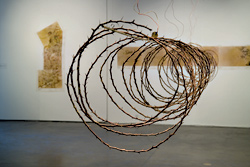
Sound artist Richard Lerman’s “Fences-Borders” is a quiet, stark installation. A long bougainvillea vine twisted and dried into a looping fence bisects the small room, cleverly mirroring the shape of razor-wire fences found along borders, right down to the menacing thorns. Lerman’s fence, however, is embedded with transducers that emit eerie sounds recorded at various locations along the Arizona, California, and Mexico borders. U.S. Geological Survey maps on the walls show the unnaturally straight lines that divide and define these regions, illustrating the artifice of politically imposed boundaries. A video screen displays footage from sparsely populated points along these desert “borderlands.” What is the difference between an “illegal alien” and a “refugee”? A fistful of dirt from Arizona and a handful of soil from Mexico? What goes on here? These are the sorts of questions Lerman poses in his piece, without overtly stating any of them. In these videos and recordings there are no voices of midnight immigrants or border patrol, whispers, or even footsteps. That absence is intentional. Instead, there are the haunting sounds of wind and scuttling debris. Lerman’s focus is the place, the symbols, and the inanimate fences themselves, which he sees as witnesses to many bitter moments in world history. “I have recorded fences at many sites: internment camps in California, concentration camps in Germany and Poland, sites along the Chilean/Argentine border where persons ‘disappeared,'” explains Lerman. “For me, these fences witnessed events. I hope to record the presence (and present state) of the fence while also hoping some of what this place/fence has witnessed comes through.” “Fences-Borders” invokes these ghosts most effectively. Jack Straw New Media Gallery, 4261 Roosevelt Way N.E., 206-634-0919, www.jackstraw.org. 9 a.m.-6 p.m. Mon.-Fri. Ends April 28.
Richard Lerman “Fences-Borders”