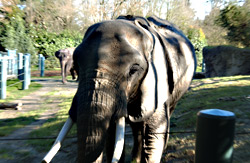
In 1990, the American Zoo and Aquarium Association deemed Woodland Park Zoo’s elephant forest “best new exhibit.” Today, Seattle’s seemingly plush pachyderm quarters have garnered a much different title. The animal-rights organization In Defense of Animals has named Woodland Park Zoo one of the country’s 10 worst for elephants.
Critics say Woodland Park, and most zoos for that matter, don’t offer elephants enough space, and advocating for zoo elephants has become the cause du jour for animal-rights groups and even some zoo professionals. They blame a variety of health issues that arise in captive pachyderms, including arthritis, foot disease, and neurosis, on lack of space. Woodland Park Zoo’s elephant forest, which comprises about 1 acre, exceeds zoo association standards, but it falls short of the area many critics consider necessary for elephants to live comfortably.
Catherine Doyle of In Defense of Animals did the research that landed Woodland Park Zoo a spot among the nation’s worst elephant facilities. She included Woodland Park because zoo documentation, she says, depicts a long-term goal to reduce the size of the elephant forest while also breeding more elephants.
But how much space do elephants really need? Former Woodland Park elephant keeper Ellen Leach says, “That’s kind of an unknown, but generally when you look at an animal’s behavioral needs, you look at its wild counterpart.” Some estimates gauge that wild elephants occupy areas as large as 12 square miles.
Woodland Park Zoo mammal curator Bruce Upchurch, who has worked with elephants for more than 20 years, refutes In Defense of Animals’ assertions, claiming the zoo “definitely plans to expand the elephant facilities.” The zoo’s Long-Range Physical Development Plan calls for construction of a bull elephant barn and an exercise yard to accommodate the addition of male elephants for breeding. These areas would be used exclusively by bulls—except, of course, during mating—who naturally live apart from females. The development plan does not, however, include enlarging the existing elephant forest, which is home to the zoo’s three females, and the plan does state there is a possibility that part of it will be used on “a rotational basis” with Asian rhinos.
Woodland Park Zoo director Bruce Bohmke says the new bull facilities would house up to two elephants, and although design specifications are not yet firm, he estimates the males’ outdoor yard might span one-half to three-quarters of an acre. Technically, then, the overall size of the elephant exhibit would “expand” due to the added male facilities, but because the zoo would also be acquiring additional elephants, the amount of space per individual would not necessarily increase.
Bohmke explains that the rhinos would “time-share” about a quarter of the elephant forest in the southern part of the exhibit. This isn’t a concern, he says, because the “elephants don’t really voluntarily go down there,” and the rhinos would rarely use the space because they’d normally reside in a separate exhibit.
And besides, says the zoo’s general curator, Nancy Hawkes, “more space isn’t always necessarily better.”
Both Hawkes and Upchurch emphasize that the quality of the elephants’ area is at least as critical as the quantity. Enrichment of the space by attending to all of the animals’ senses is more useful, they say, than focusing on the available space. Letting the rhinos roam through the elephant yard, for example, would provide elephants with “enrichment for different smells,” Upchurch explains.
But former Woodland Park Zoo veterinarian Mel Richardson does consider quantity the most important factor in evaluating space for elephants. He says he’s not surprised when zoo officials downplay the significance of space for pachyderms because “it’s the one thing they can’t give them.” Reflecting on his 23 years of veterinary experience at zoos, Richardson says the majority of animals he’s treated “were sick because of the exhibit they were being kept in.” He adds, “It became very frustrating to me as a vet to work in a situation where the reason I was there was because of the captivity.”
Elephant health problems thought to be captivity-related have received their share of media coverage in recent months. In January, the National Zoo in Washington, D.C., euthanized an arthritic elephant, Toni. Animal-rights groups said the confined space and hard floors of the exhibit exacerbated her suffering. They had encouraged the National Zoo, which is also on In Defense of Animals’ list, to send Toni to the Elephant Sanctuary in Hohenwald, Tenn., which provides pachyderms with more than 4 square miles of free range.
The animal-rights crowd, including past Woodland Park Zoo director David Hancocks, issued the same cry for Bamboo, a former Woodland Park elephant who was transferred last August to Tacoma’s Point Defiance Zoo due to behavioral problems. But Hawkes says the Tennessee sanctuary, which limits elephant-human interaction to a greater extent than zoos, was not a viable option for Bamboo because she’s grown accustomed to spending much of her time with people—an assertion that elicited laughter from Leach, who worked at Woodland Park until 2004 and specifically with Bamboo and the other elephants in the 1980s. “At the sanctuary, they are not without human interaction,” says Leach, “but they lead a more normal life in that they have more interaction with their own species.” She adds that the elephants at the Tennessee sanctuary are cared for and “not unhandled.”
Some note that the Tennessee sanctuary is not accredited by the zoo association and is therefore not held to the same standards of care as traditional zoos. But zoo association minimum standards require a mere 1,800 square feet (slightly more than a 42-by-42-foot square) of outdoor area for one elephant and 900 more square feet (30 by 30 feet) for each additional elephant. Indoors, the minimum requirement is 400 square feet (a 20-by-20-foot square) per animal. Former zoo association member Les Schobert, who is retired after more than 30 years of working at major U.S. zoos, calls these standards “a travesty.”
Bulls, who typically weigh about 6 tons, are even harder to accommodate than females, who usually weigh 4 or 5 tons, because they’re stronger and more aggressive. Upchurch, the Woodland Park curator, recounts that he once saw a bull push his tusks through the same type of steel mesh presently used in the Seattle zoo’s barn and completely bend the cables. He says the zoo’s future bull barn will be much more secure than the females’ indoor space.
And according to Richardson, the former Woodland Park vet, indoor space for male elephants also has to be smaller for keepers to maintain control.
With all the fuss about captive pachyderms, why keep them at all? Conservation and education are the two primary reasons cited by zoos. Hawkes explains that seeing elephants in zoos allows people to establish an emotional connection with them, making the public more likely to donate time and money to conservation of elephants and their habitat in the wild. Studying zoo elephants also helps humans develop technology to aid wild elephants, she adds.
The zoo’s development plan is slated to take effect over the next 20 years, so changes to the elephant forest won’t happen overnight. Leach stresses that Woodland Park has “some very caring staff,” but says “the soul of the zoo has changed dramatically.”
Schobert offers an analogy: “Take six people and put them in a studio apartment, and I don’t care how many CDs, couches, TVs, chairs, beds there are . . . you can’t have a high quality of life in that space no matter what you do with it.”