Regional transportation is the issue du jour after the surprising defeat this month of statewide Initiative 912 and the not-so-surprising thumbs-down city voters gave the Seattle Monorail Project. But instead of clarifying the route from here to less congestion, voter decisiveness has complicated pavement politics:
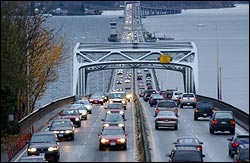
- One thing is clear. The state Department of Transportation, led by Secretary Doug MacDonald, will continue moving on $12.5 billion worth of road projects statewide. About $8.5 billion of that was approved by the Legislature last spring and affirmed by voters this month when they defeated I-912, and lawmakers passed $4 billion worth in 2003. But that money provides only partial funding for replacement of the Alaskan Way Viaduct along the Seattle waterfront and the aging Highway 520 floating bridge across Lake Washington, and for improvements to Interstate 405 through the Eastside suburbs.
- Gov. Christine Gregoire and Seattle Mayor Greg Nickels are discussing how to replace the viaduct, which is old and vulnerable to earthquakes. The city wants to replace the elevated freeway with a tunnel. Both sides agree a tunnel would be best, but the state will provide only enough money to build a cheaper elevated or surface replacement. The city says it can find the money to fund the difference. The state doesn’t want a search for that money to delay the project.
- Many local officials, like King County Council member Julia Patterson, D-SeaTac, think 2006 would be a good time to put another multibillion-dollar transportation-funding package before voters in the metropolitan area. Sound Transit wants money to extend light rail from the University of Washington to Northgate, and the Regional Transportation Investment District (RTID) wants more money for roads.
- State Rep. Ed Murray, D-Seattle, who chairs the House Transportation Committee, thinks voters need a break. He would rather see the state concentrate for now on the projects already funded and, in the meantime, reorganize the transportation bureaucracy in metropolitan Puget Sound.
- Some Seattle-area politicians and activists, advocating full speed ahead, think such a reorganization could coincide with transportation-funding ballot measures in 2006.
While voters were clear, leaders in the transportation sector now have to sort through a tangle of overlapping projects and priorities.
Along The Waterfront
On Nov. 23, Gregoire, Nickels, MacDonald, and Seattle Department of Transportation Director Grace Crunican did lunch—they ate takeout at City Hall from Tat’s Delicatessen—but they aren’t talking in any detail about what was discussed. MacDonald says the meeting focused on how the Alaskan Way Viaduct project will move forward. Gregoire and Nickels have differed over the mayor’s insistence that a viaduct replacement be a tunnel. (See “State to City: Forget Tunnel,” Aug. 24.) “Nobody made any decisions,” MacDonald says of last week’s lunch, “but it was an excellent discussion.” MacDonald says the intense debate over how to proceed on regional transportation in general did not come up.
In August, state officials, including Gregoire, and local ones, including Nickels, were pretty feisty about their differences. The governor urged a $3.4 billion aboveground rebuild of the viaduct, while the mayor insisted on a $4.4 billion tunnel along the waterfront. Now the two are talking, and MacDonald says future meetings are planned. He emphasizes that while the tunnel has been designated as the preferred alternative, the state has not made a commitment to that more expensive option. Marty Brown, Gregoire’s legislative director, says the governor is not planning to give the mayor a firm deadline on a tunnel decision anytime soon. He says the governor hasn’t even had a formal presentation as to how the city would finance the $4.4 billion cost of a tunnel. Currently, the federal, state, and local governments have pledged around $2.6 billion to replace the viaduct. The project can be trimmed back significantly, but regional voters would still need to approve around $1 billion for viaduct funding. Deputy Mayor Tim Ceis says that if state officials do not agree to a 2006 Seattle-area ballot measure, it will hold up the decision on how to replace the viaduct. “If we are held past 2006, that pushes off our deadline on the Alaskan Way Viaduct,” Ceis says.
Murray, the House transportation chair, counters that work can begin on a viaduct replacement “regardless of whether a decision has been made on a tunnel or a ballot measure. “We can do a lot before we decide on an elevated structure or a tunnel.”
MacDonald says construction won’t begin on the viaduct replacement until 2007 at the earliest. Many of the 270 projects statewide, funded by the Legislature last spring, will be well under way by then. He believes that many King County voters might think that by helping defeat I-912, they solved the funding problems associated with the viaduct and the Highway 520 floating bridge across Lake Washington. “There’s an expectation that both those projects will materialize before your eyes, if not by the end of the year, certainly by spring,” MacDonald says wryly. “We are going to get busy on the other 268 projects. We have to communicate with people about what is going on.”
Put It to a Vote . . .
In the wake of the defeat of I-912, local officials, including Nickels, are pushing hard to go to the ballot with a multibillion-dollar regional transportation package in November 2006, for roads and transit. State officials, led by Murray, are leery of going to voters again so soon. Gregoire has not taken a position, although, says legislative director Brown, “A lot of people are in transportation burnout right now. We are focused on delivery.”
He’s referring to $12.5 billion’s worth of projects in the transportation pipeline—this year’s $8.5 billion approved by the Legislature and 2003’s $4 billion. There is a whole lot of delivery to do. Seattle-area officials, however, are concerned. The megaprojects in the Puget Sound region are not fully funded. That includes the replacement of the viaduct and the 520 floating bridge, as well as expansion of I-405.
In addition, Sound Transit, the three-county transit agency that runs light rail, express buses, and commuter rail in the region, is preparing to go to the ballot with its so-called Phase Two funding package. Sound Transit has not identified a final list of projects, but it hopes the voters will fund billions of new ones including extension of light rail from the University District to Northgate, putting high-capacity transit across the Interstate 90 floating bridge, and building a commuter rail station in Ballard.
Says Ceis, speaking of going to the ballot again next year for both roads and transit: “The political timing is good. Beating 912 creates momentum. We should move on it while the voters are engaged.”
. . . Or Reorganize
“I don’t think we should go to the ballot in 2006,” says Murray. Voters, the business community that funds transportation campaigns, and legislators, he says, are exhausted and need time to digest everything that has already been approved. Instead, Murray wants to focus on transportation governance. “We need a regional transportation structure that will integrate transit with roads.” He has something in mind along the lines of Oregon’s Metro, a regional agency that plans and funds transportation projects in 25 cities and three counties in the Portland area.
Currently, the Puget Sound region has a plethora of transportation agencies, including Sound Transit, Metro Transit (buses and trolleys in King County), Community Transit (the same in Snohomish County), Pierce Transit (the same in Pierce County), and the Regional Transportation Investment District (RTID), whose focus is planning and funding regional investment in roads in King, Snohomish, and Pierce counties. While the death at the polls this month of the Seattle Monorail Project means one less agency that is pulling in its own direction, the demise has hardly brought coherence to our alphabet soup. “The one clear message that seems to be coming out of this transportation discussion,” says MacDonald of WSDOT, “is who is supposed to be integrating all this stuff? The voters sense that it should be an integrated plan.”
Patterson, of the King County Council, supports integrating regional planning but doesn’t think we can wait for a new regional government. Her legislative aide, Jon Scholes, says it might take six years for a new entity to put a package before voters. First, he says, the Legislature would have to create a regional government. Next, voters in three counties would have to elect its leadership. Then the new agency would have to identify priorities for transportation projects. And finally, a package would have to go on the ballot. “We don’t think the region can wait that long,” Scholes says.
In Patterson’s view, the necessary integration is already occurring as leaders of RTID and Sound Transit discuss a joint ballot measure for 2006. “Sound Transit is already sitting at the table with RTID,” says Scholes. “The timing question always comes up. You can always find a reason to wait. If you go to the ballot and fail, you learn a lot.”
Other locals say you can accomplish Murray’s transportation governance and go to the ballot in 2006. Says Ceis, the deputy mayor: “We have two things to figure out: transportation governance and regional financing.” Environmentalist Aaron Ostrom, the executive director of Futurewise, a growth management group, has been attending discussions convened by Murray. “You could get a lot done in a year,” Ostrom says. “To set up a model like [Portland’s Metro] wouldn’t be that huge an undertaking. For sure, you could get something on the ballot by 2006.”
However all this plays out, let’s put to rest one notion that seems to persist in the minds of many Seattleites. Ceis categorically dismisses the rumor that the city would seek to have the Legislature transfer the motor vehicle excise tax (MVET) that is now paying off monorail debt for use on the viaduct or some other project. Murray says that even if the city wanted to do that, the Legislature would never go along: “The Legislature is not going to give the city the MVET again.”