The Poverty Factor
Published 7:00 am Monday, October 9, 2006
Any effort to solve the coming multimillion-dollar shortfall in the Seattle Public Schools budget will need to consider a student population that complicates the crisis. The school district takes in and spends more money per pupil than supposedly wealthier suburban neighbors, in part because Seattle has a higher proportion of low-income students who have costly educational needs. Meantime, many middle-class and affluent students, who tend to require fewer resources and perform better academically, have fled the public system for private and suburban schools, leaving the public schools with less state money. In simplest terms, Seattle’s public schools are struggling in part because not all parents send their kids to them.
The school district estimates that only 68 percent of school-age children in Seattle attend public school. “If we were an average U.S. district,” says schools Finance Director Steve Nielsen, “we would have 90 percent market share.” Among big cities, he says, the average figure is around 80 percent. That leaves a share of poor students in Seattle’s public system that is inconsistent with the actual demographics of one of America’s most affluent cities. A 2001 U.S. Census survey, sampling residents from big cities across the country, suggested that Seattle might have the largest rate of private school attendance in the country.Nielsen says mandatory busing drove the city’s public school attendance down in the mid-1970s, and it has never recovered.
Seattle residents again and again have proved willing to tax themselves to benefit public education, and the school district receives many grants from a variety of other sources—in addition to the standard per-pupil allotment from the state that every school district receives. According to the school-district budget staff, Seattle schools spend, on average, $9,200 per student per year, while the average among 11 neighboring suburban districts—including high-achieving Bellevue—is only $7,900. So why aren’t we getting the same bang for the buck? Mayor Greg Nickels, among others, has asked that question, singling out Bellevue, where the per-pupil funding is around $1,300 less than Seattle’s.
Seattle’s more numerous and needy special-education population is a factor. But in comparing the demographics of the Seattle and Bellevue districts, what’s more striking is the percentage of Seattle’s 46,000 students who receive free or reduced-price lunches because of their families’ low incomes. In Bellevue, one of the most ethnically and economically diverse suburbs, 18 percent of students have lunch subsidized. In Seattle, it’s 40 percent. (The cost of feeding students is not part of the per-pupil spending figures.) Poverty is a factor in student performance, and students who perform poorly tend to be more expensive to educate.
Some Seattle neighborhoods have a particularly low rate of public school attendance. Ironically, some of those neighborhoods often have some of the best public schools. Only 31 percent of schoolchildren in the Madison Park area around stellar McGilvra Elementary go to Seattle public schools, for example. In affluent Laurelhurst, 43 percent do. King County Executive Ron Sims stresses the exodus to private schools as he weighs in on the current predicament facing the Seattle district. With every departure from the public schools, the state sends Seattle less money. “You have to talk about volume” of students, he says. “You’ve got to increase the supply.”
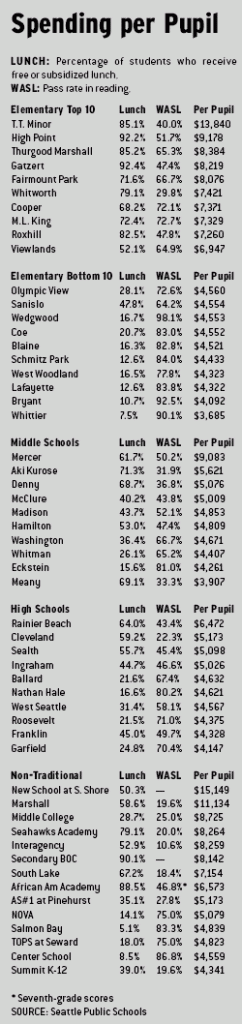
Former School Board member Don Nielsen says that if all the city’s private school students went to public school instead, “the district would not have a financial problem.” He reasons that middle- and upper-class kids are “profit centers.” The district spends less money to educate them than it receives in per-pupil funding. The surplus, according to a weighted formula, is spent on low-income students and others with special needs. The additional money goes toward lower class sizes, classroom aides, tutors, and other special services. Contrary to popular belief, this funding discrepancy often, though not always, holds true even when private donations from wealthy parents and others are factored in. A district study looking at spending by school shows, for example, that High Point Elementary, where 92 percent of the kids receive free or reduced-price lunch, receives $9,178 per student. Whittier, with a free and reduced-price lunch population of 7.5 percent, receives $3,685.
So the district is spending more money on poor students and it doesn’t have enough affluent ones to offset the costs.”If we had a different mix of students, if we had more students not requiring special services—your average Leave It to Beaver kind of kid—then those children would indeed help us diffuse the cost of the other students,” acknowledges Finance Director Nielsen. It would not solve the problem, he adds. Even if every kid in the city were going to public schools, there still wouldn’t be enough funding, but it could ease the deficit. And greater enrollment of middle-class and affluent students would give the district more state and local money to direct toward those low-income students who struggle academically, perhaps boosting the district’s mediocre average test performance.
Seattle school officials have long recognized this “market share” issue. School Board member Irene Stewart, who has been prodding district staff to do something about it, recalls that when her now 15-year-old son was a baby, she belonged to a West Seattle group of new mothers run by the popular Program for Early Parent Support, or PEPS. “I was the only person in the room who could say with certainty that I would choose a kindergarten in the public schools,” Stewart says. “That’s shocking to me.” In many cases, she says, “families have chosen private schools without checking out the public schools.”
The idea of courting better-off students is politically sensitive. “I’m not talking about catering to upper-income families,” Stewart quickly adds. The priority of the current reformist School Board has instead been to support poor and minority students. It has brought attention to an academic gap between races and classes that is long overdue. But it is tricky to boost the students who need help while creating an environment attractive to those above the poverty line, and the board obviously has not done it terribly well.
Jane Fellner, chair of the district’s Accelerated Progress Program task force, notes that board members and others frequently refer to the “privilege” enjoyed by students in the program. “What are you supposed to do if you come from a family that has been able to provide opportunities for your children so that they can maximize their potential?” she asks. “Does that mean there’s no place for us in the public schools?”
For the district to thrive financially and academically, there had better be.