TUESDAY
STAGE
THE AWAKENING
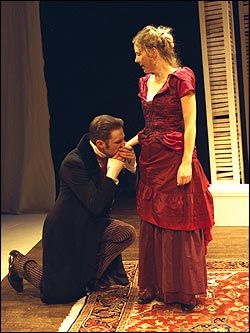
Now this should be Book-It Repertory Theatre at its finest, adapting a classic 19th-century novel that was ahead of its time and still has something to say about the way we view our lives now. Author Kate Chopin’s 1899 eyebrow-raiser concerns a wife and mother who gradually realizes that being a wife and mother involves more than anyone ever told her—and that, frankly, neither role is enough to completely satisfy her insistent inner life. Myra Platt (pictured) plays the undaunted Edna Pontellier, reprising her role from the company’s 2000 staging. Low-cost previews begin Tues., May 31. Opens Fri., June 3. 7:30 p.m. Wed.–Sat.; 2 p.m. Sun. Ends Sun., June 26. $15–$30. Leo K. Theatre at the Seattle Rep, Seattle Center, 206-216-0833 or www.book-it.org. STEVE WIECKING
FRIDAY – SATURDAY
FILM
SHORT FILMS AT COCA
Jim Jarmusch (pictured) acts as curator in absentia for an evening of nine short films—all his reputed favorites. One of the most enjoyable is the 1961 Cuban P.M., which basically consists of street-level vérité footage of a night out in Havana, with drinking, dancing, and music. It’s a kind of time capsule to a pre-political Cuba, as if the integrated revelers are taking a well-deserved break from Castro’s stern revolution. From the great documentarian Carl Dreyer, the 1948 Danish They Caught the Ferry carries no subtitles, but it hardly needs them. It’s a joyous motorcycle ride with a twist ending. Buster Keaton’s 1921 silent The High Sign has a wonderful chase sequence through a cutaway house ridden with trap doors. Unseen is Jarmusch’s own movie-making satire, Int. Trailer, Night, with Chloë Sevigny. 8 p.m. Fri., May 27–Sat., May 28. $5–$8. Center on Contemporary Art, 410 Dexter Ave. N., 206-728-1980. BRIAN MILLER
FRIDAY – MONDAY
FESTIVAL
FOLKLIFE FESTIVAL
Prepare to go down in history as part of the world’s largest harmonica band when an attempt is made to break the Guinness World Record at the Folklife Festival this Sunday, May 29. Music man Andy Mackie will teach and lead a group rendition of “When the Saints Go Marching In.” No harmonica? No problem. Throughout the weekend, Mackie will teach workshops on how to build these marvelous little instruments. Festival runs 11 a.m.–11 p.m. Fri., May 27–Mon., May 30; harmonica convergence is at 6 p.m. Sun., May 29, at Fisher Green. Free admission; $5 suggested donation. Seattle Center, 206-684-7300, www.nwfolklife.org. NICHOLE BOLAND
SATURDAY – MONDAY
TOURNAMENT
SCRABBLE COMPETITION
Scrabble is the new spelling bee. Sure, the documentary Word Wars didn’t get the warm pop- culture welcome that Spellbound and Myra Goldberg’s novel Bee Season did, but Stefan Fatsis’ account of life on the Scrabble circuit, Word Freak, did become a more-than-cult hit a few years back. Capitalizing on the zeitgeist’s current kindness toward letter tiles, this international competition, sponsored by the Seattle Scrabble Club and featuring around 120 competitors from both the U.S. and Canada, promises to spell F-U-N. Or perhaps J-O-C-U-L-A-R-I-T-Y? 9:30 a.m.–6:30 p.m. Sat., May 28–Sun., May 29. 9:30 a.m.–1:30 p.m. Mon., May 30. Free to attend. Red Lion Hotel, 1415 Fifth Ave., 206-971-8000. NEAL SCHINDLER
SUNDAY – MONDAY
FESTIVAL
PIKE PLACE MARKET FESTIVAL
This year, the annual Market Festival will honor Memorial Day with its first Memorial Flag Walk. Buy a 6-foot flag for $25, and a calligrapher will inscribe it with the name of someone you want to honor. Proceeds benefit the Market Foundation, and flags will be displayed on Pine Street between First Avenue and Pike Place. The festival also promises beer and coffee gardens, and bands begin playing at 4 p.m. on Sunday and 5 p.m. on Monday at the Market Foundation Stage. Sun., May 29–Mon., May 30. Free admission. Pike Place Market, www.pikeplacemarketstreetfestival.com. SARAH MCGUIRE