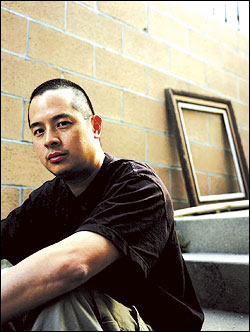
Maktub—vocalist Reggie Watts, drummer Davis Martin, bassist Kevin Goldman, keyboardist Daniel Spils, and guitarist Thaddeus Turner—formed in Seattle 10 years ago. The band’s mutable sound—equal parts rock and soul, with as much metal, jazz, funk, and pop thrown in on top, with frequent samples added to live instruments—has made them the go-to band for folks looking to pinpoint how multifaceted Seattle’s music scene has become. Their first two albums, 1999’s Subtle Ways and 2002’s Khronos, made waves locally and, increasingly, nationally, particularly after Khronos, which featured a head-turning cover of Led Zeppelin’s “No Quarter,” was picked up by New York indie label Velour for national distribution. They also tour like demons, while each member—particularly Watts, with his impossible-to-miss Afro—keeps a high profile locally, sitting in with various other musicians and playing solo gigs; Watts issued a solo album, Simplified, in 2003. For Say What You Mean (Velour), which comes out Tuesday, April 12, the band worked with New York producer/engineer Bob Power, who’s worked with Erykah Badu, D’Angelo, De La Soul, A Tribe Called Quest, and the Roots (whose drummer/leader, ?uestlove, is a vocal Maktub fan). The Jukebox—featuring Watts, Martin, and Goldman—took place in the Seattle Weekly offices on a bright spring day.
Serge Gainsbourg et Brigitte Bardot: “Bonnie and Clyde” (1968) from Comic Strip (Polydor)
Reggie Watts: Oh, it’s Gainsbourg.
Seattle Weekly: I know Reggie’s mother is French. Did she play you this kind of stuff when you were young?
Watts: There wasn’t that much French stuff. My mother was primarily into James Brown, Nana Mouskouri, Edith Piaf—some French stuff, but nothing like this.
SW: Was there much in the way of French culture in the house?
Watts: Oh, definitely, just because of the fact that she was French. We’d have French food for holidays, French onion soup; I went to France every summer.
SW: In terms of music, did you pick up much from going to France?
Watts: I wish that France had something to offer a bit more [laughs]. Whenever I’d go to France, I’d check out the music every once in a while. MTV was new at the time, and they’d be showing the French version of [whatever was popular], and I was not interested at all. I heard it, but nothing stuck in my mind.
Davis Martin: When was this recorded?
SW: 1968.
Martin: It sounds like loops—you know, [like] samples, digital music.
Kevin Goldman: It sounds very montage.
SW: It’s been sampled a few times; Luna covered it with Laetita Sadier from Stereolab singing the Brigitte Bardot part. Obviously, a lot of the French artists who are making waves now are making sample-based electronic music. The French seem to excel at that, rather than at rock and roll.
Watts: Yeah, definitely, bands like Air. Sometimes you get some bands like the Young Gods, more rock stuff, but yeah. Their hip-hop is good, too.
SW: When I moved here the first time, in 1996, there were a lot of acid-jazz types of things going on in clubs, with DJs and musicians collaborating. I know you guys play out in a lot of different configurations. When you started Maktub, did you do it with an eye toward combining that kind of thing with rock?
Martin: For me, that’s where I came from as a player. I also played a drum set at Strong at the Crocodile [Cafe], with [house DJ] Donald Glaude, that sort of thing. That was how I played. That’s what I liked to do, and that’s how I met these guys. But Maktub was never about trying to do a certain style of music. It was about what everybody could bring to the table.
Shellac: “A Minute” (1991) from At Action Park (Touch and Go)
SW: The reason I’m playing this is that Steve Albini grew up in Montana, and so did Reggie. [laughter] What was the music like there? Obviously, Albini went in one whole extreme direction after he left there, and in a way you did the opposite.
Watts: Yeah. There weren’t really kids doing local music in Great Falls. There were bands in Missoula—it was a college town. My friend John Thomas was super into Steve Albini, and pretty much anything that’s cool, that’s well respected, that was hyperunderground, we listened to. I understand the mentality behind it, for sure. Whenever we’d go to the school, we’d always see bands like Fugazi and local bands [like] that. I was in a band called Autumn Asylum, which was kind of thrashy. It was cool—a cross between new wave and the Red Hot Chili Peppers. But Montana definitely can produce some interesting psychological states that inspire music like that.
Growing up in a rural area, you’re always going to have the radio—a lot of butt-rock and a lot of classic rock, stuff like that. I think a lot of material that’s on the new record reflects that. It’s got a lot of those rock grooves that we like, or have come to like later on in our lives, however you want to look at it. I was influenced by Montana, and I definitely understood it when you’d go over to people’s houses and they have the deer hanging up in the garage, and the guy who’d have the plaid shirt or whatever, chilling out, drinking beer with his dad, his friend, and would go down and polish his guns or stuff, that kind of mentality, you know what I mean? Buck knives—like, kids coming to school with knives [laughs].
Martin: That’s like, basically, my family’s way of giving a bar mitzvah—your first folding hunter [knife].
Watts: Totally.
SW: One thing about Seattle is it’s surrounded by rural areas, and there’s always some of that rural feel even in the city.
Watts: It’s weird. It looks like a city, but it’s still a small town. You can’t really hide it.
Mylab: “Pop Client” (2004) from Mylab (Terminus)
Goldman: This reminds me of a bunch of different things.
SW: Like what?
Goldman: It reminds me of a cross between Morphine, Julian Priester, and Sun Ra.
SW: That’s a good analysis. You’re not far off at all. You’re really close.
Martin: Is it a Skerik thing?
SW: Same school.
Goldman: Is that Horvitz?
SW: Yes, it’s Mylab.
Goldman: Oh! I haven’t heard this. This is with Tucker Martine, right?
SW: Yes.
Goldman: It’s funny, the other day I was just looking at some discography thing and that one of the things I saw, “Mylab with Wayne Horvitz and Tucker Martine.” It’s hard to place that initial sound. But that’s Bill Frisell [playing guitar]?
SW: Yeah, it’s pretty much everyone in that orbit from around town on this album—including Reggie.
Watts: [sheepishly] I think I am on the record [all laugh].
SW: It’s amazing that you’ve lost track of the projects you’ve been involved with.
Watts: Totally [laughs].
SW: I played it for that, partly, but also because I know that Reggie moved here to study jazz.
Watts: I actually came here to go to the Art Institute of Seattle. It sucked [laughs]. Back in ’90, it was a pretty new institution. All the teachers were didn’t-make-it rock stars—jaded, you know, trying to come off super cool and like they knew about the music industry. And they did, but they didn’t at the same time. I didn’t like the vibe, it was weird, clinical, sterile, pretentious, mixed with ineptness.
Goldman: There’s a recovery time from art school, from what I understand, where you get out of school and you’re just lost, and it takes you a couple years to figure out who you are as an artist again. That’s only what I heard, though. I went to design school, and I guess it’s somewhat similar. There’s so much analysis, and you forget how to just feel.
Watts: You can study the structure, technical analysis, history, and so forth, and you’re encouraged to do your work, obviously. But when I went to art school, I just said, “I’m going to meet some badass artists.” I went for the social aspect. I quit, and I just got out on my own. I mean, I learned some things. But that’s probably the best thing you can do if you’re going to art school: Try to meet people and get out.
Martin: I think that’s the way it is in music school, too. I met some guys there and started playing with them.
Soundgarden: “The Day I Tried to Live” (1994) from Superunknown (A&M)
Watts: [from first note] Soundgarden.
SW: Sub Pop was beginning to happen around the time you got to Seattle. Was that part of the appeal of coming here?
Goldman: I came up here from Phoenix in ’95. Part of what brought me up here [was that] I had a couple friends from school who came up here prior to me. I’d come up and visit during the summers, and I just loved it so much. I needed to get away from my hometown after 23 years; it was time to leave. It was the exact opposite of Phoenix—rainy, wet, lots of art and culture. There’s a lot of beauty in the Phoenix desert, but in terms of art, there wasn’t very much at all. It was really hard to find good players. The second day I was here I met Davis. That’s the way it works here, most of the time.
Watts: I remember the summer of 1989, my friend Melanie was playing [Soundgarden’s] “Big Dumb Sex.” That record was incredible, and she hoarded it—she’d play a little bit of it, and I’d say, “Dude, how do I get a copy?” This is in Montana. My friends—they knew everything. They had every cool record you could possibly imagine, collectively. I was the guy who would balance them out.
One of my things about moving away when I graduated high school was, “I’m going to go to New York or I’m going to go to Seattle.” I checked out New York, and that didn’t work out. I remember [hearing] Soundgarden, and I liked that music, and I’d heard that there was a music scene going on [here], and that was just when all this stuff was just about to blow up.
Martin: At the other end of it, I grew up in Shoreline. By default I ended up around those bands—two or three guys from Alice in Chains went to my high school. I took a trip in ’92—I was 22—to Denver, on the train. I started going out to all these clubs, and once people found out I was from Seattle, I started getting treated like a rock star. Everybody was asking me how this alternative movement was in Seattle, and I didn’t know what the fuck they were talking about [laughs].
That tribute band to Mother Love Bone, Temple of the Dog—I got to hang out at those sessions, being around that whole scene. That’s when I first met Chris Cornell. I was starstruck. He was such a cool, cool person.
SW: Reggie gets compared to Cornell a lot as a vocalist. Is he someone you ever consciously modeled yourself on as a singer?
Watts: I’d say so. He’s a huge influence and inspiration, and I think he’s one of the top five rock vocalists of all time. I think that will come out later on in his life. He doesn’t get enough credit. His range was insane—the demonic, operatic range that he had. Then he had that low growl, almost Peter Murphy–esque. There’s such a great range and tone and texture, and his sensibility—to even get a slight comparison to something like that is a huge compliment.
The Roots ft. Cody Chesnutt: “The Seed (2.0)” (2002) from Phrenology (MCA)
Watts: Oh yeah!
SW: This was engineered by Bob Power, who produced most of Say What You Mean. How did you end up working with him?
Goldman: Bob had worked on a ton of records, including Meshell Ndegeocello’s, and one of the label heads at Velour had managed Meshell for a while. So he’d known Bob for a year or two, and I guess he said, “You should check out Maktub.” He brought Bob out [to Seattle], and we talked, just kind of met each other and got to know each other. [As a producer], he’s very, very, very detailed [laughs]. He’s thorough.
Martin: He’s one of those tweaker guys that loves to experiment with all kinds of drums and miking techniques. Being in the studio with him is quite the learning experience compared to other producers who don’t necessarily tell you what the hell is going on. He’s very informative. He gave us this little speech on compression as an art form. We didn’t know what the fuck he was talking about [laughs].
Watts: He’s a philosopher. He loves to explain every step of the way. He’ll give you as much as you want to know, and if you show any type of interest, he’ll just go for it. He’ll give you examples historically—he hits it from every angle. If you ask him a question, he’ll explain it from a myriad of angles. Sometimes you’re like, “Wow, dude, I don’t know if I need that much.” But he’s great.
Goldman: He’s like a New York version of Steve Fisk in that way.
Watts: Yeah, totally. He relishes information, he loves knowledge; he loves vocabulary as well. It’s really interesting: I knew he was an Aries. I had the weirdest vibe about that. I’m not really an astrological person, but there was something about his personality, that I was like, “Why does he seem so familiar to me?” We share several similarities to how we approach things. It was so familiar [that] it was weird. We’d clash at times because we thought so similarly.
[Producer] Steve Fisk is a lot less hands-on than Bob Power is. Steve Fisk is more facilitating; he has this kind of ambience about him. He kind of sits back on the hillside, watching the action unfold, then he comes in and gives some mild instruction. But really, his strength is in mixing and recording, getting the sounds you hear on the record. We’ve worked with other producers that were like, “This is the way it’s going to be,” but that was a different scenario. Bob was the middle between the extremist, dictatorial producer and the subtle influence producer. We had leeway, but at the same time, he let you know he had a vision for the songs. Sometimes I would have a different idea for what would happen for my part of the song. Very few times, but once in a while I’d be like, “I think it would be better this way,” and he’d be like, “No, it’s not going to be good this way.” It was a friendly argument, and I liked that about him. I liked that he actually had a vision.
Goldman: Yeah, he would certainly defend it. For the most part, we were on the same page. During preproduction, we were on the same page the entire time. If you look at the recording journal on the Web site, there were a couple days where Daniel [Spils] and Bob were butting heads, big time. But that’s gonna happen.
Martin: It’s pretty intense being a drummer for Bob Power: Either he works with machines or with the best drummers ever, like ?uestlove. [Power] is an intense guy; he’s really all about drum sound. Those beat guys are way into the sounds.
Watts: There was a point where we were like, “What are we going to do? Are we going to make a record? How are we going to make a record? Let’s just chill for a while.” Bob was really the guy who made this record happen. I’d been away in Europe, and then I was in New York for a while, and I called him up, and he showed me his studio. We sat down, and he went down the line and said why he thought it was important for us to make the record and why he wanted to do this record and why he was inspired to do it. He really pushed hard to make this record. The catalyst was really Bob.
Maktub play Neumo’s with Slender Means at 8 p.m. Fri., April 8. $15 adv./$17. All ages.