They Had Abortions
Published 7:00 am Monday, October 9, 2006
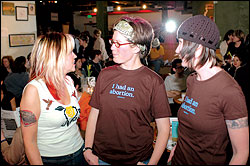
Before a standing-room-only crowd of mostly young women last week, at the Capitol Hill Arts Center, a onetime “Riot Grrrl” named Hannah Levin was talking about an abortion she had nine years ago. Wearing a jean skirt and a tattoo, seeming as sassy and funny as the abortion doctor she described, Levin recalled a virtually pain-and guilt-free abortion that contradicted all she had heard about risks and emotional turmoil. “I felt downright angry that I had spent so many hours being anxious, depressed, and afraid,” she said, reading from an essay she had written. “Since then, I’ve combated that reality the only way I know how: without apology, without shame, and”—here, she slowed to a defiant staccato—”without . . . one . . . ounce . . . of . . . regret.” The crowd went wild.
The occasion was an abortion “speak-out” featuring readings from several local women and the screening of a new documentary, Speak Out: I Had an Abortion, by former Ms. magazine editor Jennifer Baumgardner. Organized by Aradia Women’s Health Center, an abortion provider, the music magazine Rockrgrl, and Community Abortion Information and Resource, a group that helps women seeking abortions, the event aimed to present voices you don’t hear from the antiabortion camp—those of women who are not, as Aradia Executive Director Marcy Bloom puts it, “stuck in pain and regret.” These are women who feel their abortion was a “positive choice.”
But there’s also a lot you don’t normally hear from the pro-choice side, namely recognition that abortion takes a life in the making and is therefore morally complex. The pro-choice movement has also been loath to discuss what the abortion procedure actually is, in detail. It’s sensitive terrain, to be sure, but avoiding it has made the pro-choice movement seem less, not more, sympathetic. So a speak-out that delves into the unvarnished, unpoliticized truth about abortion is an exciting idea. This heavily politicized event was not exactly that. But while it might have begun with cheerleading, it grew profound as the evening wore on, thanks to Baumgardner’s moving film.
The speak-out came at an interesting time. As the Democratic Party seeks to connect with those voters who made “moral values” a defining issue in President Bush’s re-election, it has begun to talk about abortion in new ways. In a touchstone moment in January, U.S. Sen. Hillary Clinton, D-N.Y., delivered a speech in which she ardently defended abortion rights but also acknowledged that it was a “sad, even tragic choice to many, many women.”
The senator’s comments irritated some in the pro-choice movement, including Aradia’s Bloom. Clinton “clearly has bought into the antichoice view of abortion as ‘bad,'” Bloom wrote in an unpublished essay she sent me. She also forwarded a note from her cousin that she found astute. “I don’t view abortion as a necessary evil, but a difficult choice, like so many other difficult choices in life . . . ,” wrote the cousin. “Aborting a fetus is like aborting another part of oneself that could become something special.”
A fetus, however, is not like, say, one’s dream of becoming an artist or a ballerina; it’s the beginning of a separate life. One has to imagine that these kinds of trivializing comments drive many people away from the pro-choice movement.
As you might expect from this take on abortion, Bloom did not intend the speak-out to dwell on ambivalence. In preparation for it, Bloom’s staff put out a call for women who had positive stories to tell about their abortions and could write essays for a booklet to be given out at the event. “We did hear from a few antichoice women who responded,” Bloom says. Aradia told them that it would help find counselors to deal with their grief but that “their stories will not be heard and will not be in the book.” This event was to be about the admittedly worthy goal of eradicating the shame and stigma that prevents many women from talking about their abortions. Its date of March 10, the 12th anniversary of the assassination of Florida abortion provider Dr. David Gunn, served as a reminder of the violent opposition that has kept women silent and given the pro-choice movement a bunker mentality.
At 6 p.m., people started arriving. They were met by a police officer standing guard and escorts who walked them down an alleyway to a funky lower-level space with tables and red vinyl booths. On sale at the door were the controversial T-shirts that filmmaker Baumgardner has been selling: “I had an abortion.” First, three local women read their essays from the booklet. They included Levin and a spoken-word performer named Zaedryn Meade. “This was how certain I had to be in order to become the me I was meeting in dreams,” Meade said of her decision to abort.
There was nothing especially remarkable about their stories. As the third speaker, Eileen McComb, noted, “The most remarkable aspect of the actual abortion was how unremarkable it was.”
That was part of the point, and the audience loved it. It enthusiastically cheered each speaker and kept on cheering during the film. At first, as the film covered the days before abortion was legal, the women interviewed matched the spirit of the speak-out. They expressed no doubts. Gloria Steinem, one interviewee in the film, insightfully explained that the laws against abortion left little room for that. “When it was hard,” she said, “you were not ambivalent. You were desperate.” Another woman spoke of skipping down the street and singing after her abortion, so relieved was she. A third told a story of when, on an outing to a museum, she finally revealed to her mother that she had had an abortion. “Well dear, I’ve had two,” the mother said. “Now let’s talk about the paintings.”
Gradually, the film’s mood changed as other women began to talk about their soul-searching. One had to really think about whether she wanted an abortion, even though, because of a congenital heart condition, she would most likely die if she gave birth and her child would suffer from severe birth defects. “I made a decision,” she said. “My life was valuable enough.” Another recounted checking the Bible after having an abortion at 16 and reading that life didn’t begin until the quickening. “At that point in my life, I didn’t feel like I had aborted a baby, but I also didn’t feel like I had done away with nothing,” she said. A similar point was made more forcefully by a woman who already had two children when she became pregnant and decided her family couldn’t cope with a third. “I’m not antiabortion,” she said. “But I think it’s important to recognize that you are taking away a life.”
By this time, the crowd had turned silent, except for a few sniffles.
I had a similar revelation when I was pregnant seven years ago and reporting on a state initiative to ban so-called partial-birth abortion. The initiative was confusingly and vaguely worded, and to figure out what forms of abortion it would prohibit, I had to delve into the specifics of different methods. I had a hard time finding an abortion provider who would talk to me about them. A former Planned Parenthood medical director flatly refused to answer my questions. “The uterus is emptied,” he told me. “It is emptied by whatever technological method the physician chooses to use.”
Finally, I found a few doctors who would talk to me, though not all on the record. Through their explanations, I realized that partial-birth abortion, though a late-term method, was not particularly grisly; the skull is collapsed before the fetus is extracted, at least rendering it brain dead. What seemed more grisly was another late-term method known as dilation and evacuation, or D&E, in which the doctor inserts a forceps and pulls out the fetus an arm or a leg at a time.
I was then about 20 weeks pregnant, falling into the range of time that D&E would be used. And, boy, did I feel the baby. (When you’re pregnant by choice, of course, it’s always the “baby,” never a “fetus.”) I had already gained 15 or 20 pounds and suffered through long, nauseous months of knowing that something had taken over my body. I couldn’t see forcing someone to go through what for me was an agonizing experience, nor could I see ordering someone to raise a child she was unwilling or unprepared to have.
But as I looked down at my huge stomach, I suddenly understood why abortion was such a wrenching issue. In particular, the D&E method, though not common, gave me pause. I wondered whether a fetus could feel anything at this stage of development. And what about an injection I heard about that stopped the fetus’ heart before proceeding with an abortion? Doctors used it rarely, because it was an expensive and complicated procedure that few knew how to do. Should more learn how? Should scientists research easier ways to do it as well as other, possibly more humane alternatives to D&E? These were all questions that the pro-choice movement seemed unable to tolerate.
After I heard about different abortion methods, I asked one thoughtful abortion doctor why he remained committed to abortion. He told me that when he was young, abortion was illegal. He had seen the carnage that comes from backstreet abortions and knew that the alternatives to safe, legal abortions were much worse. I had seen the same. In the early 1990s, I lived in Africa, a continent that almost universally outlaws abortion. In South Africa, I talked to a doctor who had recently treated a teenager whose legs were so badly infected from an illegal abortion, they would probably have to be amputated. Other women came to the hospital with infected uteruses or poisoned kidneys from supposedly abortion-inducing drugs. Every year, some of these women died. (South Africa has since legalized abortion.) This is the most important thing antiabortion activists will never talk about.
If the pro-choice movement could discuss all these issues openly, it would reveal ambivalence, but it would also reveal that it did not take abortion lightly. Last week’s speak-out didn’t go that far. But it was a start.