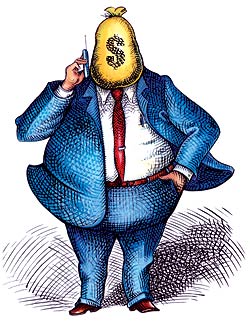
Needy students, impoverished families, kids without health insurance. Sure, they all need help from Olympia. But get in line with Paul Allen, Howard Schultz, and a lot of other fat wallets.
Their corporate lobbyists have been preparing for the 2005 legislative giveaway by working the phones, e-mail, and power corridors, explaining the virtues of backing a grateful billionaire or just an appreciative half-billionaire, so they could hit the marble halls running this week.
Besides seeking regulatory reform and tax breaks that would benefit their weighty business portfolios of technology, entertainment, retail, and bioscience investments, Schultz and Allen would like taxpayers to give them more money to help their big-time sports franchises. Starbucks/Sonics owner Schultz, for one, is asking the Legislature to extend—if not make permanent—temporary hotel/motel/car-rental taxes that could finance a $180 million remodel of KeyArena, the Sonics’ home.
So what if taxpayers remodeled the arena just nine years back for $74 million? Or that then–Sonics owner Barry Ackerley had the cojones to say it was being paid for with “no tax dollars. Not one cent,” and said the project would satisfy the team at least until 2010? No taxes were involved, Ackerley reasoned, since the renovation was financed by bonds underwritten by the public (see: “taxpayer loan”) and would be fully repaid from arena revenues. But not even that is true: $60 million is still owed, and now new owner Schultz wants the balance paid off directly by a tax.
But have a heart. If Schultz spends his own bling on an arena expansion (not so much for additional seating, mind you, but for new income-producing luxury boxes and concession stands), then how could the guy afford to open three new coffee stores in Istanbul tomorrow?
We’re talking Olympia and taxes, after all. Legislators and governors have doled out more than 500 state tax breaks or exemptions over the years, valued at $64.7 billion per biennium budget. What’s a few more perks to soothe a jittery coffee mogul? And despite rumors of a budget crunch, Olympia has the cash to throw around, says conservative tax watchdog Bob Williams. By his calculations, “Washington will have $1.5 billion more to spend for the next budget,” says Williams, president of the Evergreen Freedom Foundation. “We do not have a revenue shortfall. What the state has is a shortfall of self-discipline, common sense, and accountability.”
Extending those temp tourist taxes, currently set to expire in 2020 after paying off Paul Allen’s football stadium, could also further benefit the Seahawks owner by paying for future renovations at Qwest Field. The proposal is just starting to get kicked around the hallowed Olympian halls this week, and even the Mariners‘ shiny taxpayer gift, Safeco Field, built in 1999 for $517 million, might get more financial aid if such a package were approved.
Of course, enriching the rich is nothing new in Olympia, although it could get a little sticky for Allen in particular: While legislators weigh the possibility of giving him more money, he is asking them to rewrite his existing multimillion-dollar Seattle stadium contract with the state’s taxpayers. The world’s richest sports mogul believes he doesn’t have to disclose the finances of his Seattle Seahawks football team, as required by the 1997 stadium deal. He maintains, according to a recent memo by Allen lobbyist Robin Appleford to House Speaker Frank Chopp and other legislators, the only “benefit” of revealing Seahawks finances “would be simply to satisfy idle curiosity.” That’s true, if the public is only idly curious about where its money is going. Tacoma News Tribune columnist Peter Callahan, a persistent Allen critic, notes that taxpayers—having paid for most of Allen’s $461 million Pioneer Square playpen and exhibition center (not counting another $500 million in interest and related improvements)—”deserve to know how much that stadium is making Allen. We deserve to know how our investment is paying off. We deserve to know if ticket increases are justified based on the profits our stadium is producing for Allen.”
The state attorney general’s office says the contract obligates disclosure by Allen, and state Auditor Brian Sonntag agrees. Officials think Allen set up a shadow company called First & Goal merely to report irrelevant figures and avoid revealing how his real moneymaker, the Seahawks, spend income and other earnings from Qwest Field. Allen dismisses those claims and has challenged the state to come after him: The one with the most lawyers wins. As a pre-emptive defense, Allen is now casting about for a new law to let him off the hook. “Disclosure of proprietary business by the Seahawks,” Allen argues, according to a background memo from lobbyist Appleford, “would be inappropriate.”

(Mario Tama / getty images)
Starbucks Chairman Howard Schultz (center) wants bennies for the Sonics and says: charge it to the taxpayers. |
Obviously, Allen’s and Schultz’s companies are among many businesses or industry associations whose hired arm- twisters have begun the months-long quest for Olympia “relief.” High on everyone’s to-do list are tax incentives, as they’re known. The standard pitch is economic: Help our bottom line, and we’ll be able to make more money to hire more people who will buy more products—even if they’re imported TVs and CD players. We won’t use tax breaks just to fatten our corporate take-home, honest!
Actually, the state Department of Revenue thinks that at least $13 billion in suspended retail and use taxes could be repealed and the money recouped without causing a job backlash. In return, more funds would be available for necessary social, educational, and health programs. But the beneficiaries of those tax breaks aren’t in a regifting mood. In fact, they’re hot on the trail of new incentives, and who can blame them? Since the Boeing Co. was given a $3.2 billion, 20-year tax bribe in 2003 to build its newest plane in Everett, everyone has a Dreamliner to peddle, and the Legislature has little moral authority to say no.
Even though Boeing is flush with that tax break and the benefits of another $4.2 million in transportation measures approved by the Legislature, the company plans to be back at the trough this session. Its tentative agenda includes more business tax rollbacks and fewer environmental and construction regulations as it gets set to build a new 7E7 assembly line and related projects. Boeing, Microsoft, and Weyerhaeuser are also among those pushing a 10-cents-a-gallon gas-tax hike (double the increase sought in 2004) for new transportation projects, such as replacing the state Route 520 floating bridge and the Alaskan Way Viaduct. Like Boeing, Microsoft, which has vowed to take a larger role in Olympia politicking, is also crusading for new educational funding, in part because the company has to go out of state, if not out of country, for new computer-science recruits. (Charter schools, a Bill Gates pet project, are still on the MS agenda.) Microsoft officials such as Vice President Brad Smith have become big supporters of public-private partnerships: The state and Boeing did “what it took” to land the 7E7, Smith says approvingly. At a recent economic summit in Seattle, where corporations outlined a “bold, new” regional economic plan, former Snohomish County Executive Bob Drewel said the corporations’ strategy “may include working toward more incentives, and if that includes tax breaks, so be it.”
Most corporations keep their specific legislative wish lists secret until the session unfolds, but the agendas of their industry support groups are indicative of what to expect this year. The Washington Biotechnology and Biomedical Association (WBBA), for example, notes in one of its legislative strategy outlines that “Targeted tax incentives are the only tools that Washington state has in place to assist and encourage the growth of the bioscience sector. It is up to the Washington state Legislature to take action and enact legislation to continue these credits.” Enter the WBBA’s lobbyists. They’re looking for more business and occupation (B&O) tax credits and an additional extension of use- and sales-tax exemptions for research and development.
No matter that this is an industry awash in hype and investment capital. Its average salary is near $70,000, and according to the bio-mantra, life sciences are the cure for any region’s economics malaise. Christine Gregoire campaigned on getting more public money for biotech research. Last year in Olympia, the Legislature approved Gov. Gary Locke’s request to renew almost $60 million in tax breaks for technology and biotech companies for the current biennium, plus $190 million more in the next two years. This giveaway started quietly in 1994, when industry lobbyists pushed through an innocuous tax-deferral bill that contained a repayment requirement. The payback measure has since been waived, thanks to more lobbying, and the law has now been turned into an outright biotech exemption.
“The best social program is a job,” Rep. Jim McIntire, D-Seattle, said in justifying his vote for extending the tax break. Yet, overall, state biotechs watched their stocks fall last year, and a recent Seattle Times analysis of the Puget Sound region’s seven largest biotech companies shows they had just 5 percent annual job growth, creating 187 positions in two years.
The Olympia rush is on, nonetheless. Here are a few other industry-published legislative agendas as they relate mostly to taxes and associated reforms. As a taxpayer, your participation is not required, other than to help pay for them.
Association of Washington Businesses: The AWB is spoiling for tax reform and state tax-increment financing—financing new projects essentially by borrowing money that is paid back from the tax revenues eventually generated from those projects. (Already done on the local level, increment financing ties up tax income that may be otherwise needed in the future.) The AWB also seeks tort reform and to establish a statewide law that would require the 39 cities that impose B&O taxes on gross business receipts to allow a deduction for the costs of doing business. It wants to reduce regulatory powers of state agencies and hopes to see the state Public Disclosure Act rewritten to ensure businesses secrets are better protected from disclosure.
Building Industry Association of Washington: Wants to eliminate some state health and safety standards for workers, replacing them with less-stringent federal regulations; reduce sales taxes and impact-mitigation fees; eviscerate the Growth Management Act; and limit attorney fees and class-action damage awards that have, the BIAW says, helped create an insurance crisis for some of its builders. Costly litigation by unsatisfied consumers— especially condo associations—has led to a liability retreat by insurance carriers, unwilling to underwrite private and nonprofit builders, BIAW claims. The group also is rumored to be supporting union-busting legislation that could make Washington a right-to-work state.
Washington Retail Association: Seeks to limit further increases in sales and B&O taxes and hold the fort on any new attempts to require mandatory cash backs on gift certificates or attempts to prevent use of supermarket club card information in legal proceedings or employment actions. It is fighting imposition of penalties for minimum-wage violations. The WRA is coming off a strong showing in 2004, it says: “WRA saved the retailing industry millions of dollars in the coming years in unemployment insurance taxes as a result of successfully passing Senate Bill 6097. The most dramatic and beneficial provision of the new law is the tax structure. . . . One new provision requires that the wages of all 12 months be averaged to calculate benefits. For the retailing industry this means a reduction of benefit cost of approximately $20 million a year.”
Washington Software Alliance: Also seeks B&O reform, claiming the tax “is ill-suited to high technology companies because it taxes revenues, not incomes. . . . The B&O tax as it is currently written is a hindrance to start-up, high technology firms and should be revamped.” Also opposes any taxing of manufacturing product as intellectual property. “As the creation of intellectual property is a by-product of most high technology firms, taxation of it would only keep such firms from operating in Washington State,” says the WSA.
Washington State Grange: Continues to push for elimination of the 1987 tax reforms which adversely affected agriculture, it says. Supports a ban on sales tax on farm equipment sales between farmers and backs a constitutional cap for sales tax, B&O tax, property tax, and “possibly other existing taxes.” The Grange also wants a slightly different kind of tort reform: “We support placing limitations on state and federally funded indigent legal services groups who, in their efforts to enforce migrant labor laws, place discriminatory hardships on growers who have unknowingly violated unrealistic provisions of the law.” P.S. “We believe employers should not be held responsible for determining their workers’ citizenship status.”
None of these agendas is a slam dunk. There are now more than 1,000 lobbyists in Olympia, and competition for influence from other organizations, such as unions, has heated up. The Service Employees International Union (SEIU) was last year’s legislative party crasher, getting a surprising—and unanimous—legislative OK for a state contract with 26,000 home health care workers by, in the words of one of its lobbyists, “kicking up some dust.” SEIU tactics included running attack ads, manning phone banks, and organizing marches on the capital. The Washington Education Association has used similar strategies to forward its agenda. But whether it’s Mom and Pop or the Seahawks at the door, lawmakers do grow weary of high-pressure lobbying. “They forget,” laments Rep. Darlene Fairley, D–Lake Forest Park, that “we’re real people.” Dust kickers take note. Bring flowers.