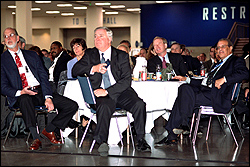
Boeing was there. So were Microsoft, Bank of America, Starbucks, and other usual suspects. Look at this attendees list: Sam Anderson, executive of the Master Builders Association, and new University of Washington President Mark Emmert. Patricia Akiyama, manager of government and community affairs for Weyerhaeuser, and Pierce County Executive John Ladenburg. Jim Mueller, senior director of real-estate development for Vulcan, and, nudge, nudge, Seattle Mayor Greg Nickels. The big room swarmed with 1,100 captains and lieutenants of industry, consultants, attorneys, fund-raisers, and public officials, figuratively locked in a $50-a-head, public-private group hug as they threw down coffee and pastry at 9 in the morning. As influential gatherings go, it was a lobbyist’s, if not a Lexus dealer’s, wet dream. Between two 20-foot projection screens, the AMEN Gospel Group was onstage, singing something about opening the eyes of my heart, Lord, I want to see you. “That’s odd,” said one of the suits, who was in a sea of them at the Prosperity Partnership coming-out party in Pioneer Square last week. “But I guess it is a revival of sorts.”
Prosperity, a good biblical word, usually refers to success of a heavenly nature, and I half expected Bob Drewel, the partnership’s honcho and executive director of the Puget Sound Regional Council, to arrive in a flowing gossamer robe. Drewel, the former Snohomish County executive who was instrumental in guiding Boeing’s tax-subsidized 7E7 Dreamliner assembly plant to his county last year, said the Prosperity congregation—a new regional consortium of government and business—was “coming together for the first time to create a unified strategy for the entire region.” But, in fact, the regional movement was being born again. Go back at least to 1966, when timberman Norton Clapp said, “Today, Puget Sound has become one great community.” From there you can trace a solid line of efforts by corporate and public leaders trying to form a regional front for fun and profit. “This is nothing new in that sense,” said Rick Cocker, publicist for the event last Friday, Nov. 19. “The difference will be if they actually bring it off.”
Among those scheduled to deliver sermons on collaborative economics were tax-break evangelist Gov. Gary Locke and Ted Lyman of the Economic Competitive Group, which makes a living performing public-private marriages. King County Executive Ron Sims, son of a preacher man, introduced Locke and embraced him, but not fiscally. Sims’ recent failed gubernatorial bid was premised on tax reform, including a new personal income tax. If, Sims told me, a new governor and Legislature hand out another tax break like the $3.2 million Locke gave Boeing last year in the 7E7 deal, “it will blow an even bigger hole in the state budget.”
As the daylong session progressed, sincere concern was expressed about the shaky future of education and transportation in Washington. Economic bliss depends on increased funding for both, to educate our future workers and hurry our commerce. That can’t be achieved without a unified public-private effort, speakers said. The indication was that business would spearhead the crusade. But how? There was corp-speak about infrastructure fixes, mega-trends, and cluster-based strategies. Yet, wasn’t “Lord grant me a tax break!” the unsaid prayer of the day? Washington has doled out more than 500 such breaks or exemptions over the years, valued at $64.7 billion per biennium budget. Why else were the corporations coming together? Not to give money to each other. They already had regional partnerships, working agreements, and commercial networks.
Prosperity Partnership wants to build an ever-larger consortium, to compete globally on the level of the metropolitan economic partnerships of Europe. But taxpayers would also chip in more, right? And the partnership, an unelected group beholden to no one and created by another unelected, unbeholden group, the Puget Sound Regional Council, would also pit the four Puget Sound counties against the state’s 35 other counties. As Port of Seattle watchdog Chris Cain asked in a recent edition of The Port Observer, quoting from a partnership press release: “Does anyone remember authorizing [Boeing Commercial Airplanes President and partnership co-chair] Alan Mulally to ‘secure public funds’ or ‘pursue a single agenda for the benefit of the entire metropolitan region’?” When jobs and growth are the leading issues in a public policy debate, Cain adds, business calls the shots.
What lies beneath? Lies? I moseyed about, looking for whispered exchanges and secret handshakes. I eavesdropped on three-piece cabals. Did it mean anything that Prosperity’s “bold, new action strategy” was being unveiled in the spacious events center at Qwest Field, the playpen of billionaire Paul Allen, built by taxpayers? (And whose proud Qwest logo represents a company that just paid $250 million for allegedly cooking its books.) Was it significant that one of the event’s prime sponsors, Boeing, when it’s not in a courtroom defending its ethics, is in a back room negotiating for more government subsidies to compete with Airbus?
Drewel says the partnership’s intent is to devise a strategy to create 100,000 new jobs by 2010, and, as leery Seattle City Council member Nick Licata told me, “How can anyone be against jobs?” That’s how Boeing scammed its 7E7 tax break, spreading the notion that if the Dreamliner wasn’t assembled here, those 800 or so jobs would be lost and, gosh, who knows what might happen to the rest of Boeing’s local operations? Locke bought it and then resold it to the Legislature. Last week, the governor was still pimping the ride he took us for: The 7E7 tax giveaway meant “keeping all Boeing production in Washington,” he told the partnership audience. Just forget that Boeing CEO Harry Stonecipher last month blurted out that the 7E7 would have been built—here or elsewhere—”with or without the Washington state tax incentives.”
Locke had said the Boeing pact shows how the state is “open for business in a way we have never been before.” To which the Building Industry Association of Washington’s president, Gary Cronce, asked, “So where are our special concessions?” Was this meeting the grand opening sale at Gary’s Duty-Free Store?
Ultimately, the fat cat wandered out of the bag. “I assume at some point that tax breaks will be a goal,” Seattle City Council member Richard McIver, who is also president of the regional council, told me cautiously. “I think the plan is about bootstrapping,” said business strategist Joe Quintana, “but maybe tax breaks will eventually be part of it.” Public affairs consultant John A. Wilson saw the incentives as inevitable and says the entire state tax system needs revising—”Microsoft recently paid out $32 billion in dividends, and $18 billion of that went to Washington residents,” he said. “The state treasury got no part of it.”
In a speech, Brad Smith, the Microsoft vice president and chief counsel—his job is to ensure Microsoft kicks the antitrust habit—praised the kind of public-private partnerships that enabled the state to do “what it took” to land the 7E7. “Creation of jobs is the key,” he added. Locke, in passing, added another key: “targeted tax incentives.” Aha! But not exactly a surprise. Since Locke became governor in 1996, the state has granted or sustained $1.6 billion in tax exemptions—not counting Boeing’s. Finally, Drewel said that indeed the idea is to build on the Boeing 7E7 strategy, and when I ask him if that means an investment by taxpayers as well as businesses, he said: “You hit it right on the head.” The plan “may include working toward more incentives, and if that includes tax breaks, so be it.”
Is this potential new public debt really necessary? Washington, home to three of America’s 10 richest businessmen (Bill Gates, Paul Allen, and Steve Ballmer), ranks fourth nationwide for business-friendly environment, seventh in “wealth friendliness” (keeping wealth out of the reach of state government), and ninth in favorable business-tax rates, according to various studies. Locke says there was a net gain of 61,000 jobs last year, a stunning 10,000 last month, and that Washington has “virtually” regained every job it lost since 9/11. Even without the 100,000 jobs Prosperity Partnership hopes to create, Washington will add an estimated 290,000 more positions by 2010. Earnings growth is twice the national average, and based on gross state product, if Washington were a country, it would rank 21st, between Sweden and Austria. Is it possible we don’t need no more stinkin’ partnerships?
Bob Watt, Boeing Commercial Airplane’s avuncular vice president for government and community relations, told the assemblage, “We have the opportunity of leaving this room [having] created something that doesn’t exist.” The only thing I could figure they overlooked was a taxpayer exemption from corporate welfare.