Political Capital
Published 7:00 am Monday, October 9, 2006
City governments are helping fill the coffers of the Building Industry Association of Washington (BIAW), the state’s most aggressive conservative lobby. The cities’ contribution to the organization’s political efforts is not large, but it is ironic. The BIAW is known for rabid opposition to government regulation and a virulent campaign style. It’s one of the biggest political spenders in the state. This past election cycle, it spent between $1.7 million and $1.8 million, mostly in support of three candidates: Republican gubernatorial hopeful Dino Rossi, Republican Attorney General–elect Rob McKenna, and conservative state Supreme Court Justice–elect Jim Johnson. Erin Shannon, the BIAW’s public relations director, is thrilled with the results: “It was a big ‘Fuck you!’ to all the liberals out there.”
Rossi, in particular, having been a real-estate agent, has long-standing BIAW ties. The group was instrumental in his first election victory in 1996, and he has voted the BIAW’s way 99 percent of the time during his seven years in the state Senate. The Seattle Times has reported that Rossi and two BIAW lobbyists even bought an apartment building together.
So how did public money become involved in the organization’s rabid partisanship? Nearly two dozen municipalities participate in an industrial insurance pool run by the BIAW. The cities aren’t otherwise active in the organization—the insurance pool is simply recognized as well run— but some of the profit the BIAW makes from running the insurance pool is used for lobbying and other political activity. At least one of the two-dozen public entities involved, the city of Coupeville on Whidbey Island, plans to end its participation in the insurance pool, having learned the fees collected by the BIAW are being used for political purposes. Says Coupeville’s clerk treasurer, Linda Marsh: “We didn’t realize what they were doing with the money.
The BIAW does a variety of things on behalf of its 11,000 members, most of which are companies in the home-construction business, and the industrial insurance is a major revenue generator. State law requires that every company or public agency carry insurance so that workers who are injured on the job receive compensation. The state allows employers who pool their premiums to be part of a “retrospective rating” program, administered by private organizations like the BIAW or the Association of Washington Business. Annually, the state returns any portion of the pooled employers’ premiums that are left over after all claims are paid.
The BIAW’s “retro rebate” program is the biggest in the state, with 5,200 members. It is also extremely well run, netting $25 million in rebates to date this year alone. BIAW takes a hefty 20 percent cut from its members’ rebate money. Half of that money is spent in Olympia to help fund a staff of 34, most of whom are working directly on the “retro rebate” program, according to the BIAW’s Shannon. The other half is sent to BIAW’s 15 local affiliates, like the Master Builders of King and Snohomish Counties. Both the BIAW and its affiliates engage in lobbying and electioneering, using money from their members’ fees.
The BIAW’s political activity frequently puts it at loggerheads with the Washington State Labor Council. The Labor Council is furious that the BIAW is able to use the state’s industrial insurance program as a “cash cow,” and it has tried a variety of things over the years to cut off that source of funding (see “Tearing Down the Builders,” Jan. 20, 2000). In October, the Labor Council noted that the BIAW’s newsletter welcomed the city of Mount Vernon to its “retro rebate” program. Immediately the Labor Council requested a list of all the participants in the BIAW’s industrial insurance program. The BIAW sued to block release of the names—another irony, since the group frequently lambastes poor public disclosure practices in government—but lost in court.
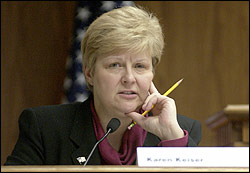
The Labor Council’s communications director, Karen Keiser, who is also a Democratic state senator representing south King County, says city participation in the BIAW’s program raises a number of concerns. First, Keiser thinks that many cities are unaware that the BIAW uses some portion of its fees for partisan political activity. She argues it is an inappropriate use of taxpayer money. Second, Keiser claims that the law governing the “retro rebate” program requires that only workers in similar job categories form a pool. Municipal employees and construction workers don’t belong in the same pool, she says. Keiser hopes this latest brouhaha about the “retro rebate” program will push the program’s regulators to stop the practice.
Keiser will also use what she calls “the scandal” to push for a change in the law governing the “retro rebate” pool. “The BIAW may have bought themselves a governor, as well as an attorney general and a Supreme Court justice,” says Keiser. “But our plan is to cut their funding out from under them.”
Replies Shannon of the BIAW: “We are kicking their ass. How many years have we whipped labor?” Indeed, the BIAW has been on a roll lately. It might have won the trifecta—governor, attorney general, and a Supreme Court justice—and in recent years it successfully blocked reform of unemployment insurance (Referendum 53) and ergonomic standards (Initiative 841). Shannon points out, and the state confirms, that cities were given the green light to participate in the BIAW insurance program. She argues that once the BIAW collects its fees, the money no longer belongs to taxpayers but to a private organization that can do what it wants with the cash. If you accept labor’s logic about taxpayer funds, Shannon says, then the union dues paid by state workers that help fund the Labor Council’s political activity is also government money. “We have never gone after labor unions’ source of revenue,” Shannon says. “But if they keep coming after us, the time is right to take some swings at labor unions—defund them.”
Besides Coupeville and Mount Vernon, the governments and public agencies participating in the BIAW insurance program are Chehalis, Clallam County Public Utility District No. 1, Cle Elum, Connell, Covington, Ellensburg, Hoquiam, the Housing Authority of Chelan, the Housing Authority of Sunnyside, Kennewick, Prosser, Public Utility District No. 1 of Benton County, Public Utility District No. 1 of Cowlitz County, Roslyn, Selah, the Spokane County Water District, Sunnyside, Wenatchee, West Richland, and Zillah.
If they were to withdraw, it would not be much of a financial blow to the BIAW. If, however, Keiser and her allies can use the buzz to remind Democratic legislators, who now control both the state House and Senate, that the group responsible for attack ads against them garners millions from a state-mandated program, labor might find the votes to pass changes. As governor, Christine Gregoire would probably sign such a bill. Rossi would probably veto it.