 Being Julia
Opens Fri., Oct. 22, at Seven Gables and others
After marriage to a control-freak multimillionaire (Warren Beatty), four kids, and nine years of bad movies, Annette Bening seemed to have been swallowed up by what fellow thesp Teri Garr bitterly calls “the Actress Protection Program”—Hollywood’s habit of hiding talent from public view, forever. Then came Bening’s dazzling turn as the fierce realtor wife in 1999’s American Beauty, leading to . . . five more years of sybaritic obscurity. Thank God for Being Julia, which gives her an Oscar-worthy comeback role that may just save one of our most gifted actresses from a life of way too much leisure.
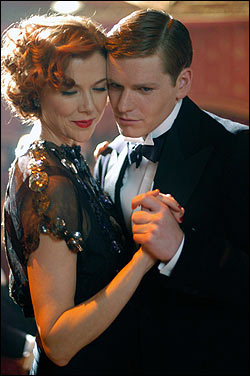
It’s about a former star’s comeback: Julia Lambert, the toast of London’s West End in the ’30s, hitting a bad patch in her 40s. Oh, it’s not as if she hasn’t got it all: her unflappably doting if erotically AWOL husband/manager (Jeremy Irons, ever the Debonair Wimp); her adoring dresser, Evie (Juliet Stevenson), and longtime male admirer (Bruce Greenwood); her annoyingly horny but enormously rich gay patron (Miriam Margolyes); and most sustainingly, the wily ghost of her first acting teacher (Michael Gambon), who indefatigably gives her notes on the ongoing performance that is her life.
But something is missing: recent sex and success. Soon she gets plenty of both. Into her life and lap plunges an armful of warm boy, a wet-behind-the-ears yet scurrilously ambitious American suitor, Tom Fennell (Shaun Evans). Tongues all over England start wagging about the affair. But hey, like Sophie Tucker said, 20 goes into 40 a hell of a lot more times than 40 goes into 20—especially when your 50ish husband has the hots and a plum part for the new ingénue he’s discovered, the unadmirable Ms. Crichton (Lucy Punch), who possesses the raw but useful talent of bringing down the house with a stage sneeze, an English version of Miss Adelaide.
Director István Szabó (Mephisto) and his crew give the period soap opera a glossy, coffee-table book look, but it’s the sharp performances that stick with you long after the Brideshead Revisited visual glow fades away. Ghostly Gambon, whispering notes in Julia’s ear, has more life than the living, and that’s saying something. Stevenson’s Evie sees right through Julia with a laser look of love; Evans manages to make his on-the-make American both puppyishly attractive and repulsive. Irons and Bening nimbly convey the sexless affection of the state of holy deadlock, and Lucy Punch is gut-bustingly funny as the Eve Harrington type who’s sure she’s seized the man (or men) in Julia’s life and her spotlight.
Fat chance! We won’t spoil the third-act coup whereby Julia reconquers her kingdom, but rest assured it’s pure theater, deliciously cruel.
Pure movie people may not fully get it, though. And that’s the big reason Bening hasn’t had the career we all expected from her after Valmont and The Grifters. Her talent came from the stage (San Francisco’s ACT), and it’s always had a stagy quality. True movie stars don’t necessarily need to be great technical actors, but they need to connect with us as electrically as the angel in the TV Angels in America. When they glance at us with those giant shining eyes, we must feel like mortals fucked by gods. That’s not how Bening looks at us. Her gaze is more remote, unreadable, detached, even amused. Her theatrical talent works best on-screen, as it does here in Julia, when her character has a calculating distance from the drama and the audience. This somewhat fusty film—based on a 1937 novella by Somerset Maugham—may lack true movie magnetism, but it lets Bening be Bening. (R) TIM APPELO
Stage Beauty
Opens Fri., Oct. 22, at Harvard Exit
Director Richard (Iris) Eyre’s 17th-century backstage-romance-and-intrigue diversion is a smart, often very funny film, but it never gels into something as effortlessly disarming as Shakespeare in Love—though, O!, how ‘t’would like to be. It’s been careful to stock all the same ingredients: a romping story, attractive leads, delicious character turns from stellar British actors, scrupulous attention to period detail, a whimsical way with historical circumstance. Somehow it doesn’t taste quite the same.
Jeffrey Hatcher’s clever script, adapted from his stage play, is certainly a rich base. Billy Crudup is Edward “Ned” Kynaston, an actor in 1660s London who has, by virtue of his refined prettiness and the law forbidding women to tread the boards, become English theater’s top leading lady. He is, ahem, bottom for furtive lover the Duke of Buckingham (Ben Chaplin), but when impudent Ned refuses similar chores for preening, porcine Sir Charles Sedley (Richard Griffiths), then offends the theatrically ambitious mistress (Zoë Tapper) of King Charles II (unrecognizable Rupert Everett), it brings about the end of his career—and an era. The king reverses the law against actresses, which ruins lifetime thespians like Ned and puts novices like Maria (Claire Danes), Ned’s adoring dresser, in the diva spotlight. Soon he needs a job, she needs an acting coach, and together they discover Method acting.
This is all fine, and so is Eyre’s company, packed with ripe professionals. And I do mean ripe: Everyone seems to be grabbing a Big Moment all the time. The comic juiciness of pros like Griffiths is always welcome, and the estimable Tom Wilkinson is also around to keep things grounded as the proprietor of Ned’s theater. But both Crudup and Danes, once their frustrated attraction comes to the fore, are sworn to be dewily dramatic: First he gets a knowing sideways look in his eyes and wells up; then her chin quivers and she cries, or vice versa. They both do it beautifully, and Lord knows they’re delectable to behold, but you can’t say the movie ever really relaxes into their tears. The film makes such a claustrophobic production out of being grandly thoughtful or tragic or comic that it rarely feels at ease. When Maria and Edward have some quiet moments together, and she asks what it is, exactly, that men do in bed together, Danes and Crudup seem at last to be natural and happy in each other’s company, and it feels like we’re in a different movie. This is probably what Eyre wants (he’s busily stripping away people’s poses in a time of great change for both sex and theater), but it makes the rest of the film appear to be working very hard.
That’s the picture’s nagging problem: It’s trying to give you a theater seminar. It needs to make sure you’re appreciating the pedagogy while you’re being entertained; whereas in Shakespeare in Love,you happily discover the lesson right along with everything else. Stage Beauty is wise, but it never gets past its proscenium archness. (R) STEVE WIECKING
Tarnation
Opens Fri., Oct. 22, at Varsity
In terms of aesthetic payoff per dollar invested, Jonathan Caouette’s video autobiography Tarnation may be the most successful movie ever made. He claims it cost him $218.32 to take his fantastically extensive home-movie footage shot over 20 years or so, plus snippets of old TV shows, horror movies, and the video-cam extravaganzas he made as a precocious preteen, and blend them on a borrowed iMac into a psychic typhoon as psychedelic as anything in Natural Born Killers, only better.
Caouette (pronounced “co-ETTE”), 31, is the stagestruck Texan son of Renée LeBlanc, a onetime child model whose parents consented to give her electroshock therapy after a bad fall off a roof. Caouette thinks she never needed the treatments, and that they made her insane. This does not seem scientifically likely, but his movie appallingly documents her descent from drop-dead gorgeous girl to operatically psychotic glamour-hag, and his own tortured upbringing, mostly by his grandparents, Renée’s folks. It is one grim saga: Manic Renée lights out for the territory with little Jonathan, gets picked up and raped by a stranger before her son’s eyes, and becomes a human pinball bouncing around the mental-health system.
Jonathan gets abused in foster homes and alienated in his grandparents’ care. At 11, he tapes himself impersonating a beaten white-trash Southern wife, scarily skillfully. He shows us his high-school musical production of Blue Velvet, with tunes by Marianne Faithfull, his filmed fantasies of gory murder, and his real-life horrors, like the time somebody gave him two joints laced with PCP. Tarnation unsettlingly conveys the dissociative effects he says he got after the PCP damaged his brain. Ever since, he’s watched his life like it was a movie about somebody else.
It’s a movie far stranger than anything David Lynch ever dreamed up. Tarnation is a mordantly mocking, exhibitionistically mournful dysfunctional-family drama that makes Capturing the Friedmans look commonplace. It’s a bit like Crumb if Crumb’s nightmare cartoons could have seized control of the camera and bent reality, whimpering, to their maleficent will. It also has something of Crumb’s (and Crumb director Terry Zwigoff’s) visual acuity. If it were about earthworms instead of an astounding, ultimately rather inspiring, life story, it would still be riveting in formal cinematic terms. Its rhythms are jittery but artistically modulated, its incoherencies accumulating into a coherent family portrait.
You really get to know these people, so that you feel the tantalizing loss when Renée’s stubbornly vital drama-mama energy succumbs to the meaninglessness that is madness, and the triumph when she comes partway back. When she moves in with Jonathan and his boyfriend in New York, you want to cover your eyes, while compelled to peek through your sweating fingers. The movie makes you feel something of the love that binds them, and the theater bug that bit them both, big time.
Its producer, Gus Van Sant, is correct: Tarnation is a masterpiece, despite its improbable origins. Psychodrama was never so psycho, nor so dramatic. (NR) TIM APPELO
Woman, Thou Art Loosed
Opens Fri., Oct. 22, at Pacific Place
It saddens me that many have already pegged this movie as merely a “religious film,” a label that unfortunately will repel those who, like me, managed to avoid The Passion of the Christ like the plague. Fortunately, this redemption melodrama—directed by Michael Schultz (Car Wash) and adapted from the play and novel by televangelist T.D. Jakes—has plenty of genuine power and much less blood than the Mel Gibson picture. Jakes essentially plays himself in a story centered around Michelle (Kimberly Elise), whom we follow from troubled childhood to an even more troubled adulthood.
Woman begins with an explosive first scene in which Michelle pulls out a gun at a religious revival, shooting a man for reasons later uncovered in her unhappy life history. The movie shifts between the past and present, alternating between Michelle’s jail cell (where Jakes counsels her) and a girlhood that went to hell after she was raped at the age of 12 by her mother’s live-in boyfriend.
We see how that tragedy affects Michelle’s relationship with her self-centered, unsupportive mother; how it destroys her whole sense of self-worth; and how it leads her into a life of drug abuse, prostitution, jail time, and murder. Delivering fervent speeches about Christ’s love for sinners, Jakes encourages her to forgive the people who hurt her—and most of all, to forgive herself. Can Michelle rebuild her life? Can she reconcile with her estranged mother (Loretta Devine)? The answers are as old as the Bible, making Woman a simple yet potently effective work for believers and nonbelievers alike. (R) HEATHER LOGUE