THE KINKS
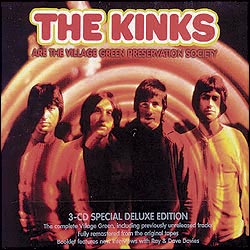
The Kinks Are the Village Green Preservation Society
(Sanctuary)
“This is the world we build in our heads as defense against the real world . . . think of the village green [as] your own personal version of it”: Ray Davies explains his picture-book utopia village green, along with British writer Andy Miller, whose elaborate liner notes (culled from his 2003 Continuum Books volume on the album) accompany this handsome three-disc release. Davies’ vision is both wistfully nostalgic and forward thinking. Quintessentially British, Davies’ impish paean to a country childhood—tea and china cups, little shops, and fresh air—evokes its everyday joys precisely. The 1968 release, originally slated as a Davies solo outing, was a commercial failure–turned–cult classic. Unlike the Kinks’ earlier records, with their British Invasion bullet points (fuzzy, three-chord rave-ups; laconic backing vocals), Village Green‘s sophisticated storytelling and heavy-lidded psych guitar work stick out like a paisley ascot tucked into a Nehru jacket. Dave Davies still sneaks a little R&B shuffle into “Last of the Steam Powered Trains,” while Ray works haughty naughtiness into “Wicked Annabella.” The real boon here is the third disc, filled with several strays that make up the storied Great Lost Kinks Album (think of it as the British Smile), among them the ornate, “Strawberry Fields”–style “Lavender Hill” and playful “Polly” (both previously released on the great 1972 compilation The Kink Kronikles), along with the unabashedly groovy instrumental “Mick Avory’s Underpants” and one of Davies’ watershed moments as a songwriter, “Where Did My Spring Go?” (“When you were loving me/You were just using me/You were employing me/You were destroying me/Now all I’ve got are varicose veins”). Gilded by extras, Davies’ pristine pop hamlet stands like a wrinkle in time, with laugh lines.
THE ZOMBIES
Odessey & Oracle
(Fuel 2000)
There’s a bittersweet taste to Colin Blunstone’s declaration, “We’ve only just begun/This will be our year, took a long time to come.” 1969 actually might have been the Zombies’ year had they stuck around long enough to enjoy the success of their chart-topping single, “Time of the Season.” Instead, the English schoolboy wonders disbanded following the release of Odessey & Oracle in 1968. The Zombies’ final studio LP has long been declared the “lost classic” of the psychedelic era. The first domestic reissue of O&O in 15 years contains arbitrary extras (mono mixes and overdubs), though the record certainly needs no accoutrements. O&O is pure soft-focus pop vision: “Care of Cell 44″‘s clever prison letter, along with the Faulkner-inspired “A Rose for Emily,” sets up an imaginary pop opera, a non sequitur narrative of lost loves and discovered documents. The Zombies’ 1968 masterwork, like the Kinks’, sidelines their R&B influence, veering into Burt Bacharach–style horn arrangements and rippling overdubs. While “Time of the Season” and its phosphorescent shifts may typify late-’60s hedonism, O&O stands timid. Blunstone’s boy-on-the-verge falsetto peers through rose shades but never quite sees what’s on the other side.
THE UNITED STATES OF AMERICA
The United States of America
(Sundazed)
“We were unlike anything. Before or since,” says Joseph Byrd of his experimental outfit’s place in pop’s trajectory in the liner notes of this reissue of their sole album, from 1968. He’s not quite right, though—the United States of America sound an awful lot like a more academic Jefferson Airplane. USA, formed after scholar Byrd arrived in New York City from Stanford to study with John Cage, were left-leaning enough to record epic threads of Stockhausen and Pierre Henri, yet centrist enough to be absorbed by the daisy-haired Midwesterners flocking to San Francisco; they signed with Columbia after a performance at the Monterey Pop Festival. Dorothy Moskowitz’s astral-planing intonations are undeniably slick, not to mention graceful, but she’s collected enough for Nico comparisons to stick. Her later solo material, also here among 10 bonus tracks (“You Can Never Come Down,” “Tailor Man”), evokes the Technicolor light fills of USA’s best—”Hard Coming Love” and “The American Metaphysical Circus”—but without the acid burn. Moskowitz admits in a reprinted interview that she considered herself less a singer than a composer. Her duet with Byrd, “I Wouldn’t Leave My Wooden Wife for You, Sugar,” plays like burlesque striptease with a handful of mother’s little helpers. He grabs the lead vocal, and the roles are reversed in a bonus version.