Persepolis 2: The Story of a Return
By Marjane Satrapi (Pantheon, $17.95)
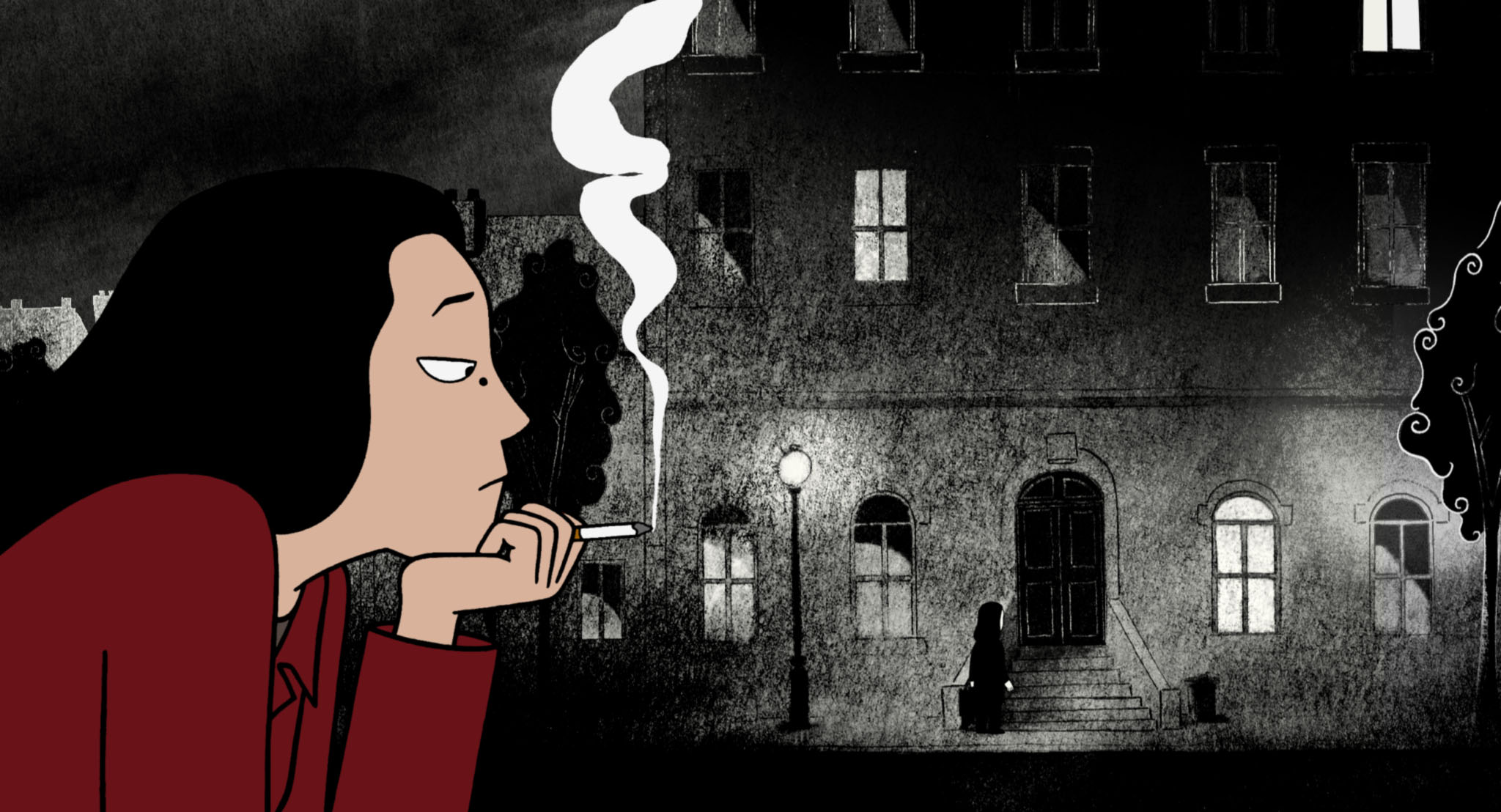
Marjane Satrapi's self-portrait, from her book cover.
Related Content
More About
It's a world-encircling effort: An Iranian graphic novelist is published in France, her work is translated into English, and the themes resonate universally. Marjane Satrapi did it with Persepolis: The Story of a Childhood; now she takes readers into her teen years, when her parents sent her to Austria for schooling (after which she returned to Iran).
Persepolis 2 is at least as compelling as its predecessor. Satrapi, whose childhood was shattered by revolution, fundamentalism, and the military conflict between Iran and Iraq, becomes a teen stoner in Austria after taking up with a pack of bourgeois anarchist kids. When Christmas comes around, they're off to the ski slopes to be "bored." When Satrapi tries to tell her friends about her winter holiday, Iran's New Year, nobody listens. Many such collisions of culture—nuns and a landlady with expectations for her behavior, her first boyfriend's complicity as his mother cruelly turns her away, faux radicals insistently quizzing her about war and death—dent Satrapi's spirit. She winds up living on the street for three months in winter, lands in a hospital with severe bronchitis, and decides her homesickness is just too much to bear. Satrapi goes home to Iran.
At home, of course, she finds herself as isolated and misunderstood—and as much a misfit—as she had been in Austria. Many returns lie in store for Satrapi: a return to tradition, to the oppression of the fundamentalists, to her family's love, and to school. Her schoolmates want the freedom to go without a veil, wear makeup, and go to clubs, yet they reveal their ties to traditions by calling Satrapi a whore for having had sex with her boyfriend. Then there are the Guardians of the Revolution, the fundamentalist police, constantly looking for an excuse to throw her in prison. After six years encompassing a bout with depression, a failed suicide attempt, a marriage, a divorce, and a college degree, Satrapi heads back to Europe.
Questions of identity, belonging, origins, and freedom echo throughout Satrapi's black-and-white drawings, which appear simple yet are exquisitely expressive. Her discussions of veils, for example—their length, their placement, their purpose—would be that much less rich if left only to words.
Satrapi's tales are riveting and revealing. It is difficult to call all of them enjoyable, but this book contains a gentle humor that softens its depiction of the horrors of Iranian life. Persepolis 2 provides readers with a rare perspective: a picture of life in a country about which most Americans know very little, and a viewpoint of the world we almost never see. JOANNE GARRETT
Marjane Satrapi will appear at Elliot Bay Book Co., 206-624-6600, at 7 p.m. Wed., Sept. 15; and at UW's Kane Hall, sponsored by University Book Store, 206-634-3400, at 7 p.m. Thurs., Sept. 16.
Ticket to Ride: Inside the Beatles' 1964 & 1965 Tours That Changed the World
By Larry Kane (Penguin Books, $14)
It was 40 years ago when the Ed Sullivan Show, featuring the Beatles in their American television debut, went head-to-head against The Wonderful World ofDisney and divided our household: boys (Beatles) against girls (Disney). The boys won. So we all watched those mop-topped lads from Liverpool—John, Paul, George, and Ringo—not knowing at the time that these four musicians would have such a far-reaching impact on American culture in just three years of touring.
Larry Kane, a barely-out-of-college kid who was working for a Miami radio station, asked for an interview and ended up in the band's traveling press party. He posits that the group was a catalyst for changing the world—that the girls who were held back by barriers as they tried to touch their music idols were the same girls who a few years later would be crashing the barriers at peace marches. That seems a stretch.
But there's no doubt that the girls were at the giddy, hysterical forefront of the screaming, dreaming crush of crowds that threatened the Beatles' safety at almost every tour stop—nearly loving the band to death. Kane captures the excitement and the fear as the Beatles introduced a new definition of concerts. They took the stage, played a 33-minute set, and escaped. The concertgoers' memories are vividly universal: They knew they could hear the songs (despite news reports that their screaming overpowered the music); they knew Paul was looking right at them; and they floated on air for days, knowing they had just attended the definitive concert of their lives.
Kane was privy to it all in those early days. He had a ringside seat when the conversation turned to the burgeoning Vietnam War or to the racially divided South. He witnessed the parade of women who visited the hotel rooms late at night (although he never included these visits in his stories), and he watched as the Beatles took the first of many steps to keep their public image spotless.
His tales quicken the heart. He puts us in the heat of the arenas, in the pressed-against-plate-glass craziness at airports, in the stands at Shea Stadium. Kane's memories resonate with those who are of that certain age. His book—with the accompanying CD of interviews with the Beatles—keeps that age fresh. JOANNE GARRETT