The knocks on Josh Harper’s door in Seattle came at 7 a.m. on May 26, just 20 minutes after he’d been awakened by a telephone call from California. There, federal agents, accompanied by a helicopter overhead, had just arrested three animal-rights activists. The caller warned Harper that he could be next. The California trio was taken into custody on an array of federal terrorism charges related to an aggressive campaign aimed at closing down Huntingdon Life Sciences. HLS, based in England but with facilities in the U.S., uses animals—dogs and nonhuman primates, for example—to test products for an array of pharmaceutical and biomedical companies.
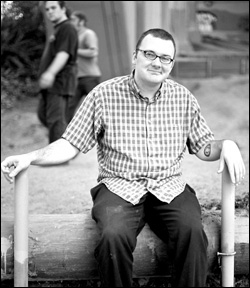
After hanging up, Harper thought for a moment. From 2001 until last fall, he’d been involved in the anti–HLS movement, known as Stop Huntingdon Animal Cruelty (SHAC), in both England and the States, principally organizing protests in the southern U.S. and editing videos for the group. Last year, the feds raided his apartment in Seattle’s University District and seized his computer and other property in connection with an investigation into SHAC. Although arrested at least a dozen times previously in the course of environmental and animal-rights activism, Harper reasoned that he was in the clear this time. He says he’s had no involvement with SHAC for much of the past year. “I told myself I was paranoid,” Harper says. He went back to bed.
But the knocks came, and they were for him. When he opened the door to the apartment he shares with his girlfriend, the FBI arrested him. Later that day, he was read an indictment in U.S. District Court in Seattle, charging him and six other SHAC activists with conspiring to violate a federal animal-enterprise terrorism law by taking actions against HLS, its suppliers and financial partners, as well as individual employees—crimes that largely amount to harassment and property damage. “It really is a form of domestic terrorism,” insists Michael Drewniak, a spokesperson for the U.S. attorney’s office in Newark, N.J. HLS’s American operations are in New Jersey.
Other legal experts see it differently. They call the move by the feds overreaching, a misapplication of laws designed to combat real terrorism, and an assault on the First Amendment. “It’s almost a little like charging Malcolm X with criminal acts for saying, ‘By any means necessary,'” says Harper.
There are many companies around the world that test potential medical innovations on mammals. But HLS became a big target of activist ire in 1999 after a BBC cameraman sneaked inside a company facility in England and videotaped an employee repeatedly punching a beagle. It was the video seen round the animal-rights world.
The response in England was to mount a protest campaign unlike any before. The goal wasn’t merely to protest against the company and force legislative change on animal research. They wanted an end to all such research, and HLS was the rallying point. The goal was to shut down the company by any means necessary. For the past five years, SHAC activists in the U.K. have protested at company facilities, raided its laboratories and freed animals, harassed employees, and targeted companies and individuals that do business with HLS—from customers to investors to insurers. The idea was to bleed HLS to financial death by holding anyone who did business with HLS accountable for the perceived ethical violations of the company’s research. At times, SHAC’s tactics were successful. Several companies quit doing business with HLS. At times, the campaign was violent. In 2001, masked men with baseball bats attacked Brian Cass, HLS’s managing director.
In 2001, SHAC came to America. The activists here differ from their British counterparts in that their protests have been largely under the public radar, the participants loosely organized. Along the lines of the Earth Liberation Front (ELF), SHAC USA had spokespeople articulating the group’s philosophy for reporters and a Web site devoted to posting communiqués from anonymous activists. But the tactics were in keeping with those used in Europe. SHAC activists regularly protested outside the homes of people connected to HLS. The SHAC USA Web site sometimes featured the names and home addresses of HLS employees. Some postings said that SHAC activists knew where a particular employee’s children went to school, what their names were, what color and make of car the parents drove, and who insured the car. This information was contained in anonymous communiqués posted to the SHAC USA Web site, according to Andrea Lindsay, SHAC spokesperson in San Francisco.
In addition, companies doing business with HLS in the U.S. have been targeted with e-mails, Internet attacks, letters, phone calls, and protests. That’s what happened to Warren Stephens, a large investor in HLS, and Marsh Insurance. Both Stephens and Marsh stopped doing business with HLS.
Harper helped organize the protests against Stephens’ financial firm in Little Rock, Ark., in October 2001. Last September, he shouted through a bullhorn during a protest outside the Seattle offices of Chiron, an Emeryville, Calif.–based biomedical company, purportedly a customer of HLS. The previous month, an anonymous person claiming to be connected with a group called Revolutionary Cells set off a pipe bomb at Chiron’s headquarters. SHAC USA posted a communiqué but denied any connection to the bombing.
Harper and other activists promised to hound Chiron employees for their connections to animal research—at their homes, grocery stores, and neighborhood parks. “We won’t go away,” he said. “You’ve never seen anything like us: We are a pissed-off bunch of activists.”
As far as the feds are concerned, the Web postings and property damage connected with demonstrations at the homes of HLS employees in New Jersey (broken windows and damaged cars) amount to a conspiracy and terrorism, even though SHAC USA’s Web site—over the top though it is—is mostly communiqués and cheerleading messages. “This is a conspiracy to participate in a pattern of conduct that has individual acts of what could be considered vandalism but also involved terrorizing and harassing,” says Drewniak of the U.S. attorney’s office. “The victims in these acts were clearly terrorized, they felt their lives and families were in danger. You just have to ask yourself, ‘How would I feel or how would my children feel,’ if you were the object of intimidation and harassment?”
Harper, 29, and six other SHAC activists were charged under an animal- enterprise terrorism law that Congress passed in 2002, in response to attacks against animal-research facilities by groups such as the Animal Liberation Front (ALF), which has broken into and torched research labs. The other defendants are Kevin Kjonas, 26, Lauren Gazzola, 25, and Jacob Conroy, 28, of Pinole, Calif; Andrew Stepanian, 25, of Huntington, N.Y.; Darius Fullmer, 27, of Hamilton, N.J.; and John McGee, 25, of Edison, N.J.
Frankie Trull, president of the Foundation for Biomedical Research, an industry advocacy group in Washington, D.C., says the indictments are a “victory” and a sign that, after ignoring aggressive animal activists for years, the feds are regarding activists’ deeds as more than random acts of protest.
The indictment charges the activists with conspiring to commit terrorism and committing acts of property damage in New Jersey and New York, as well as with setting off smoke bombs in two Seattle office buildings in 2002. No specific individual is named in relation to the Seattle incident. The indictment was handed down by a federal grand jury less than a week after the Senate Judiciary Committee held a hearing on animal-rights activists and the threats posed by them to research companies and other businesses. Much of the testimony before the committee focused on SHAC.
Harassment and vandalism aside, SHAC hardly comes off as anything close to ALF or ELF. There have been no bombings and no physical attacks on individuals in this country. The group’s rhetoric is strident, to be sure, but its acts don’t pass the sniff test of terrorism, according to legal experts.
“One of the problems with a lot of the terrorism laws is that they are incredibly broad,” says Jenny Martinez, an assistant professor of law at Stanford University, who recently argued part of the Jose Padilla case before the U.S. Supreme Court. She’s troubled by the feds’ go-for-broke attitude, under the flag of domestic terrorism, toward prosecuting what might be free speech. “There are all kinds of civil disobedience that’s designed to impact public policy that could be described as terrorism.”
The indictment charges Harper, a longtime animal-rights activist and self- described anarchist, with fomenting the conspiracy through the Web site. Harper says he’s done little for the group of late, doesn’t even know one of the people named in the conspiracy, hasn’t talked with another in four years, and is only in sporadic contact with the others. What’s more, he isn’t what you’d call Web-savvy. “I can’t program HTML,” he says, referring to the formatting behind Web pages. “I’ve never designed or written anything for this Web site.”
Attorneys who reviewed the indictment say the feds will have a tough time making their case. They stress that under federal case law, threats of violence have to be imminent threats and not rhetoric disconnected from the scene of the crime. “Is the letter of the law too broad or is it constitutionally too vague?” asks Lise Wiehl, an associate law professor at the University of Washington and a legal commentator for Fox News Channel. “That’s going to be an interesting legal question.”
“They are very clever,” Trull, of the Foundation for Biomedical Research, says of the SHAC campaign. “But is what they are doing, and the mission they are on, really the best for society?”
Harper and other SHAC activists are scheduled for arraignment in U.S. District Court in Trenton, N.J., on Tuesday, June 15. HLS is still in business in the U.K. and U.S. But in the U.S., the company has changed its name to Life Sciences Research.