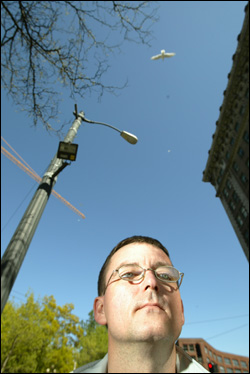
Arthur Pokorski wears T-shirts with pockets, and if you ask him about his left arm, he will tell you about the 20 scars, white and puffy, running like hash marks on the inside of it. Pokorski, who is 5 feet 4 inches and looks professorial in oval glasses, heard voices one day in San Francisco almost 20 years ago. He’d never had a mental problem before in his life—this was a classic psychotic episode. The voices told him to take a razor blade and kill himself. He tried to comply, and he awoke several hours later in a pool of his own blood.
“It was a very bad day,” he says. He was 20 at the time and has been trying to adjust to that suddenly new reality ever since.
In 1996, he sold all his possessions, moved to Seattle, and put to sea as a cook on bottom-fishing boats, in search of a better day. Off-season, he stayed in a small apartment in Belltown and drank a 12-pack of Bud Light each day. A schizophrenic will tell you: The voices are so strong you’ll do anything for a release. The voices continued. He became unemployed in 2002. He drank himself right into the psychiatric unit at Harborview Medical Center. Following his release last summer, he crashed at a hostel downtown and started drinking again.
One day last October, by then broke, Pokorski checked out of the hostel and walked with a duffel bag bearing all he owned to a parking lot along Second Avenue. He sat and drank beer. It was a warm day, and he wore shorts and a T-shirt and a thin vest. He was drunk and hearing voices again. Two men stole his belongings and drove off. That was enough, he decided—of the voices, suicide attempts, death by cheap lager— enough of the marginal living. “I feel like I’m in prison for things I didn’t do,” says Pokorski, 38, a Polish immigrant, who became an American citizen in 1995. He walked downtown and checked himself into the main shelter at the Downtown Emergency Service Center (DESC), a homeless shelter–cum–psychiatric ward. He was one of the lucky ones. DESC turns away 100 people a night.
Two decades after America deinstitutionalized hundreds of thousands of mentally ill people, the community safety net that was supposed to serve them is ripped. Over the past four years in King County, up to $70 million has been slashed from services for low-income, chronically mentally ill people. It’s about to get worse. Come next January, about 2,000 King County schizophrenics, bipolars, and depressives will find that they no longer have services, due to cuts in federal and state funding. People like Pokorski who want to get better won’t get the chance. They will be loosed upon the streets and left to deal with their demons, untreated.
Are we really that stupid?
Enlightenment, But No Money
Thirty million Americans have a major mental illness, according to the National Institute of Mental Health. As many as 3 million are considered chronically mentally ill. Schizophrenic, sufferers of bipolar disorder, or severely depressed, they are ill to the point of disability and, in many cases, have been for years. That 3 million is a group much larger than the American prison population.

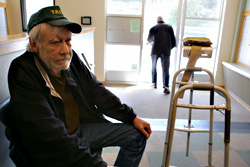
The Downtown Emergency Service Center serves homeless people of all kinds. But social workers think about two out of three clients either take psychiatric medication—or ought to. |
For generations, veritable prison was what we offered the mentally ill in America. We shuffled them off to large state hospitals, some so immense that they housed 10,000 patients. That system was in many ways a shame and a disgrace. Patients forgotten by their families, helpless and unprotected, were raped, assaulted, and murdered by hospital workers and other patients. The mentally ill were sometimes forced to undergo lobotomies and scientific experiments. Common treatments included leather restraints and crude medications that obliterated mind, body, and soul.
We weren’t interested in their rehabilitation or recovery. The paradigm was a warehouse.
When Ronald Reagan became president in 1981, he resolved to fix this—partly to offer some of the less severely ill in state hospitals a measure of freedom, but mostly because getting them out of the hospitals would cut government spending.
Supported by many advocates for the mentally ill, the goal was to shift these patients to a system of community care. There would be medication and therapy and life-skills classes and vocational training. There would be transitional housing, residential housing, and subsidized long-term housing. Continuity of care was what this new paradigm was supposed to be for people who mostly knew a continuity of hell. The mentally ill—known by professionals as clients or consumers—would go into the system and, someday, come out the other end, productive members of society.
But the mental-health system has evolved into a fragmented mess. More than 100 federal agencies fund it. The largest of those is Medicaid, sister program to Medicare. Medicaid pumps about $35 billion into treatment and services by making payments to states and requiring each to match the federal money. At approximately $70 billion, the public mental-health system in America is twice the size of Microsoft’s annual sales.
It’s designed to serve the low-income mentally ill, those otherwise uninsurable people who have chronic illnesses—people for whom a capsule of Prozac isn’t an answer. People so broken by schizophrenia and depression that they require regular intensive care over a period of years. The kind of people you step around on Broadway. The people who wander downtown, speaking to no one in particular. People leading lives of noisome desperation.
Yet we have never been very serious about taking care of these people. Successive Congresses and presidents and legislatures have systematically cut the system to the point where there’s a perpetual crisis. Mentally ill people are lucky to see a psychiatrist once a month, regardless of their condition. Visits to Harborview’s state-of-the-art crisis triage unit, an emergency room for the mentally ill, has doubled since it was opened in 1998, to 9,000 patients a year. State institutions, such as Western State Hospital in Steilacoom, Pierce County, are releasing a far more psychotic batch of patients into the community than before.
Social workers and doctors all over King County report that what they see each day is a crisis without end. By this time next year, though, many who work in the system might remember these conditions as a happy prelude to something even worse.
Medicaid has long allowed states and the agencies that deliver mental-health services to pay for non-Medicaid patients with whatever Medicaid savings they could engineer—doing more with less. It has been the only practical way to fund treatment for those who don’t qualify for Medicaid under its Byzantine rules. In large urban areas such as King County, the non-Medicaids can comprise as much as 15 percent of a system’s low-income caseload. Somehow, the agencies and organizations have found money to treat as many of them as they can. Left untreated, many of these people would melt down and commit a crime. They’d crash and burn and end up in a psych ward for two weeks, at a cost of about $7,000—enough to fund routine, ongoing mental-health care for five people for a year. They’d go into the streets and die. Scrimping to pay for their treatment, with creative management of money from Medicaid grants, has been a financial and ethical necessity.

During the day at DESC, vinyl mattresses are stacked. At night, on the floor, sleep is not always restful. |
But America’s perpetual search for the better, faster, and cheaper alternative to everything will be a disaster in King County when, at the end of the year, agencies will no longer be permitted to raid Medicaid money to cover the expenses of other patients. That means showing more than 2,000 chronically mentally ill people the door. Many will return to the snake pit of the streets. Many will die cold, hungry, and fucked up. They’ll slash a razor blade across a wrist, plunge a spike into an arm and overdose.
Don’t we already have an example to warn us, in Stanley Stevenson? You remember him, right? In 1997, the 64-year-old retired firefighter was stabbed to death near the old Kingdome by a schizophrenic man, Dan Van Ho, 30, after a Seattle Mariners game. It was a civic sore spot, symbol and signifier of a society that just doesn’t take mental illness seriously enough, and it led to a tightening of involuntary commitment in Washington.
We are about to go down that trail of tears again. It’s the American way. This is a nation that often allows policy imperatives to be driven more by disaster than by reason. We need a victim to get solutions moving through the political system. We need dead folks under the Alaskan Way Viaduct. It takes a 9/11 to get anything done.
Or does it?
A Life Falls Apart
Pokorski grew up in the southern Polish city of Walbrzych, about 70 miles north of Prague in the Czech Republic. It’s coal- mining country, the West Virginia of Eastern Europe. The hills are covered with oak trees, and in the local imagination, the forests are filled with spirits and sprites. Men work in the coal mines each day and pound vodka at night, on the fast track to an early death. When Pokorski lived there, the country was under martial law. He left in 1984, finding his way to Detroit and, later, San Francisco, taking a stab at a new life. He lived in the Mission District and worked as a pastry chef at the venerable St. Francis Hotel.
That’s when the voices started and the suicide attempts began. Besides cutting himself open with a razor blade, Pokorski survived at least two other suicide attempts. He tried to hang himself. He blew out the pilot light on his oven and let the gas fill his apartment. Meanwhile, he was hearing voices and, as he puts it, was having supernatural experiences—his apartment filling with ghastly light one day. “It was like something on The X Files,” he says. He could see the future. None of this was helped much by Pokorski’s crystal methamphetamine habit. But he was hearing voices all the time, thought he was being followed, and knew, in more reflective moments, that his life was falling apart.
Pokorski also buffered schizophrenia’s self-destructive demands with his passion for dancing in clubs, where he lost himself in the thundering bass, and by throwing himself into work, rolling out phyllo dough at the hotel. But it wasn’t always enough, and despite several brief hospitalizations in the Bay Area, Pokorski says, none of the psychiatrists did much for him. He’d come to America for a better life and the chance to send money home to his parents in Poland. What he got was psychosis and minimal medical help.
That’s why he put to sea as a cook. You can keep busy and focused enough on keeping a ship’s crew fed over the course of a 16- to 20-hour day to hold off a host of demons. Still, the experience almost killed him. One day, he fell overboard at a fuel dock in Kodiak, Alaska, plunging deep into the icy water, and the bobbing ship nearly crushed him against the wood. He lived through that and returned to Seattle. By then he had come to realize that he’d never be successful at suicide. There was something in his strict Catholic upbringing that kept him from making any more attempts.
So he’s trying to get his life back on keel. That day last October, when Pokorski watched the thieves of his belongings pull away in a van, he drew the line. Those damn voices were winning. He’d fight them, cost be damned. It’s not easy to convey the kind of courage that takes, but it is the sine qua non of fighting mental illness without help.

Arthur Pokorski hears voices, but he’s on medication and just graduated from FareStart, a program that helps the homeless learn restaurant skills. |
The trouble is, schizophrenia cannot be brushed off with courage alone. It’s an organic brain disorder that results in delusions (the voices), paranoia, and a whirlwind of other problems. Pokorski is now on medication. But it wears him down to the point where he looks rattled in the evening. He’ll come up to you and his eyes narrow and his body is tense and he looks worn and haunted. He’s better on the weekends. He briefly sees his caseworker almost every day and has been sober for seven months now, but Pokorski still has voices to contend with. The Downtown Emergency Service Center still classifies him as having alcohol-induced psychosis. But with the demon Budweiser out of his system and the voices hectoring him to the point where he feels possessed, he’ll probably be diagnosed as a schizophrenic soon enough. Still, Pokorski is trying damn hard. He resides at a Salvation Army housing project. A week ago, he graduated from FareStart, a program designed to give the homeless work experience in a restaurant setting.
His quest is to live—to get some peace and some distance from the voices, to send some money to his family. There are limits to what he can handle, of course, but for people in his predicament, trying is often the most important program of all. The deck has been stacked against Pokorski for two decades, and he’s determined not to give up on himself. Too bad the state of Washington and the federal government might give up on him.
Life in the Shelter
When Pokorski pulled himself off the streets last fall, he went to DESC’s main shelter at 517 Third Ave., in the ballroom of the former Morrison Hotel. Though serving a mix of clients that includes those without mental problems, the DESC shelter is mostly the sanctuary of last resort for many of King County’s mentally ill, a state hospital ward without the restraints.
The windows are large, leaded, and arched and look south, toward the sun. But they’ve not been cleaned in years. More than 200 residents and clients keep the small, dedicated staff too busy for such chores.
Men and women wander about the grand ballroom. There are generations of grime on the linoleum floor. It costs $1.2 million a year to run the shelter, and that’s not enough to cover all the needs that come through the door. The city pays for the space. Funding for the treatment of clients comes from Medicaid.
An elderly woman approaches you, takes your hand, stares into your eyes, and talks about a long-dead husband as though he’d slept next to her the night before. These people want you to hear. Something.
Others, mostly men, who carry that look of perpetual shock you often see in the seriously mentally ill, sit at tables, playing cards, reading paperbacks. There are bunk beds with piles of thin, gray, vinyl mattresses. Some sit on chairs against the wall. It smells of foot odor and too many bodies.
“To the general public, if they came in here, they’d say, ‘Yes, this is a psych ward,'” says Daniel Malone, DESC’s housing program manager. Of the 200 people the center can serve, 67 percent either take psychiatric medication or would be strong candidates for it, according to the agency’s data. The percentage could be higher, says Malone. Diagnosis and treatment, however, are not compulsory under the shelter’s come-as-you-are policy. Clients are not screened for weapons or drugs.
Pokorski didn’t sleep well at DESC. At night, he’d be awakened by someone screaming his mind out somewhere in the building. So in the morning, he’d get a bus ticket from his case manager and walk onto Third Avenue and hop the 358 bus that runs up Aurora Avenue North. He’d sit in back, stare out the window, and ride all the way to Shoreline, where he’d reverse the process. He was out of DESC inside of three months, stable enough to move over to the William Booth Center in the International District, run by the Salvation Army. Many people at DESC aren’t so capable or lucky. They will sit in those chairs for years, just like at Western State Hospital in the not-so-good old days.

On this day, the clients who sought help at the Downtown Emergency Service Center, which serves Seattle’s homeless, included Teresa Fiddler. |
Clients get one meal a day, sometime after the doors close at 5:30 p.m. They go to other downtown feeding sites during the day. On a recent night, the menu at DESC was two hot dogs, baked beans, a bit of salad, and a cup of Kool-Aid. Later, the mattresses come down onto the floor. Gray, industrial-strength blankets get passed out. Men curl into them, some wearing clothes, some not, and try to sleep. Women do the same in a separate dorm.
There are occasional fights. On a recent afternoon, when the ballroom was tropically hot, two male clients squared off. The first time was in a hallway, the second was out on the sidewalk.
How anyone gets stable at DESC is beyond me. Some do, some don’t. Karyn Boerger, the shelter’s manager, describes it as a process of “small victories,” such as a man who, two weeks ago, finally agreed to inspect a longer-term housing option offered by the agency. It took him a week to make up his mind to make the move. Some clients are at the shelter a couple of weeks, some have been there more than five years. Then again, I can see how for some it can be a crucial transition point. The staff is humane. On multiple occasions during my visits to the shelter, I watched as DESC employees, pressed into a quasi-nursing position at about half the pay, worked compassionately—there is no other word for it—with clients for whom the rest of us would summon 911. They bar clients whom even they cannot work with. And some clients, including one I encountered there who appeared to be fairly well, disappear for days, wandering the streets, openly psychotic.
Life and care at the shelter worked, however, for Arthur Pokorski.
$70 million vanishes
Amnon Shoenfeld knows all about funding cuts, and he calls the ones he’ll have to make on Jan. 1 “the worst ever.” Shoenfeld is director of the King County Mental Health, Chemical Abuse, and Dependency Services Division. He’s worked in mental-health services in the Seattle area for more than 25 years. He lived through the Reagan cuts of the 1980s and the managed-care cuts of the 1990s. Those were the warm-ups.
For the past four years, the Legislature has cut money for King County’s mentally ill. In 2000, it cut about $10 million a year from Medicaid funding destined for King County. Keep in mind that was before the state went into a fiscal crisis due to the economic recession. In 2003, the Legislature reallocated (perhaps that’s too polite a term) an $8 million balance that King County had managed to save over the years, which was set aside to fund services for, you guessed it, non-Medicaid patients. King County has also borne a very high share of the expenses related to the state’s tightened commitment laws, which have led to twice as many people being hospitalized against their will in 2001 as in 1998. The county’s share of that works out to about $10 million.

Amnon Shoenfeld of the King County Mental Health, Chemical Abuse, and Dependency Services Division says imminent budget cuts are the worst ever. |
Shoenfeld estimates that all the cuts pencil out to $70 million over the last four years. And that was before federal officials told the state that they wanted non-Medicaid patients cut off in April of this year, meaning that Medicaid money can’t be used to treat people who aren’t in the Medicaid program. It’s hard to place a dollar figure on the loss in services, but officials estimate 2,000 people will be affected in King County. The feds delivered the message to the state’s Department of Social and Health Services in March, demanding the April cutoff. The state negotiated an extension until Jan. 1.
Due to earlier cuts, some agencies are already making insane choices. The crisis triage unit at Harborview will have its county funding cut from $700,000 to $100,000. The unit is a quiet, efficient place of respite for the people who are suicidal or having psychotic episodes. It’s designed to triage them for either hospitalization or a next-day appointment with an agency like Seattle Mental Health. Harborview officials say they might have to cut some services and staff.
The previous cuts are already being felt at Consejo Counseling and Referral Services. It’s a mental-health agency in the Rainier Valley neighborhood, serving the Latino community. A year ago, it had $500,000 per year with which to treat non-Medicaid clients. This year, it’s $180,000. Next year, $0. In January and February, the agency turned away 45 people who needed help but didn’t qualify for Medicaid.
Already, the agency is making stark choices. Do they keep treating a long-term schizophrenic who’s begun to improve and deny treatment to a new patient? Or do they treat the new person and cut off the other’s care? Untreated, the first one will most likely have a psychotic episode and end up in the hospital or jail or worse.
2,000 Souls in Need
I saw Pokorski riding his mountain bike on Capitol Hill two weekends ago. It was warm, and the sun was shining on Pine Street. He pedaled his bike (which was stolen last week) toward downtown, outracing cars and buses.
I worry about Pokorski when I see him like that, when he looks that good and hopeful. He always tells me how much he wants to work, and I have a vision of him sitting in a parking lot downtown, a blank stare on his face, voices in his head, a Budweiser tall boy at his side.
Right now, he receives $338 a month in general assistance from the state of Washington. Because of that, he qualifies for Medicaid. But when he returns to work at a restaurant, say, he will lose his state money and Medicaid coverage. He might get some coverage under private health insurance.

The DESC main shelter is in the former Morrison Hotel on Third Avenue. |
The trouble is that private insurance companies, such as Group Health and Regence Blue Shield, discriminate against the mentally ill in this state. You don’t get the same level of coverage and treatment as if you had cancer. The number of times you can see a doctor is restricted to as few as two a year. And the insurance companies allocate those visits so that they are often 15-minute medication-management appointments. Pokorski will also need to make enough money to not just put a roof over his head and eat, but to pay for atypical antipsychotics, as they are known, to keep him stable. Most private insurers cover on the order of 70 percent of prescription costs, leaving the insured to pay the balance. In Pokorski’s case, he could easily face a monthly prescription bill of about $2,000, of which he’ll need to pick up one-third. No matter how hard he works, he won’t be able to cover that making $10 an hour. For a long-term schizophrenic like Pokorski, that could mean returning to the streets.
That’s stupid. Having a mental illness myself, I have largely given up hope of ever seeing insurance parity. Society sees mental illness as a character flaw. These people are lazy. Hey, just hurry up and feel better. Go back to work.
Over the past 15 years, mental illnesses have been acknowledged to be medical in nature. Study after study—everything from reports by the U.S. surgeon general to insurance studies—has established that by taking mental illnesses seriously, treating them with medications and therapy, society could reap tens of billions of dollars in increased productivity. But little has changed. We’d still rather pay for crime, pay for emergency-room visits, and let sick people fend for themselves on the street than provide preventive mental-health care.
I asked Norwood Knight-Richardson why that is. He is an associate professor of psychiatry at Oregon Health & Science University and an adviser to the secretary of Health and Human Services. A personal friend of President Bush, he sat on the Presidential Freedom Commission, impaneled to recommend improvements in the system. He also ran a mental-health system in Texas. He’s angered by the stasis that blocks effectively dealing with mental-illness issues on a national level. What’s his explanation for that?
“Why are some people racists?” he asked.
Racism might not be the best analogy. But when you take into account the mistreatment and open discrimination against the mentally ill in America, it comes close. We need a change of thinking and a change of heart. We need to think of the chronically mentally ill as being like Arthur Pokorski, who is working so hard to right himself, and not the man who stabbed Stanley Stevenson. We need to accept them as our sisters and brothers with medical conditions that are mostly treatable. We need to give them a chance.
But the more immediate crisis in King County is those 2,000 people who will be pushed back into the streets on Jan. 1. To prevent that, King County’s Shoenfeld says, he needs $20 million. Similarly, the mental-health systems in Clark, Pierce, and Spokane counties are expected to push hundreds of mentally ill people out the door, as well.
This requires immediate attention. Last December, the Legislature met in special session to approve $3 billion in tax cuts for Boeing in exchange for the company’s pledge to provide about 1,000 jobs in Everett. Here we have 2,000-plus lives and souls on the line. What will we do for them?
pdawdy@seattleweekly.com; 206-467-4384