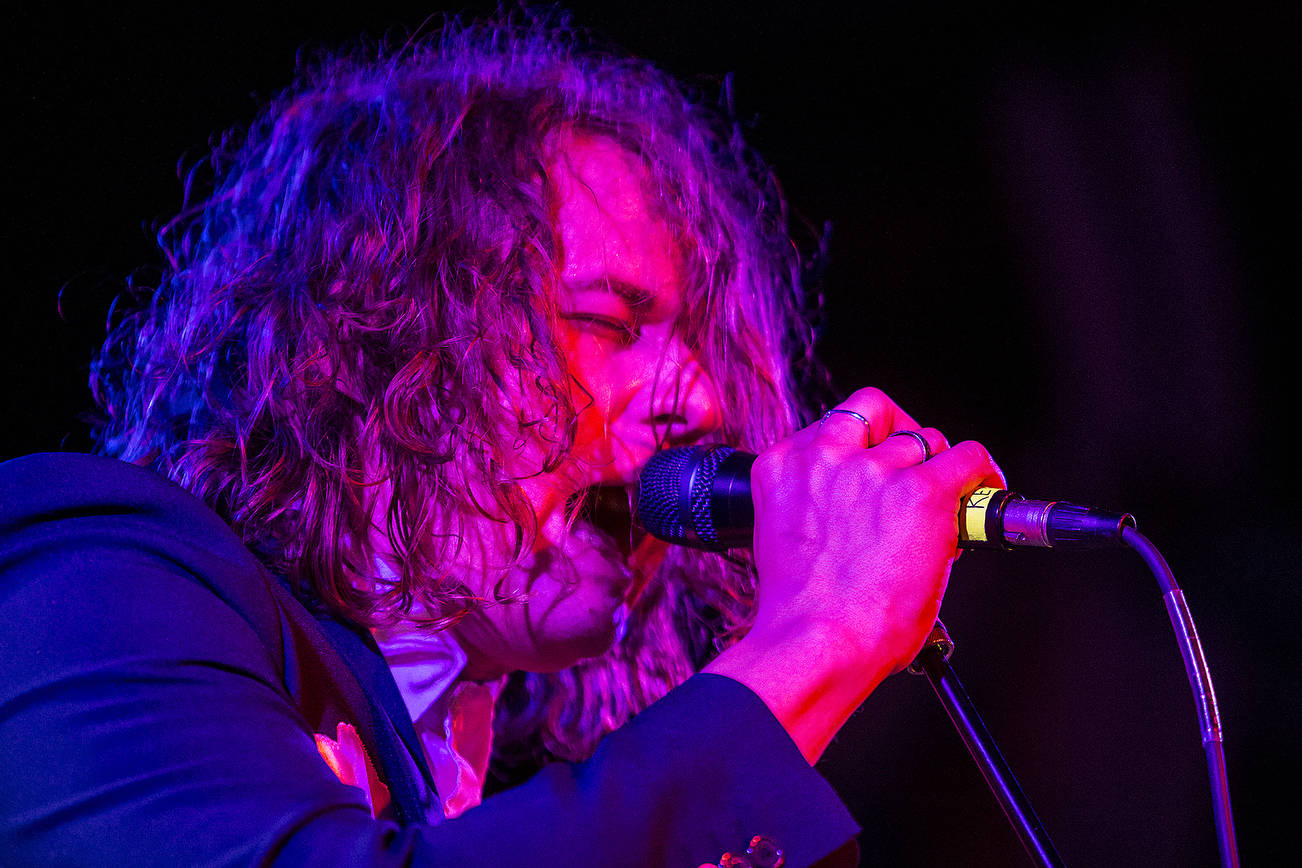
Ann Powers grew up in Seattle and began writing for the now-defunct Rocket as a teenager. Moving to San Francisco in the early ’80s, she became music editor of San Francisco Weekly, eventually meeting Eric Weisbard, a Queens native fresh from U.C. Berkeley’s history department with a thirst for rock criticism as pronounced as hers. Powers and Weisbard would eventually marry; they would also both edit the Village Voice‘s music section, and in 1995 each co-edited an influential anthology—Powers, Rock She Wrote, with Evelyn McDonnell; Weisbard, Spin Alternative Record Guide, with Craig Marks. Weisbard was also an editor at Spin during the mid-’90s, while Powers spent several years writing about pop for the New York Times.
All of that changed in December 2001, when Powers, now 40, and Weisbard, 38, moved from their Brooklyn home to Fremont and took jobs as senior curator (Powers) and senior program director of the Education Department (Weisbard) at Experience Music Project. Weisbard’s first task was to organize the museum’s inaugural Pop Music Studies Conference, in April 2002, which was successful enough to occasion a second and now a third conference, hosted this weekend. This year’s topic is “This Magic Moment,” a good, broad heading for what looks to be a good, broad array of subjects. The Jukebox took place in Powers and Weisbard’s Fremont home on a balmy early March evening; during much of the discussion, the couple’s baby daughter, Rebecca, slept in Powers’ lap.
Ui: “The Grand Piano” (1996) from Monsters, Robots and Bug Men: A User’s Guide to the Rock Hinterland (Virgin AMBT, U.K.)
Eric Weisbard: “Nameless, Formless,” as far as I’m concerned.
SW: Can you guess when it’s from?
Ann Powers: I’d say it’s from the dawn of dance music, or it’s from the mid-’90s.
SW: This is Ui.
Powers: Oh! It’s Sasha [Frere-Jones, Slate and New Yorker pop critic]. We like his writing, but we’ve never listened to his CD.
Weisbard: Let’s just be honest about it. Actually, let’s make a more broad blanket statement about it. We care a lot more about music writing than music, if push comes to shove.
Powers: That’s not true.
Weisbard: In the case of Sasha . . .
Powers: Eric’s speaking for himself. Sasha Frere-Jones is one of the best music writers out there right now. I’d like to take credit for his career, sort of—I was the first person to publish him in the [Village] Voice. He was writing for Pretty Decorating, Ann Marlowe’s ‘zine. I thought he was a girl. I was seeking out great, wonderful girl writers, but when I discovered he was a boy, I decided he was still really good. And so he wrote some pieces for me. But the truth is I always kind of avoided Ui partly because I had a working relationship with Sasha as a writer and I didn’t want to have to make judgments about his band.
Weisbard: As a musician, he was a very good writer, and as a Pop Conference participant, he definitely rocked the house. He was the funniest speaker last year, as he addressed things like Stephen Malkmus’ refusal to be great.
The Mountain Goats: “The Black Ice Cream Song” (1995) from Zopilote Machine (Ajax)
Powers: We have a concept: Pop Conference.
Weisbard: [The Mountain Goats’ John Darnielle] was not only at the first Pop Conference, but has an essay in the book, This Is Pop, which is from that presentation, which is almost exclusively comprised of quotes from obsessive hair-metal fans who never got over the death of their genre. What’s great about John is he can write about anything—write prose about anything and write a song about anything. And he’s one of the few people I know whose instinct to write [prose] and instinct to write music are equally well developed, and I think he’s extremely gifted at both. And I think he’s someone who has this natural Beat sensibility. He approaches everything, essentially, as: His first draft is going to be his best draft, and that’s the quality in his music. It’s very similar to Kerouac hammering out that endless scroll.
Powers: Maybe a better comparison is not the Beats but Denis Johnson, who wrote Jesus’ Son and the wonderful California novel Already Dead, a fantastic book. He sort of updates the Beat story for a more cynical age, a kind of body-fluid-oriented thing, more mental, I don’t know.
SW: The piano player on the new Darnielle record is Franklin Bruno. . . .
Weisbard: Another Pop Conference alumni and another guy who combines writing about music [with playing it], which is not easy. Although it should be easier, because these days, in particular, it’s a lot of the same demographic: You go to college, you start a band—well, you play music in some way, you write about music in some way—it’s a lot of similar kinds of people. Not that that’s the entirety of music, but the overlap is there.
Powers: Franklin is very interested in that nexus between philosophy and poetry, but at the same time, he’s most interested in musical forms that some might consider premodern or at least pre–rock and roll. There’s a kind of fascinating connection there between his interest in the classic song form and his interest in the most esoteric tricks that poets can play with language, and I think that his work is a very clever and insightful look at how language works in that classic form. I’m very interested in that, whether it’s Adam Gabbler, who’s writing musicals now, or even this new composer Thomas Adés, whose record I was listening to the other day. I’m sort of interested in how it’s happening outside of rock, and I like Franklin for going outside of rock.
SW: That’s pretty much what his presentation was about last year, wasn’t it?
Weisbard: He talked about the Tin Pan Alley roots of Bob Dylan. Or not so much the Tin Pan roots, but Dylan likes to say he killed Tin Pan Alley, and since he’s an artist, he doesn’t have to speak consistently—he also uses Tin Pan Alley forms.
Powers: He’s a song-and-dance man. If you were one of the seven or eight people who saw Masked and Anonymous, you saw him in Tin Pan Alley form.
Weisbard: This year [Franklin is] going to give a paper on the Peggy Lee song “Is That All There Is?” His proposal mentions other versions of it, so the first draft of the proposal he gave me credited a cover version to Christina Aguilera, and then he sent me a really apologetic e-mail saying, “I was reading and not listening, it was actually Cristina,” you know the turn-of-the-’80s Ze Records disco diva.
The Masked Marauders: “Cow Pie” (1969) from The Complete Deity Recordings (Rhino Handmade)
Powers: It sounded Dylan-ish.
Weisbard: If this is David Grubbs, we’re not going to know the specifics.
SW: It’s not David Grubbs.
Powers: Is it a Pop Conference attendee?
SW: It is, sort of.
Weisbard: Did you actually stump us with [Jon] Langford? Is this a Langford instrumental?
SW: This is not Langford.
Powers: [To Weisbard] You’re just going to keep guessing Mekons. “Sort of a Pop Conference attendee”—someone who was in the crowd, but didn’t give a presentation?
SW: No, somebody who gave a presentation. It was the Masked Marauders.
Weisbard: Oh, OK. That sort of fake record in the ’60s that everybody thought at the time might be a Beatles or Dylan all playing together.
SW: Right. That record came about as a result of a fake record review Greil Marcus published in Rolling Stone in 1969. He’s the Pop Conference attendee I was referring to. The band was the Cleanliness and Godliness Skiffle Group.
Weisbard: Greil is a great inspiration that you don’t have to play music to write about it.
Powers: I remember somewhere hearing about his [City Pages column, Real Life Rock] Top 10, and I mean this with all fondness, his sort of, “I went to the darkest corner of Romania and I saw a street musician play in an alley, and he dropped dead right after playing, and this was best musical experience I ever had.” That was a satire of Greil printed a long time ago, actually. He likes a good joke, but he also likes a good obscurity.
Weisbard: These days he seems to be writing about such non-obscurities as the Rolling Stones and Bob Dylan.
Powers: Maybe he’s making his run for the canon.
Weisbard: I think he’s always kind of gone back and forth. And I think one of the things he and [Robert] Christgau—it’s important that the two most well-known rock critics have always shied away from the two great errors, blind populism and blind avant-gardism, especially since popular music has become so divided and gone through so many convolutions, you know, they’ve never gotten lost in one camp or the other.
Powers: They’ve really made an example for making it a career, which I think is one thing we’ve all found challenging at one point or the other, whether when you’re 25 and trying to figure out if you can make a living at it at all, or you’re 40 and trying to figure out, like I am, how to continue it when you’re not really in the flow anymore.
SW: When did you meet Greil Marcus? Did you both meet him together?
Weisbard: We met him on the same day—in fact, on the day we met each other. It’s actually kind of pathetic. Ann and I met in the context—yes, it’s true—of a panel on rock criticism. Ann was on the panel, meeting her idol, Greil, for the first time. He told her he loved her work, and that blew her away. I was just a young wanna-be in the audience.
Powers: He was cute. It was a panel organized by this guy Kevin Berger in San Francisco 15 years ago, and the panel included Kevin Berger, who I’d dated a little bit; Gina Arnold—at the time I was a columnist for the San Francisco Weekly, and she was a columnist for the East Bay Express; Greil; and Robert Duncan. I was incredibly nervous, for all the obvious reasons. I made a remark about how I was a Seattleite, someone who grew up in the ’80s, the ’70s, I couldn’t really understand rap music, and this person jumped up out of the audience, without even waiting to be called on . . .
Weisbard: And I said, “That’s just nuts. The whole notion of rock and roll is based on the fact that people hundreds and thousands of miles away can listen to somebody totally unlike themselves and get something out of it. Of course that’s happening with rap music.”
Powers: That’s what he was yelling at me from out of the audience.
Weisbard: And I will point out that Greil, at the time, said something like, “Well, I’m not sure that hip-hop beats are strong enough to do that again.”
Powers: Well, who cares what Greil said? The point is, here’s this guy—I should have known then—he doesn’t even wait to be called on to argue with me, and the truth be told, I thought he was very intriguing in many ways, and afterwards this guy had the nerve to come up to me and say “I want to work for you; I want to write for your newspaper.”
SW: So you, Ann, were writing before Eric?
Weisbard: Ann had been writing about music since she was a teenager. She was the music editor of San Francisco Weekly, and I was maybe six months out of college and had never written anything outside of my college newspaper and the backs of record covers—I wrote a lot on the backs of record covers at the college radio station. More rock criticism took place on the back of record covers in college radio stations than in a lot of other venues. I had to be a radio DJ for five years, scribble on the backs of a lot of records, read tons of cultural studies before I could even start. So then I had to spend a couple of years unlearning all of that so I could write in a way that could be read.
Holy Modal Rounders: “Bad Boy” (1999) from Too Much Fun! (Rounder)
Weisbard: Peter Stampfel?
SW: Yes, the Holy Modal Rounders.
Weisbard: I’m thrilled that Peter is coming out this year. His [current] project is to cover one song from every year in the 20th century and put out a record with voluminous liner notes on each song. Some of them will be really well known and some will not, but essentially it will be a continuation of a project that he’s been at for almost a half-century. He kind of has a right to try to tackle a century’s worth of music. He’s been immersed in folk music in a way that truly honors the folk present and the folk past. He’s fascinated with Americana of all kinds.
If you go to the conference and you’re at [Stampfel’s] lunch performance, it’s my hope that instead of specific requests we can shout out specific years, and I want to request 1958, because he has the most amazing spiel about how that was the crucial year when the folk scene and the Beat scene and what was left of rock began to transmute in a way that the people that became pivotal in the early-to-mid-’60s started to find their voices across America—[San Francisco’s] North Beach and [Minneapolis’] Dinkytown, and so on and so forth.
Powers: And young girls coming to Greenwich Village. He said that a big part of it was the young girls coming and hanging out in Washington Square Park, so jailbait was a big part of it.
Afrika Bambaataa and Soul Sonic Force: “Planet Rock” (1982) from Looking for the Perfect Beat: 1980–1985 (Tommy Boy)
Powers: That sounds familiar.
SW: Eric mentioned Robert Fink’s presentation on this song to me and I’m interested in how he came across it.
Weisbard: This is the one presentation that I specifically requested for this year. I was in L.A. last fall at the American gathering of what was called the International Association for the Study of Popular Music—you can see how popular music academics have come up with things as catchy as pop itself. Robert Fink gave this incredible presentation called “The Story of ORCH5,” about how this particular keyboard-sound-sampled disk that is first in Kraftwerk and then taken by Afrika Bambaataa, probably with the help of Arthur Baker. I really am going to get the argument wrong. It was some snippet by some classical leader that’s played through an early synthesizer It’s a beautiful presentation I would strongly recommend to people who have heard a million times this sort of general thing about how this song being taken by Kraftwerk from Bambaataa and how pluralistic that is and how interesting that is. It’s an example of how the academic approach to popular music can be incredibly relevant, because he just gets 16 paragraphs deeper than anyone else I’ve seen. Robert Fink has done some really excellent music writing in other places as well. He’s from UCLA.
Sleater-Kinney: “Burn Don’t Freeze” (1999) from The Hot Rock (Kill Rock Stars)
Powers: Sleater-Kinney! We were honored to have [guitarist/singer] Carrie Brownstein on the advisory board this year.
Weisbard: She was also at the first Pop Conference. This is kind of an amazing story about how difficult it is to get musicians into the swing of it.
Powers: Carrie’s not easily intimidated, but I really felt like she was put in a bad position on that panel. She worked, she actually wrote something, and she presented it to the panel.
Weisbard: At the first conference in 2002, we had a musicians panel that was due to be the final event, carried live on KEXP with Mark Arm, Calvin Johnson, Sam Coomes of Quasi, and Carrie, and they were all supposed to give short talks followed by a Q&A. I was new to the Pacific Northwest, and didn’t quite realize just how deeply the strand of thought that rock is essentially anti-intellectual ran in this part of the world, which I have to say is the single most depressing thing for me about living here. There’s always been exceptions and always will be. But there is a general bias toward pretending to be dumber than you are, or being afraid that you’re not as smart as you think you are. I don’t know what it is.
SW: Which is odd, considering that in a lot of cases that myth is perpetuated by indie rockers, where the kind of stance is that they’re smarter than the average pop fan.
Powers: I grew up in Seattle, and I was away for almost 20 years, so I’m no expert in a way. But I will say there’s a very deep strain in Northwest culture that’s about (a) keeping to yourself and (b) not being too ostentatious in your presentation, or verbally, in the way you talk. I think there’s a big fear of pretentiousness in this town.
Weisbard: Pretentiousness is fine. I say to you, Seattle—be more pretentious! [laughs]
We had this musicians’ panel, and only Carrie ends up writing a paper. She doesn’t get to say it, because it becomes this terrible Q&A where the other [panelists] are like, “We don’t have anything to say.” Ann has to come from the audience to try to moderate it, to try to redeem the thing. The upshot is that the presentation Carrie was going to make that day became an essay in This Is Pop, is in print, and will have a longer shelf life. And Carrie this year is going to be part of Critical Karaoke, which is something that Joshua Clover, one of our regular participants, came up with, a 90-minute panel followed by a free-for-all, including anyone from the public, can participate in. You can take any song you want as long as, at some point in your life, you thought it was the greatest song ever. Your mission is to talk over that song for the length of that song, interpreting that song, stopping when that song stops.
Powers: She was a big part of what we did and did not select [this year]; she had the scoop on lots of people up and down the West Coast, in terms of what kind of papers they would present.
SW: I know she’s done a lot of academic work, but being a musician, did her approach to selecting papers seem noticeably different from that of the rock critics or other academics?
Powers: She was quiet at times, but when she spoke, her words carried a lot of weight. She was more like the quiet-but-deadly force. It’s an intimidating room when you’ve got a bunch of blabbermouth rock critics.
Weisbard: Not just rock critics—academics and musicologists and cultural studies professors, those kinds of folks, too. Another person on the program committee who’s returning to Seattle for this conference is Gage Averill . . .
Powers: He’s probably the absolute opposite of Carrie in some ways.
Weisbard: He’s someone who basically ran the Society for Ethnomusicology conference that happened in Florida a couple months back. He got his degree at the University of Washington’s School of Music, which really, if you’re into world music, is the place that did for the study of world music what people are trying to do for the study of pop music. When you go looking for all the strands of music writing out there, it’s great to learn about something like the ethnomusicology tradition at the University of Washington School of Music and realize that these were a lot of pretty gnarly, cool people sitting around a room, many of whom were just as arty and inspired by the same weird things as the Beats, and often were on the same radio stations.
Powers: Stuart Dempster, for example, was a big guy in the department—the man who brought the didgeridoo to the United States.
Gastr Del Sol: “The Seasons Reverse” (1998) from Camofleur (Drag City)
Weisbard: [After about 20 seconds] Is this Grubbs?
SW: Yes, Gastr Del Sol.
Weisbard: David’s a good guy. He wanted to come this year—we actually asked him to be on the programming committee—but in classic contemporary musician form, he had a prior commitment in Oslo, Norway, that weekend. He is a wonderful example of a different kind of hybridity, which is how many musicians schooled in punk are now essentially on this kind of international art scene, where they live with commissions to be artists in residence in Sicily for two months and go on a tour of Japan for a couple of weeks.
Powers: David’s always been an inspiration to me on the level of someone who did figure out how to be an art-world musician and still survive—although he survives on a certain edge. As Eric says, it’s not like hanging out at Oslo at a conference gets you health insurance. [laughs] But he’s managed to figure out how to make, quote-unquote, “pop music,” indie music, the kind of career that you can have as a very successful painter or poet. Probably a poet is a great analogy—small audience, you’re very significant to that small audience, you get to do the work you want to do, and you’re advancing the art. I think that David does all those things.
Weisbard: The first time I saw Grubbs, I was in college. His band Squirrel Bait, another Homestead band, came through and played Maxwell’s in Hoboken, and then ended up somehow back in our college dorm. The woman he’s now married to had gone to high school with David and was in my school. I think they were the first band I’d seen who were my age or, in fact, maybe a year younger, who were really an important band.
Ultramagnetic MC’s: “Ego Trippin'” (1986) from Cricial Beatdown (Next Plateau)
Powers: I’m curious why you chose this track.
SW: It’s called “Ego Trippin’,” the source of Ego Trip magazine’s name.
Powers: Last year we had a fantastic thing from them, “The Ego Trip Experience.” We built a big wheel with all these topics, and they had a woman, Vanna Brown, who was spinning it, and they answered questions from the audience spontaneously. I was happy to see the Ego Trip guys were picked among the top 25 funniest people in the country by Entertainment Weekly magazine.
Weisbard: The topics were things like, “Who Wants to Get Punched in the Face?” But there turned out to be some fairly serious topics behind it, because that one, for instance, was about the very real question of physical violence that hip-hop writers confront in their careers more often than you would think, and far more often, of course, than they should. The other thing that panel included was an audience-participatory sing-along version of Missy Elliott’s “Work It,” with lyrics posted on-screen. Given some of those lyrics are backwards, it made for a gooood bad time.
I’m proud of the fact that there’s been strong hip-hop representation at the Conference. This year, it’s great that Joan Morgan’s putting together a conclave of older and newer women covering hip-hop talking about what they’ve encountered. Joan’s book, When Chickenheads Come Home to Roost, is one of the excellent overlooked books about hip-hop. It’s probably not overlooked by a certain demographic, but I don’t hear it mentioned that much, and I think it’s a really great book.
Weisbard: There’s also a panel that Jeff Chang, who’s going to come out with an extremely important hip-hop book sometime in the not-so-distant future, put together about a particular moment that’s an oral history of a particular moment. He resurrected the gang truce of 1971 that pushed, in that classic West Side Story/Michael Jackson fashion [laughs], gang-becomes-music. But the Ghetto Brothers were sort of a Latin gang that started making music that was pivotal to early hip-hop. It’s a story that Jeff and Benjamin Melendez, who was in the Ghetto Brothers, and Henry Chalfant . . .
Powers: Who was documenting things at the time and was a filmmaker; Jim Fricke worked with him a lot on the hip-hop exhibit.
Weisbard: It’s definitely something that I knew nothing about until Jeff proposed spending 90 minutes talking about it. We’ll see what we learn.
SW: One thing I remember very clearly about the Ego Trip panel last year was Ann calling the panelists out on their sexism.
Powers: I think we were frustrated, because there was a bit of offhanded dismissiveness about women in hip-hop. I know Jessica Hopper was there and she spoke a bunch, too. Eric mentioned the Missy sing-along, and they wanted us to sing Salt ‘N Pepa’s “Push It,” and we just felt like, “You’re choosing all these songs by women and yet you’re dissing women with your attitude.” I have to say, that’s something that, after spending years in rock-critical circles, I’m not unfamiliar with. Feminism has long been considered a humorless and unfortunate interjection into the conversation about popular culture—at the same time that I’ve met a lot of feminist men. But to bring it out, to sort of call it out in a quote-unquote negative way, is what got Evelyn McDonnell and I declared hairy-legged feminists years ago. When we were doing Rock She Wrote, the anthology, we were totally made fun of, you know? And also, it made us interchangeable—so often it was, “Well, if you can’t get Ann for a piece, get Evelyn or get Karen Schoemer, or get Gina Arnold—get one of that generation of [rock critics], they’re all the same, all those girls.” I say that at the same time as I’ve had fantastic male mentors; I’m married to a male rock critic, for Christ’s sake. But what happened at the Ego Trip panel was not exactly [unforeseen]. It wasn’t the first time that ever happened.
Weisbard: I’m very proud that we have more women presenting this year at the Conference than ever before. And we have our first female keynote speaker, Sarah Vowell. We were really determined, if we possibly could, not have it be, in Greil’s own words, “Have it be another middle-aged white male.” Although one’s backing her up, Jon Langford. Can’t get away from them.
The Vulgar Boatmen: “Margaret Says” (1989) from Wide Awake (No Nostalgia)
Weisbard: [Before the vocal comes in] “That’s what Margaret says.” [singing along with the first verse] [Vulgar Boatman] Robert Ray who, I think, probably wrote those lines—he’s a professor of film and literature at the University of Florida—wouldn’t come, because every year it’s been on the weekend of the Masters golf tournament, and he takes his daughters every year. But Dale Lawrence and Jacob Smith, who’s the bass player in the Vulgar Boatmen these days, both were at last year’s conference.
Powers: When we adopted Rebecca—she’s adopted in an open adoption—her mother lives in Medford, Ore., and we made many drives to Medford before she was born to get to know Mallory, her birth mom. I remember very vividly what must have been well into the many hundreds of miles we drove; Eric brought along the recent collection. It was an hour of bliss; I’ve heard these songs countless times and I never tire of them. It’s the greatest driving music ever made, especially late at night, driving over Grants Pass.
Weisbard: On the one hand, you hear this and it sounds really almost—it’s great music, but you can hear it as very generic, sort of strummy indie-pop. On the other hand, Robert Ray, who’s about 60, 65—his mission was always to combine the music of the ’50s and ’60s with the bands he loved when this one started in the ’80s, like New Order and the Feelies. The reason this is such great driving music is he was trying to combine a ’50s and ’60s sense of road music with that kind of minimal post-punk. And Dale Lawrence last year presented a paper on mash-ups. So many things that seem to be a single, solid form are really mishmashes that keep, because they were the right thing to make.
Mekons: “Thee Olde Trip to Jerusalem” (2002) from OOOH! (Quarterstick)
Weisbard: Finally!
SW: When you started guessing Langford right away, I was glad I put this last, since you’d just be crowing about it the whole time if I hadn’t.
Powers: The Mekons are our band as a couple.
SW: How did you get Langford involved this year—and last year?
Powers: We met him years ago. We bought the painting in the other room from him.
Weisbard: I think there’s a moment when you’ve been a rock critic long enough that you have to know Jon. The first time I really met him, I was assigned by Spin to write a feature story on the Mekons in 1993, about the I [Heart] Mekons record that never came out the first time around on a major label, and finally came out on Quarterstick, after the major label had screwed the band over. Not the first major label to do so, but I guess the last one. I was in Chicago, slept overnight at Langford’s apartment, had to catch a flight the next morning at 5 a.m. I remember him pulling me awake off the couch in the living room. The fact that I even ended up on that futon is so typical of the man.
Powers: That’s not the first time you met him, because actually the Mekons were your first interview. He interviewed him on WKRV, the Princeton radio station, and didn’t you talk so much he didn’t get to talk at all? [laughs]
SW: Langford is going to be backing Sarah Vowell at the Pop Conference keynote. I grew up in Minneapolis, where she published a lot of her first writing, and she started out as a rock critic.
Weisbard: The presentation is called “Songs of the Assassinations of American Presidents.” It’s gonna be Sarah’s take on political songs in the whole scheme of American history, from “John Brown’s Body,” the “Battle Hymn of the Republic,” Stephen Sondheim’s Assassins. Jon will go wherever Sarah goes, and probably tweak her six or seven times. They’ve done portions of this before on This American Life.
Powers: Then everyone meets Jon in the bar afterward.
The Experience Music Project Pop Music Studies Conference begins Thurs., April 15 (welcoming reception at 5:30 p.m., keynote address by Sarah Vowell and Jon Langford at 7:30 p.m.), and goes through Sun., April 18 (conference wrap-up session, 9:30 a.m.). A full schedule can be viewed at www.emplive.com. Full conference pass: $35 members and students/$55. Friday and Saturday one-day passes: $10 each (panels only). Keynote address: $6 members and students/$8. Box office: 206-770-2702 or 1-877-454-7836.