Editor’s note: This article has been periodically updated since its original posting to reflect the latest war casualties.
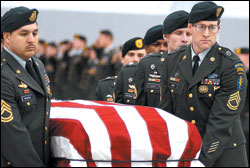
Saddam Hussein has finally been captured by American forces, but at what cost? The dying in Iraq is now done at such a rate that back home we can hold two services just miles apart on the same day. On Dec. 6, 2003, an Everett funeral was held for Todd Drobnick, 35, a Gulf War I vet killed in a head-on crash Nov. 22 near Mosul. He was a civilian interpreter working security and intelligence assignments in Iraq for U.S. defense contractor Titan Corp., which has lost 13 employees in five months. Borne in a flag-draped casket, Drobnick received full military honors at Evergreen Funeral Home next to the freeway. At the same time, down Interstate 405 that Saturday, memorial services for Army Capt. James Shull were being held at a Mormon church in Kirkland. Shull was accidentally shot in the head by another soldier while making his rounds in Baghdad Nov. 17. In the packed church, mourners filed past an array of happy family photographs including Shull, 32, with his wife and three children.
Not counting Drobnick, who does count, 402 active-duty soldiers with Washington state connections have died in Afghanistan, the Philippines, Pakistan, and Iraq since October 2001. All were raised, based, or had family here. Ages 18 to 53, they left behind 246 children, 169 widows, and four widowers. The American dead of what might be called Gulf War II in Southwest Asia include Army Sgt. Nathan Chapman, 31, of Puyallup, the first to die in combat during Operation Enduring Freedom, and Marine Cpl. Cedric Bruns, 22, of Vancouver, the seventh to die in Operation Iraqi Freedom following George Bush’s May 1, 2003, “Mission Accomplished” speech aboard the Everett-based USS Abraham Lincoln, declaring the end to major hostilities. As of September 2011, more than 4,335 U.S. military have died since then, more than 4,470 since fighting began. Counting the 1,750-plus dead of Afghanistan and the Philippines, where this state lost 97 fighters, more than 6,220 American military personnel have died in the Southwest Asia war zone from combat and noncombat wounds since October 2001. Casualties, officially, include more than 33,500 wounded in action and a similar number in noncombat. Another 30,000 troops were evacuated for medical and psychological conditions that included stress and depression. An estimated 360,000 have brain injuries and several hundred troops have committed suicide in the war zone. (Editor’s note: The statistics in this paragraph are continually updated.)
The Reuters news service recently noted that the U.S death toll in Iraq has surpassed the number of American soldiers killed (392) during the first three years of the Vietnam War, 1962 through 1964. The Orlando Sentinel, relying on Pentagon figures, calculates that since the war began, almost 10,000 U.S. troops have been killed, wounded, or injured or become ill enough to require evacuation—the equivalent of almost one Army division. But that is based on figures through only October, and November was the deadliest month yet, with 79 U.S. soldiers killed and hundreds more wounded, many suffering the loss of limbs from suicide bombings.
Such statistics are not easy to come by. The Department of Defense does not do body counts. In a political war such as Iraq, as in Vietnam, a high count is an added government liability. The Pentagon does compile lists—who died, who was wounded—without totals, which only keeps us guessing. An Associated Press story the other day on the funeral of Army Spc. Bob Benson of Spokane said he was the fifth Washingtonian to die in Iraq; in fact, he was the seventh. There are now 12. There is no official way for the public to know this, so we’re left to compile our own figures using our own methods. For me, that means counting casualties such as Todd Drobnick and James Shull.
MY CASUALTY COUNT also includes Iraqi and Afghan civilians, coalition and enemy troops, and American and allied civilians. (The Web site unknownnews.net pegs the toll of coalition and enemy soldiers and civilians in Southwest Asia at 26,486 as of the start of this month, with 79,040 wounded or injured.) I also include U.S. military personnel who died from events related to war. Among them is Army reservist Rachael Lacy, 22, of Illinois, a combat medic headed for Persian Gulf duty who died in the U.S. in March after being vaccinated against smallpox and anthrax. She is one of many casualties of military medicine.
I count the home-front killing, too. Four women were murdered by their soldier husbands at Fort Bragg, the Special Forces headquarters in North Carolina, during a six-week stretch of 2002. Three of the soldiers, two of whom had just returned from Afghanistan and had taken an anti-malarial medicine that causes psychotic reactions, then killed themselves. At Fort Lewis, a soldier murdered his young wife and baby this year before committing suicide in a head-on collision. In Georgia, Spc. Richard Davis was recently found in a crude grave, beaten to death by four Army buddies who served with him in Iraq. And in Arizona, Spc. Kyle Edward Williams, who served with Jessica Lynch, murdered a young car prowler, then drove to California and killed himself. They are reminders that battles are not always fought on battlefields. Besides the debilitating long-term effects of vaccines, medicines, and weaponry such as depleted uranium, soldiers in Iraq are suffering three times the common rate of brain injuries, Army doctors say, due to high-concussion explosives used by enemy forces.
The lesson here is to not accept an official number as the definition of war’s consequences. The combat death toll in Gulf War I was 148. More than 215,000 of the 696,000 deployed for that conflict—almost one-third—have sought war-related disability treatment from the Department of Veterans Affairs; another 11,000 veterans of that 1991 war, average age 36, have died. The bottom line of war, in addition to combat tolls, is the sum of all nonnatural casualties in service to the country. The Pentagon will not agree. But once you cut through the politics and patriotism of war, you get down to the deciding factor: life. How did Gen. George Patton put it— “There is only one unchanging principle of warfare: that is, to inflict the greatest amount of death and destruction upon the enemy in the least time possible.” Unfortunately, the enemy sees it this way, too.
THUS TODD DROBNICK, the Titan worker and 1986 Mariner High School graduate, is not an official military number but nonetheless a casualty of war. He and a second Titan worker were killed when hit by an oil truck in Iraq, becoming the San Diego company’s 12th and 13th casualties there. His funeral went mostly unnoticed, and I couldn’t find his name while wading through his company’s Web site. Titan, which is being acquired by the nation’s biggest defense contractor, Boeing rival Lockheed Martin, calls itself a provider of “national security solutions.” It also provides modern-day soldiers of fortune in Iraq, and Drobnick’s recent Everett Herald obituary made little distinction between his Persian Gulf tours: “Todd served more than eight years in the U.S. Army, doing three tours of duty in the Gulf War Theater, and two civilian assignments supporting our government in both Iraq and Kuwait as a manager of Arabic linguists.” On its Web site, Titan lists a current opening for an Arabic linguist. Must be ready to work in an “unstructured environment,” it says.
Capt. James Shull, meanwhile, is an official but noncombat casualty—of little difference if you are the one dead. He was deployed to Iraq May 1, the day that the war, in some minds, ended. At his memorial service, Brad Shull remembered his brother as the wild baby boy who once bounced his crib across the room, a high-school athlete, and a peacemaker. A Washington State University criminal justice grad, James joined the Army to become a military police officer. Kim Cooney, a spokesperson for the Kirkland Third Ward church, told me about a surprising coincidence between James Shull and a Utah man, Nathan Dailey. Both were Mormons. Both were Eagle Scouts. Both were in the Army. Both were captains. Both were in the 1st Armored Division. Both were hit by nonhostile fire. And both died the same day. “It’s amazing,” Cooney said. Regrettably, we now have the numbers to make the amazing possible.